At the centre of our galaxy lies a supermassive black hole, Sagittarius A* (Sgr A*), that’s more than four million times the mass of the Sun. Astronomers have now discovered the fastest-known star in the Milky Way zooming around this black hole in an extremely close orbit. Observations of this star, known as S301, could shed new light on the spin of Sgr A*.
Black holes are extremely large concentrations of matter condensed into very small regions of space. As a black hole spins, it drags the surrounding space–time around it, a phenomenon known as frame dragging or the Lense-Thirring effect. This frame dragging creates a cosmic whirlpool, twisting the fabric of space–time and warping the orbits of nearby stars. However, unless the orbiting star reaches very close proximity, this subtle effect is difficult to measure.
“Our group has determined the mass of the central black hole down to sub-percent precision,” says team member Felix Mang, a PhD student at Max Planck Institute for Extraterrestrial Physics (MPE) and author of the study published in Nature. “A black hole is characterized exclusively by its mass, spin, or angular momentum and electric charge; now that we’ve measured the mass really, really accurately, the next step is to measure the spin.”
Probing Sgr A*
Astronomers can measure black hole spin through various methods, including X-ray reflection spectra and the thermal X-ray emission of the gas disk surrounding stellar-mass black holes, as well as gravitational-wave signatures from merging black hole binaries.
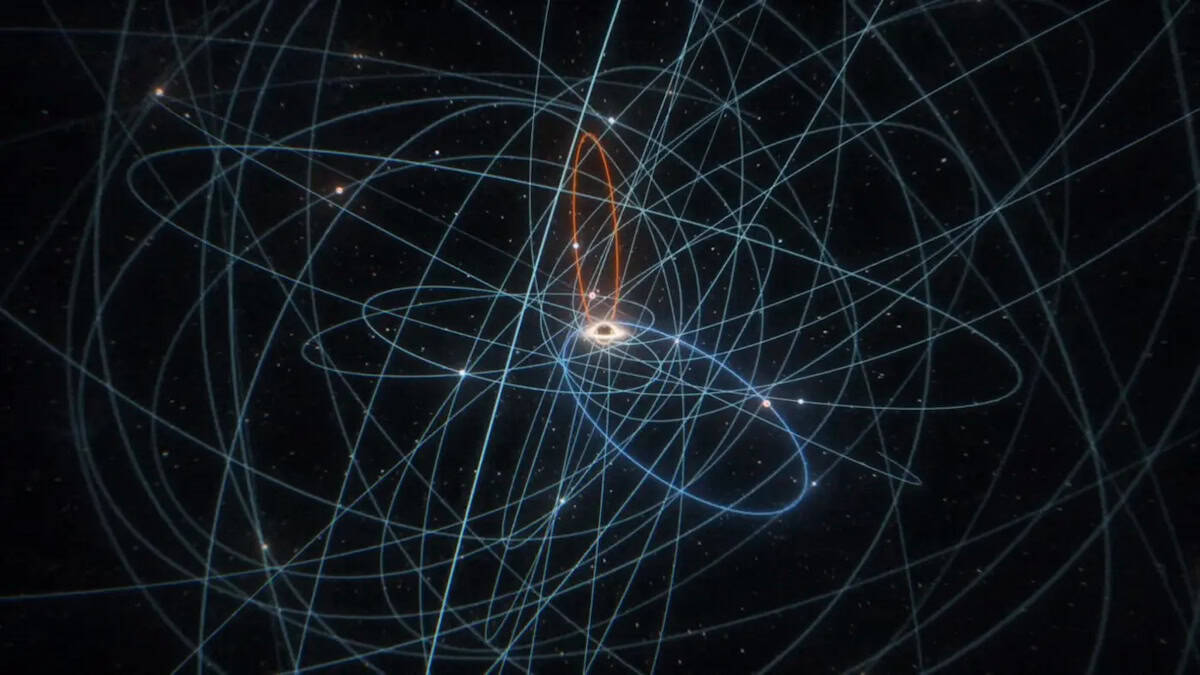
Lying in the galactic centre approximately 27,000 light-years from Earth, Sgr A* offers another direct way to measure its spin. There are a few dozen stars whirling around the massive black hole on nearly Keplerian orbits. The stars that come closest to Sgr A* most effectively probe its spin as they reach into the deepest parts of the gravitational potential, altering their trajectories.
For example, the star S2 is on a 16-year orbit and has been meticulously tracked using the GRAVITY instrument on the European Southern Observatory’s Very Large Telescope Interferometer. GRAVITY’s emergent near-infrared interferometry enabled the detection of strong relativistic effects during S2’s close approach in 2018, including a 12-arcminute orbital precession consistent with the Schwarzschild metric derived from Einstein’s general theory of relativity.
Despite these measurable relativistic effects, even at its pericentre when it is closest to Sgr A*, S2 remains too far away to detect the black hole’s spin without prohibitively long years of observation.
Discovery of S301
Although S2 is not a suitable candidate for Sgr A* spin measurements, the newly discovered star S301 is an ideal cosmic probe. Mang notes that the star is “a bit heavier than the Sun, and it has a radius which is a bit bigger; but overall, it’s not that special”. S301 is under 1.5 solar masses with a radius about 1.4 to 1.6 times that of the Sun, and it is too faint to be one of the giant stars in the galactic centre. Although the main-sequence star S301 may seem fairly ordinary, its extremely eccentric orbit and very close approach to the supermassive black hole are remarkable.
“We found the star in Spring 2023,” recalls Mang. Upon detection, the team could not conclude whether it was a foreground or a background star. However, dedicated follow-up observations in 2024 revealed a pronounced acceleration in S301’s proper motion, or apparent angular change of position on the sky. “It was curving away from a linear trajectory, which gave us a hint that it may be bound to the black hole,” Mang explains. Continued observations in 2025 allowed the team to create a robust initial model of S301’s orbit, revealing it to be “indeed a very eccentric and tightly orbiting star, which was then later on confirmed”.
Armed with evidence that the star might be gravitationally bound to Sgr A*, the team looked to the past, hoping to lock down S301’s orbit. Combing through archival data, the astronomers searched for traces of the star before its close approach in 2023. As Mang notes, “getting these two pre-peri positions in 2021 and 2017 was rather challenging, [we were] digging through the data”. The meticulous hunting paid off and revealed a strong trace of S301 in 2021 and a weaker signature back in 2017.
With 19 distinct positions found across nearly a decade of data, the team outlined a clear elliptical orbit, revealing that the star had zoomed past the supermassive black hole at its closest approach in early 2023 and passed significantly closer to the black hole than S2 ever has.
Extreme path of S301
The team determined that S301 boasts an orbital period of just 8.7 years, making it the shortest known orbital period around Sgr A*. This breaks the previous record, held by the star S55, which takes about 12 years to complete its path.
But S301’s orbital period is only part of what makes its path extraordinary. With an eccentricity of about 0.98, S301’s elongated path brings the star to a pericentre distance of approximately 1.78 billion kilometres, roughly 10 times smaller than that of S2. At that closest approach, S301 speeds around at about 25,000 km/s, making it the fastest known star in the Milky Way.
Because S301 gets so close to the supermassive black hole, general relativity strongly affects its orbit. In particular, S301 experiences a phenomenon known as the Schwarzschild precession, which shifts the star’s orbit by about 2° per revolution. Over the course of roughly 1500–1600 years, those slight shifts accumulate into a full 360° rotation of the orbit.
While this dramatic shift is driven by the colossal mass of Sgr A*, S301’s extreme orbit is also subjected to a subtler spin-induced effect: the Lense-Thirring precession. As Sgr A* spins, the twisted space–time forces S301’s orbital plane to slowly wobble, making it a powerful probe of the curved space–time around Sgr A*. By precisely tracking the star’s motion, astronomers can examine how its trajectory is shifted by these two precession effects, thereby enabling them to measure the spin of the supermassive black hole.
Einstein’s general theory of relativity tested by star orbiting a black hole

Looking forward, the upcoming years should bring substantially better data. “The instrument we are observing with, GRAVITY, has undergone some major upgrades, which gives us more flux, and we also expect to get better astrometric precision,” Mang says. “Along with that, we expect the Extremely Large Telescope, and one of its first light instruments, MICADO, to be operational by roughly 2030.”
These advances will allow astronomers to trace the motion of S301 with incredible precision. As a result, the team is confident that these instruments will decode the mystery of Sgr A*’s spin. “Combining the astrometry or proper motion measured with GRAVITY on the sky of that star, and then having a perception of the velocity of that star in the plane or out of the plane of the sky with MICADO, will allow the measurement of SgrA*’s spin, probably within the next 10 years,” Mang explains.