With artificial intelligence rarely out of the headlines over the past year, Honor Powrie reflects on how the good side of this apparently limitless technology can outweigh the bad or the ugly
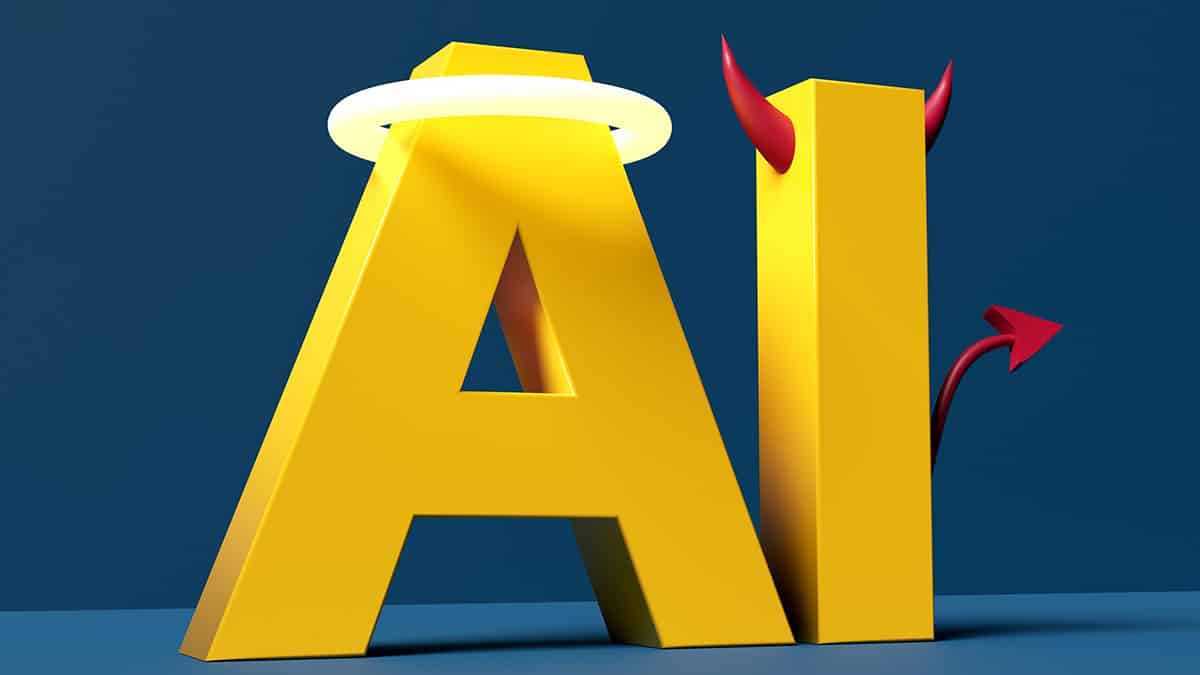
I recently gave a keynote talk to high-flying executives and tech leaders entitled “How to tame the AI wild west”. As part of the preparation for my address – and in keeping with my wild-west theme – I thought I’d start by highlighting “the good, the bad and the ugly” of AI. But when I reviewed how AI had been portrayed in the media over the previous few months, I struggled to find much good being said about it.
There was certainly a lot of “bad” going on, with AI appearing to threaten people’s livelihoods. I read of robotic taxis replacing human cabbies. There were warnings of AI cloning actors’ voices and making them redundant. I also saw a lot about AI being linked to the fall in the number of graduate jobs in computing and economics.
As for the “ugly” side of AI, take your pick. I read of rival chatbots hacking each other, with first OpenAI hacking the US computing company Hugging Face, then Hacktron AI using Claude to hack OpenAI. I learned of huge data centres being proposed that will gobble up precious water and energy resources, as well as contributing to climate change. One in London, we were warned, would have an annual carbon footprint equivalent to 840 flights to the US.
Some reports underlined how dangerously misleading AI can be, whether by providing misleading health advice or being used for spying or bioweapons. Then I saw various stories about work that used to take months being compressed into days, which sounded optimistic – until I realized this was the unparalleled efficiency with which Hacktron had been able to undermine ChatGPT.
With all this going on, it’s not surprising that many of us are struggling to keep up with AI. It seems like it’s being pushed from every angle. AI’s hard to ignore and it’s not always transparent what it’s up to. Microsoft Office tools are always offering to summarize my documents and “coach” me on how to write e-mails and make presentations more accessible.
And, I will be honest, I lean into AI to help but I’m not sure I want or even need everything that’s being offered. Some things it suggests aren’t even necessarily what I asked for. And the more I use AI, the more it presumes – I ask it to do something, and it goes way beyond my initial request. And oh, that irritating Copilot icon popping up everywhere. Just like Clippy the paperclip; did Microsoft never learn?
The good side
Now back to my AI wild west talk, which focused on what actions businesses could take to harness AI in a safe and controlled manner, whilst avoiding risky, ad-hoc adoption. I shan’t go into the specifics of my talk, but I feel that there are some basic rules of AI governance that we could apply in our own lives, to help safeguard personal adoption of AI.
Undoubtedly, AI can make many tasks more efficient. It can also enable better informed decisions and free us up from grunge work, giving us more time to do the things we want to. But it feels like we are at a new frontier of where AI can take us, and not everything is in our control, as the available tools are all being developed by tech giants, who don’t necessarily have our best interests at heart.
However, learning from corporate approaches to AI governance, there are some basic things we can do to protect ourselves in these turbulent times (see box). Just to be clear: I’m focusing here mostly on generative AI, or Gen AI, which is a type of machine-learning algorithm that creates new content, such as images or text, based on the data it was trained on.
How to deal with AI
- Remember that we are human – AI is not.
- Take time to become familiar with AI tools. Learn to recognize where AI helps and where it hurts.
- Don’t feel pressurized to “do AI”. Not everything requires an AI solution.
- Categorize your data. What are you prepared to share publicly and what you are not? This includes images, personal, health, financial data.
- Remember that personal AI tools will likely use your data and outputs for updating publicly available models.
- Implement personal guardrails. What are you prepared to use AI for, what would you prefer to keep for yourself? Don’t let AI erode your personal creativity and skills.
- Realize that AI is not accountable for what it does and can replicate or amplify model bias. Make sure you verify AI output for accuracy and correctness before using in any key decisions etc.
- Put time in for a breathing space between yourself and AI – try to avoid becoming addicted.
Making a difference
So to balance things up a bit, I now give you a couple of recent examples of how AI can really make a difference. The first is the cumbersomely titled Jet-engine AI Research and Validation Intensive Sprint (JARVIS) challenge. It involved students at the Massachusetts Institute of Technology in the US being set a task to design, build and test a jet engine using GenAI.
Essentially, whilst Claude and ChatGPT were good at offering design alternatives and filling in knowledge gaps, there were very real issues with the hallucinations, sycophancy and a lack of physical understanding. Nonetheless, the challenge did show what’s possible when AI-enabled design is adopted by motivated workers within a culture of rapid experimentation. Still, when it comes to building safety-critical physical systems, nothing can replace human expertise, human hands and human accountability.
My next example of a promising use of AI centres on the recent claim made by OpenAI that an internal AI system using 10,000 autonomous agents had solved a major part of the 90-year old Navier–Stokes problem in just 88 hours. The issue at stake, which centred on whether smooth 3D fluid motion can break down, was one of seven Millennium Prize Problems. Representing some of the deepest questions in mathematics, they were first unveiled by the Clay Mathematics Institute in 2000, with $1m on offer for anyone who can solve them.
If true, this was a phenomenal achievement by OpenAI. Detractors have pointed out that the company spent $10m – $15m in tokens and associated computation to win the $1m prize, which is perhaps not the best example of AI saving money. Still, it’s clear to me that AI is here for to stay. I simply hope that those in charge of AI will do their utmost to ensure that this rapidly evolving technology is used only for the benefit of humankind.