In September 1976 physicist Masao Doi, then working at Tokyo Metropolitan University, published two groundbreaking papers. The work – published in Journal of Physics A – cast classical stochastic many-body problems in the mathematical language samiliar to that of quantum-field theory (9 1465 and 9 1479).
Although this happened at a time when theoretical field methods in statistical mechanics were getting into full swing, this gem of deep scientific insight remained hidden for many years.
Indeed, it was reinvented several times, most notably in 1980 by Peter Grassberger and Martin Scheunert from the University of Wuppertal, who also highlighted the many applications for the theory.
Following conversations with Grassberger at a meeting organised by the Centre Européen de Calcul Atomique et Moléculaire in September 1985, Luca Peliti from the University of Rome went about putting Doi’s theory into a path integral formalism, thus making it amenable to renormalisation.
That same year he published a letter on the renormalisation group treatment of a reaction-diffusion process, using the framework that was named Doi-Peliti field theory (J. Phys. France 46 1469).
The works by Doi and Peliti quickly became viewed as fundamental building blocks to calculate not only asymptotics but also systematic approximations of observables in reaction-diffusion processes.
Theoretical physicist John Cardy from the University of Oxford, used Doi-Peliti theory as a work-horse for reaction-diffusion processes.
In the 2000s, Cardy and colleagues produced not only a string of renormalisation group treatments of reaction-diffusion processes, but also reviews and tutorials at different levels of technicality, which made Doi-Peliti field theory accessible to many of us.
Key insights
In 2018 Doi became chief scientist at the Wenzhou Institute of the University of Chinese Academy of Sciences and was well-known for his work in polymer and soft-matter physics.
Yet when my former PhD student Ziluo Zhang joined the Wenzhou Institute as a postdoc in 2023, he found that Doi was unaware that the field theory bears his name and the many developments since its inception.
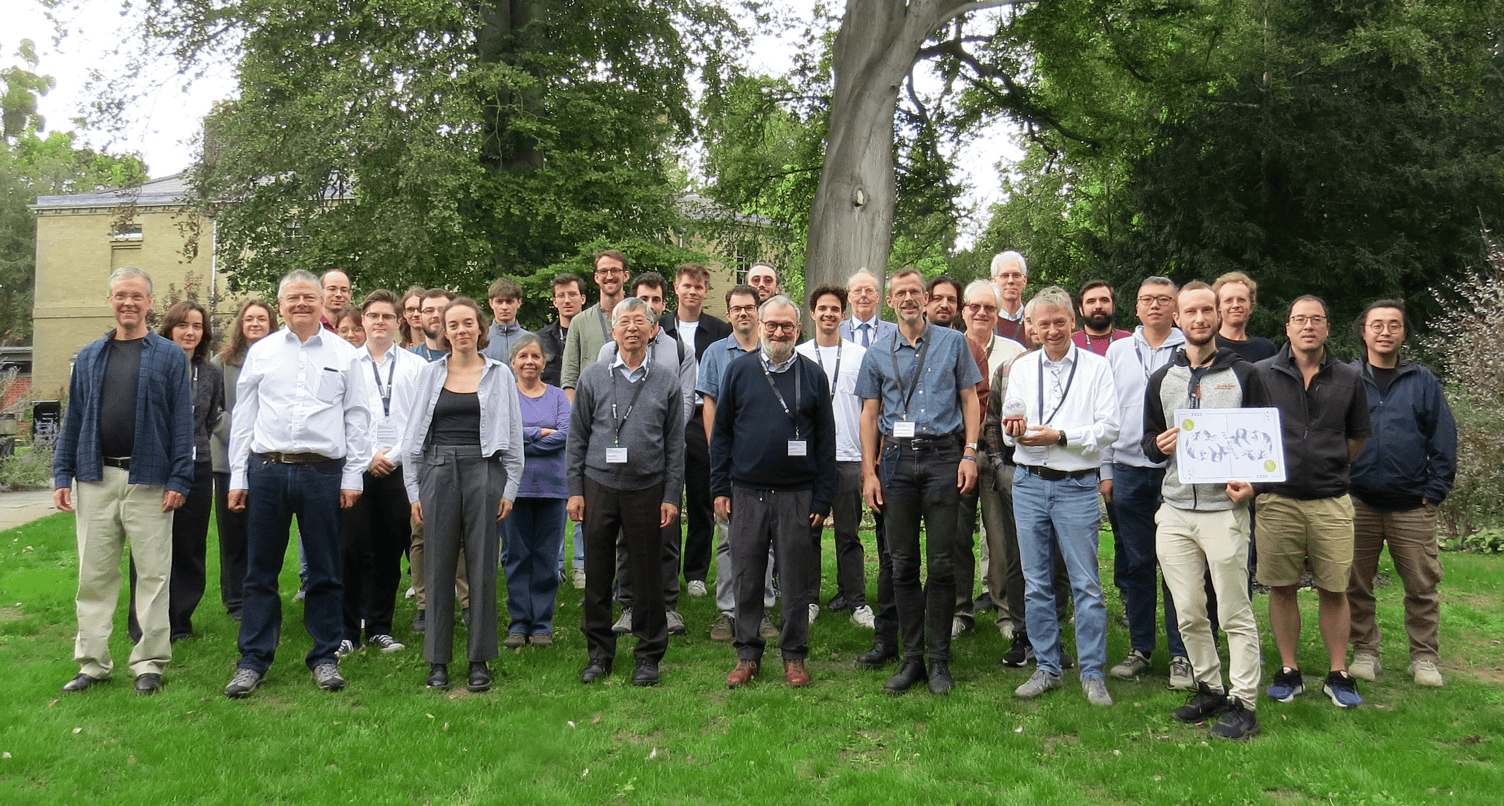
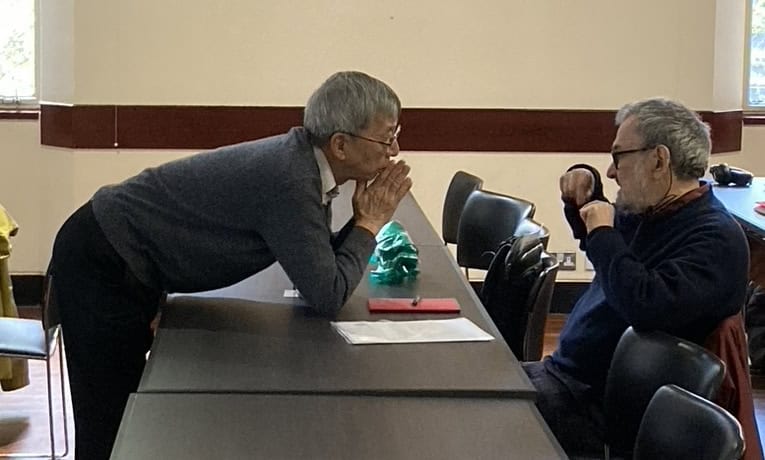
Indeed, Doi and Peliti had never met until a meeting from 22 to 25 September at the University of Cambridge that celebrated Doi and Peliti’s work.
“[It was ]the first time that I attend a conference which has my name on it,” noted Doi.
Funded by the Wildcard programme of the German Carl Zeiss Foundation, the meeting featured talks on historic developments and the many achievements and challenges of the Doi-Peliti framework.
In a relaxed atmosphere, some of the key players explained how their insights came about.
Doi-Peliti field theory is a brilliant concept conceived by brilliant minds. One might be tempted to speculate how many more theories have been spun off and developed that are attributed – or even unattributed – to the pair without them ever knowing.
- An upcoming special issue of Journal of Physics A will be dedicated to the Doi-Peliti field theory.