Physicists are increasingly collaborating with scientists from other fields, but few have taken this concept as far as Albert-László Barabási
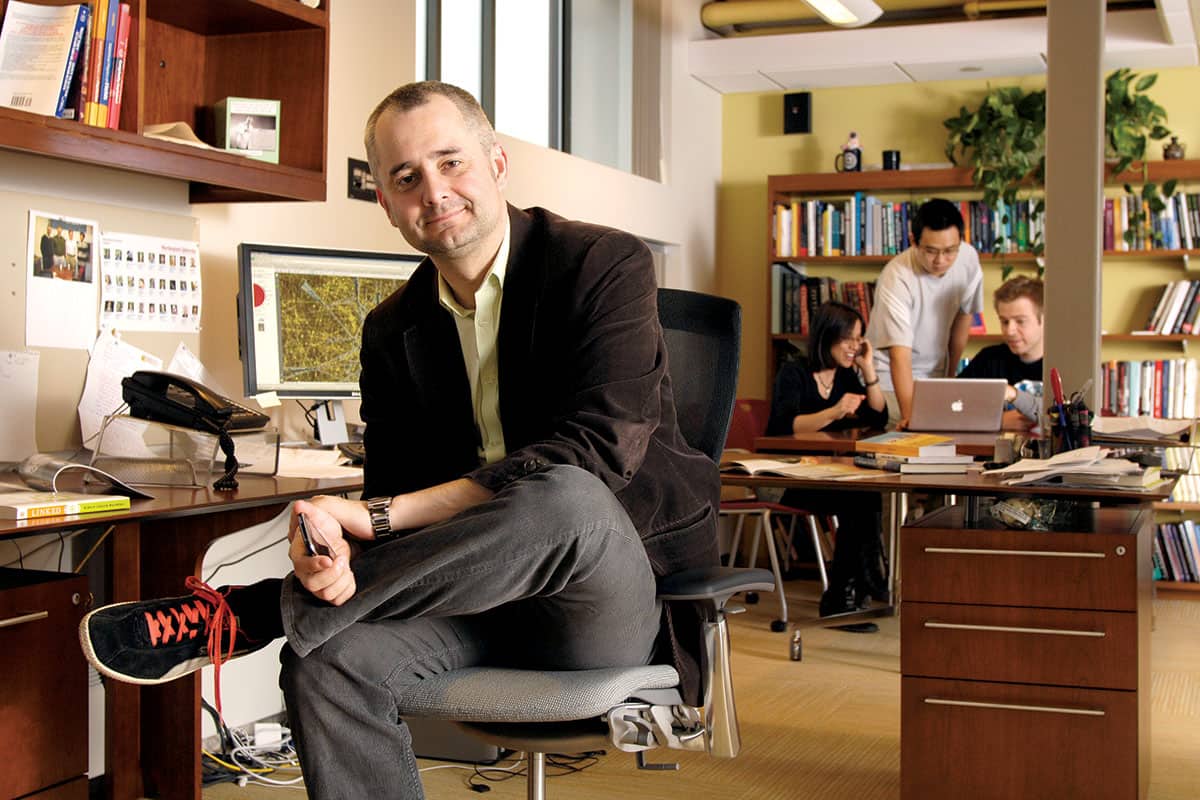
Albert-László Barabási wants to set the record straight. “I consider myself a physicist,” he says, and it is easy to see why. Born in Transylvania to a Hungarian family, he studied physics at the University of Bucharest in Romania and is now a professor of physics at Northeastern University in Boston, US. But at the same time, the versatile Barabási is also a lecturer at Harvard Medical School, and holds appointments in Northeastern’s biology department and its College of Computer and Information Science. “I may have chosen my topics of enquiry a bit more freely from the traditional physics canon,” he admits.
Barabási made his name in 1999 when, with Réka Albert of Pennsylvania State University, he used tools from statistical mechanics to develop a theory describing the origins of “scale-free networks” (Science 286 509). These are networks that are held together by a few highly connected nodes, called hubs, like Google on the Web or very popular individuals in social networks. Since then, Barabási has continued to develop and apply these techniques to networks in fields as diverse as biology, computer science, economics and human behaviour. Gene Stanley, a physicist at Boston University who has made major contributions to complexity research, says that showing that many networks in the real world can be described as scale-free – and recognizing that this property is ubiquitous – is Barabási’s biggest accomplishment. But Stanley adds that Barabási has “done something which some people do not do. He’s stuck with it – he’s stayed with the field he helped to develop”.
Beyond tradition
Barabási has, for example, set up a collaboration between Northeastern’s Center for Complex Network Research, which he directs, and Harvard Medical School. One focus of the group’s work is to treat the cell not just as a bag of genes that have a mutation, but as a bag of interacting components. In Barabási’s eyes, this gene network is the kind of complex problem that Ludwig Boltzmann faced in the 1870s and 1880s when he developed thermodynamics from statistical principles, translating microscopic randomness into macroscopic behaviour.
In Barabási’s view, being a physicist means using the techniques of physics to inquire into the world around us – and while that world is made up of stars and subatomic particles, it also includes social and biological systems. In the past, Barabási explains, there have not been enough data for physicists to apply their tools to these complex systems. However, “big data” now offers a deluge of information about the real-time behaviour of many complex systems, and these resources can enrich physics. Indeed, Barabási is critical of the concept of “traditional physics”. “Traditional physics is the physics that isn’t worth studying, isn’t it?” he asks with a glint in his eye. “Because it is already traditional and we know everything about it.”
Branching out into research areas untouched by “traditional physics” does have its pitfalls, however. Although Barabási’s work on human behaviour and mobility is arguably among his most interesting to date, he recently pulled the plug on it after becoming uneasy with the way certain organizations, such as the US National Security Agency, have used his findings. He refuses to be drawn on specifics, but says that, in general, scientists “occasionally have to step back and ask ourselves why we do certain things and whether there are proper safeguards for how the research is being applied”. Barabási believes that in this particular case, the safeguards have failed. “My personal answer was to scale back that part of research and also to think a bit deeper about what our responsibilities as scientists are in this domain,” he says.
The need for change
Despite these risks, Barabási thinks it is essential for the boundaries of physics to change. In the past, he notes, the subject suffered when it failed to accommodate new directions of research. “For a long time, physics departments short-sightedly believed that astrophysics and astronomy were not physics,” he says. “They are struggling to bring astrophysicists back now that they are becoming very exciting and making major discoveries.”
It is essential for the boundaries of physics to change
Barabási’s affinity with these outcast astronomers of the past triggered in him some mixed feelings earlier this year when one of his papers knocked the astronomer Subrahmanyan Chandrasekhar off his perch as the author of the most-cited paper in Reviews of Modern Physics. “I have always been a fan of Chandrasekhar who himself was actually an outsider in physics,” he says. “Had there been any person that I would not want to dethrone, it would have been him.”
Barabási believes that physics still has a tendency to exclude those who are perceived as outsiders. When he and his colleagues in the other departments hire someone, he says, they do not ask that person whether they have a PhD in that subject. “[Instead] we ask them what they can bring to the department and how exciting their research is.” In contrast, he adds, “I can’t remember one single hiring in a physics department that didn’t ask, ‘Is this candidate a physicist?’ ” If physics does not adapt, it risks becoming “an insular enterprise” that will be left behind by other fields, Barabási warns.