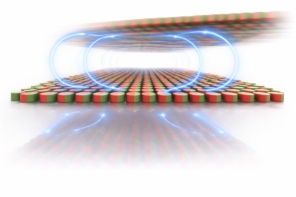

New calculations by physicists in the US provide deeper insights into an exotic material in which superconductivity and magnetism can coexist. Using a specialized effective field theory, Zhengyan Shi and Todadri Senthil at the Massachusetts Institute of Technology show how this coexistence can emerge from the collective states of mobile anyons in certain 2D materials.
An anyon is a quasiparticle with statistical properties that lie somewhere between those of bosons and fermions. First observed in 2D electron gases in strong magnetic fields, anyons are known for their fractional electrical charge and fractional exchange statistics, which alter the quantum state of two identical anyons when they are exchanged for each other.
Unlike ordinary electrons, anyons produced in these early experiments could not move freely, preventing them from forming complex collective states. Yet in 2023, experiments with a twisted bilayer of molybdenum ditelluride provided the first evidence for mobile anyons through observations of fractional quantum anomalous Hall (FQAH) insulators. This effect appears as fractionally quantized electrical resistance in 2D electron systems at zero applied magnetic field.
Remarkably, these experiments revealed that molybdenum ditelluride can exhibit superconductivity and magnetism at the same time. Since superconductivity usually relies on electron pairing that can be disrupted by magnetism, this coexistence was previously thought impossible.
Anyonic quantum matter
“This then raises a new set of theoretical questions,” explains Shi. “What happens when a large number of mobile anyons are assembled together? What kind of novel ‘anyonic quantum matter’ can emerge?”
In their study, Shi and Senthil explored these questions using a new effective field theory for an FQAH insulator. Effective field theories are widely used in physics to approximate complex phenomena without modelling every microscopic detail. In this case, the duo’s model captured the competition between anyon mobility, interactions, and fractional exchange statistics in a many-body system of mobile anyons.
To test their model, the researchers considered the doping of an FQAH insulator – adding mobile anyons beyond the plateau in Hall resistance, where the existing anyons were effectively locked in place. This allowed the quasiparticles to move freely and form new collective phases.
“Crucially, we recognized that the fate of the doped state depends on the energetic hierarchy of different types of anyons,” Shi explains. “This observation allowed us to develop a powerful heuristic for predicting whether the doped state becomes a superconductor without any detailed calculations.”
In their model, Shi and Senthil focused on a specific FQAH insulator called a Jain state, which hosts two types of anyon excitations. One type has electrical charge of 1/3 of an electron and the other with 2/3. In a perfectly clean system, doping the insulator with 2/3-charge anyons produced a chiral topological superconductor, a phase that is robust against disorder and features edge currents flowing in only one direction. In contrast, doping with 1/3-charge anyons produced a metal with broken translation symmetry – still conducting, but with non-uniform patterns in its electron density.
Anomalous vortex glass
“In the presence of impurities, we showed that the chiral superconductor near the superconductor–insulator transition is a novel phase of matter dubbed the ‘anomalous vortex glass’, in which patches of swirling supercurrents are sprinkled randomly across the sample,” Shi describes. “Observing this vortex glass phase would be smoking-gun evidence for the anyonic mechanism for superconductivity.”
New type of quasiparticle emerges to tame quantum computing errors

The results suggest that even when adding the simplest kind of anyons – like those in the Jain state – the collective behaviour of these quasiparticles can enable the coexistence of magnetism and superconductivity. In future studies, the duo hopes that more advanced methods for introducing mobile anyons could reveal even more exotic phases.
“Remarkably, our theory provides a qualitative account of the phase diagram of a particular 2D material (twisted molybdenum ditelluride), although many more tests are needed to rule out other possible explanations,” Shi says. “Overall, these findings highlight the vast potential of anyonic quantum matter, suggesting a fertile ground for future discoveries.”
The research is described in PNAS.