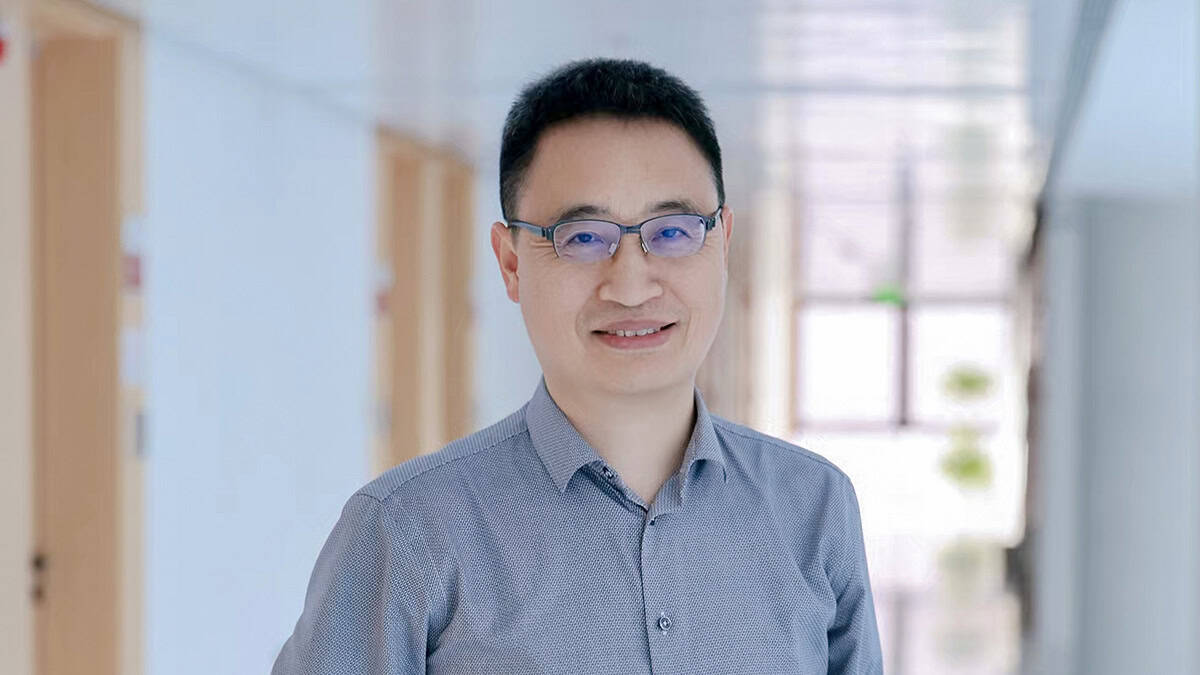
Wenhui Duan, head of physics at Tsinghua University in Beijing, talks to Michael Banks about Tsinghua’s plans for the future as it celebrates its centenary this year
Can you tell us about your career in physics?
My academic path studying physics at Tsinghua University began in 1981 where I completed a bachelor’s and a master’s before earning a PhD in 1992. I then did a postdoc at the Central Iron & Steel Research Institute in Beijing before returning to Tsinghua University in 1994 as a faculty member in the physics department.
Have you always studied and worked in China?
During my time at Tsinghua I carried out two research visits abroad, first at the University of Minnesota from 1996 to 1999 and then at the University of California, Berkeley from 2002 to 2003.
What is your research focus?
My career has been centred on employing and developing theoretical computational methods to understand, predict and design the physical properties of materials from the microscopic level of atoms and electrons. My work is an attempt to use a “computational microscope” to probe the fundamental nature of materials and sketch blueprints for new ones. This journey from fundamental theory to potential application has been continuously challenging and immensely rewarding.
Can you explain some examples?
One is in the theoretical study of topological quantum materials. We have performed theoretical work predicting the potential for the quantum spin Hall effect in two-dimensional systems and we have explored new states of matter such as topological semimetals. Another avenue of research is on the physics of low-dimensional and artificial microstructures. My group has a long-standing interest in the electronic structure, magnetic properties, and optical responses of low-dimensional systems like graphene and two-dimensional magnetic materials. Recently, our team discovered a novel spin chirality-driven nonlinear optical effect in a 2D magnetic material.
Are you using AI in this endeavour?
Yes. A significant recent focus is pioneering the integration of artificial intelligence with computational materials science. We are developing deep-learning models that are compatible with mainstream computational frameworks to increase the efficiency of simulating complex material systems and accelerate the discovery of new materials.
What areas of physics research is Tsinghua active in?
Our department boasts a robust and comprehensive research portfolio. Our research can be mainly outlined as three core directions. The first is condensed-matter physics, which has historically been one of our largest and most prominent areas. Research here spans from fundamental quantum phenomena to materials design for future technologies.
Experimentally we work in areas such as topological quantum materials, high-temperature superconductivity, two-dimensional systems, and novel magnetic phenomena. The recent experimental discovery of the quantum anomalous Hall effect at Tsinghua is one example. Theoreticians, including my group, focus on predicting new quantum states and understanding complex electronic behaviours using first-principles calculations and model analysis.
A more diverse international community brings essential perspectives that challenge assumptions, spark innovation and elevate our collective work to a global standard
What about the other two areas?
The second area is atomic, molecular, and optical physics. Key topics include ultra-cold atoms for quantum simulation of complex many-body problems, quantum optics and quantum communication and precision measurement science. Work here often provides the physical platforms and techniques that enable advances in quantum-information science.
The other area is nuclear physics and particle physics: In particle physics, our faculty and students work in major international collaborations such as the Large Hadron Collider. Besides these core directions, our research is also focused on programmes in astrophysics/cosmology and in biophysics. The emergent field of quantum-information science also connects nearly all these areas making it a defining feature of our current research environment.
Are there some areas of physics that Tsinghua might increase its efforts in?
One is the integration of artificial intelligence and machine learning with fundamental physics research. In my own field of computational materials science, we are already using AI to accelerate the discovery of new quantum materials and predict complex properties with unprecedented speed. This approach should be expanded and deepened across the department — from using AI to analyse data from particle colliders and gravitational-wave detectors, to developing new algorithms for quantum many-body problems and astrophysical simulations.
Any other areas?
We must also intensify our efforts in the development and application of quantum technologies. We already have excellent groups in quantum information, quantum optics and quantum materials so the next step is to combine these strengths towards the engineering of functional quantum systems.
What are some of the major international institutions that Tsinghua collaborates with?
Internationally, our researchers are embedded in several “big science” projects such as the XENON collaboration for direct dark-matter detection, particle physics experiments like ATLAS, CMS and FASER at CERN as well as the LIGO collaboration in gravitational-wave astronomy. IOP Publishing launches dedicated resource for researchers in China
What about those closer to home?
Domestically, we work with the Institute of Physics at the Chinese Academy of Sciences and the Beijing Academy of Quantum Information Sciences, particularly in areas like condensed matter and quantum science. We also value industry partnerships, a notable example being our long-standing collaboration with Foxconn, which formed the joint Foxconn Nanotechnology Center within our department.
How many students and staff are there in Tsinghua’s physics department?
We have an academic community of more than 900 people: 85 faculty members, around 100 staff members, 420 graduate students and 320 undergraduate students.
How many foreign staff and students do you have?
We currently have four foreign professors together with 11 international undergraduates and five international PhD candidates – from Malaysia, Germany, Belarus, Russia, and Iran.
Would you like to see these numbers increase?
Yes, but my emphasis is more on qualitative enhancement than just quantitative increase. A more diverse international community brings essential perspectives that challenge assumptions, spark innovation and elevate our collective work to a global standard. We are working to create an even more welcoming and supportive environment – through dedicated discussions on internationalization, fostering research collaborations, and hosting global conferences.
I hope we are known not just for our discoveries, but for building essential research “bridges” that solve big problems
Why is Tsinghua an attractive place to work?
It’s appeal lies not in any single attribute, but in a unique ecosystem that fosters research and innovation. First, is Tsinghua’s strengths across science and engineering that create a natural incubator for interdisciplinary work. My own research, particularly in integrating advanced computational methods with materials discovery, has been significantly accelerated by collaboration with leading experts in adjacent fields.
Second, is the balance of academic freedom and responsibility. The university provides substantial intellectual freedom and long-term support allowing researchers to pursue high-risk, fundamental questions without being bound solely by short-term deliverables. Coupled with this freedom is a profound sense of responsibility to contribute to national and global scientific efforts, an ethos deeply embedded in Tsinghua’s tradition.
Third, it is the quality of the students. Engaging with some of China’s most talented and driven young minds is perhaps the greatest privilege. Their curiosity, rigour and fresh perspectives constantly challenge and renew my own thinking. Mentoring them from promising undergraduates to independent researchers is a core part of the scientific legacy we build here.
What events do you have planned to mark the centenary of physics at Tsinghua?
We have a number of activities planned including the publication of an updated departmental history book that formally documents our century-long journey from 1926 to the present as well producing a centennial documentary film. We also have an alumni interview series and department exhibitions to visually narrate our history and scientific contributions.
We are collaborating with the Chinese Physical Society, the Chinese Academy of Sciences and the National Natural Science Foundation as well as IOP Publishing to publish commemorative special issues throughout the year. There will also be a series of high-level academic forums and lecture series at Tsinghua. The culmination of the year’s celebration will be the Centennial Commemoration Conference on Saturday 5 September.
What do you hope for Tsinghua in the coming 100 years?
First, I hope we become the world’s leading centre for a new way of doing physics: integrating AI directly into the core of our research cycle. This means moving beyond using AI just as a tool. I envision a future where AI actively helps us formulate new theories about quantum materials, guides the design of critical experiments in astrophysics and particle detection and even controls advanced instruments to run complex measurements. Our goal should be to pioneer a “AI-scientist” partnership, making it as natural as using a microscope.
Second, I hope we are known not just for our discoveries, but for building essential research “bridges” that solve big problems. This means deeply partnering with our engineering schools to turn quantum science into reliable technology as well as with life sciences and environmental science to apply physical principles to global challenges in health and sustainability. We aim to educate students who are not just technically able, but who are also ethically grounded and driven.
If we succeed, then Tsinghua Physics will continue to contribute meaningfully, not just to the scientific community, but to the broader human endeavour of understanding our world. That is the enduring legacy we strive for.