An international team of researchers has shown that superconductivity can be modified by coupling a superconductor to a dark electromagnetic cavity. The research opens the door to the control of a material’s properties by modifying its electromagnetic environment.
Electronic structure defines many material properties – and this means that some properties can be changed by applying electromagnetic fields. The destruction of superconductivity by a magnetic field and the use of electric fields to control currents in semiconductors are two familiar examples.
There is growing interest in how electronic properties could be controlled by placing a material in a dark electromagnetic cavity that resonates with an electronic transition in that material. In this scenario, an external field is not applied to the material. Rather, interactions occur via quantum vacuum fluctuations within the cavity.
Holy Grail
“The Holy Grail of cavity materials research is to alter the properties of complex materials by engineering the electromagnetic environment,” explains the team – which includes Itai Keren, Tatiana Webb and Dmitri Basov at Columbia University in the US.
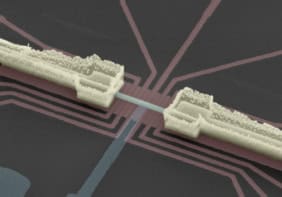
They created an optical cavity from a small slab of hexagonal boron nitride. This was interfaced with a slab of κ-ET, which is an organic low-temperature superconductor. The cavity was designed to resonate with an infrared transition in κ-ET involving the vibrational stretching of carbon–carbon bonds.
Hexagonal boron nitride was chosen because it is a hyperbolic van der Waals material. Van der Waals materials are stacks of atomically-thin layers. Atoms are strongly bound within each layer, but the layers are only weakly bound to each other by the van der Waals force. The gaps between layers can act as waveguides, confining light that bounces back and forth within the slab. As a result the slab behaves like an optical cavity with an isofrequency surface that is a hyperboloid in momentum space. Such a cavity supports a large number of modes and vacuum fluctuations, which enhances interactions with the superconductor.
Superfluid suppression
The researchers found that the presence of the cavity caused a strong suppression of superfluid density in κ-ET (a superconductor can be thought of as a superfluid of charged particles). The team mapped the superfluid density using magnetic force microscopy. This involved placing a tiny magnetic tip near to the surface of the superconductor. The magnetic field of the tip cannot penetrate into the superconductor (the Meissner effect) and this results in a force on the tip that is related to the superfluid density. They found that the density dropped by as much as 50% near the cavity interface.
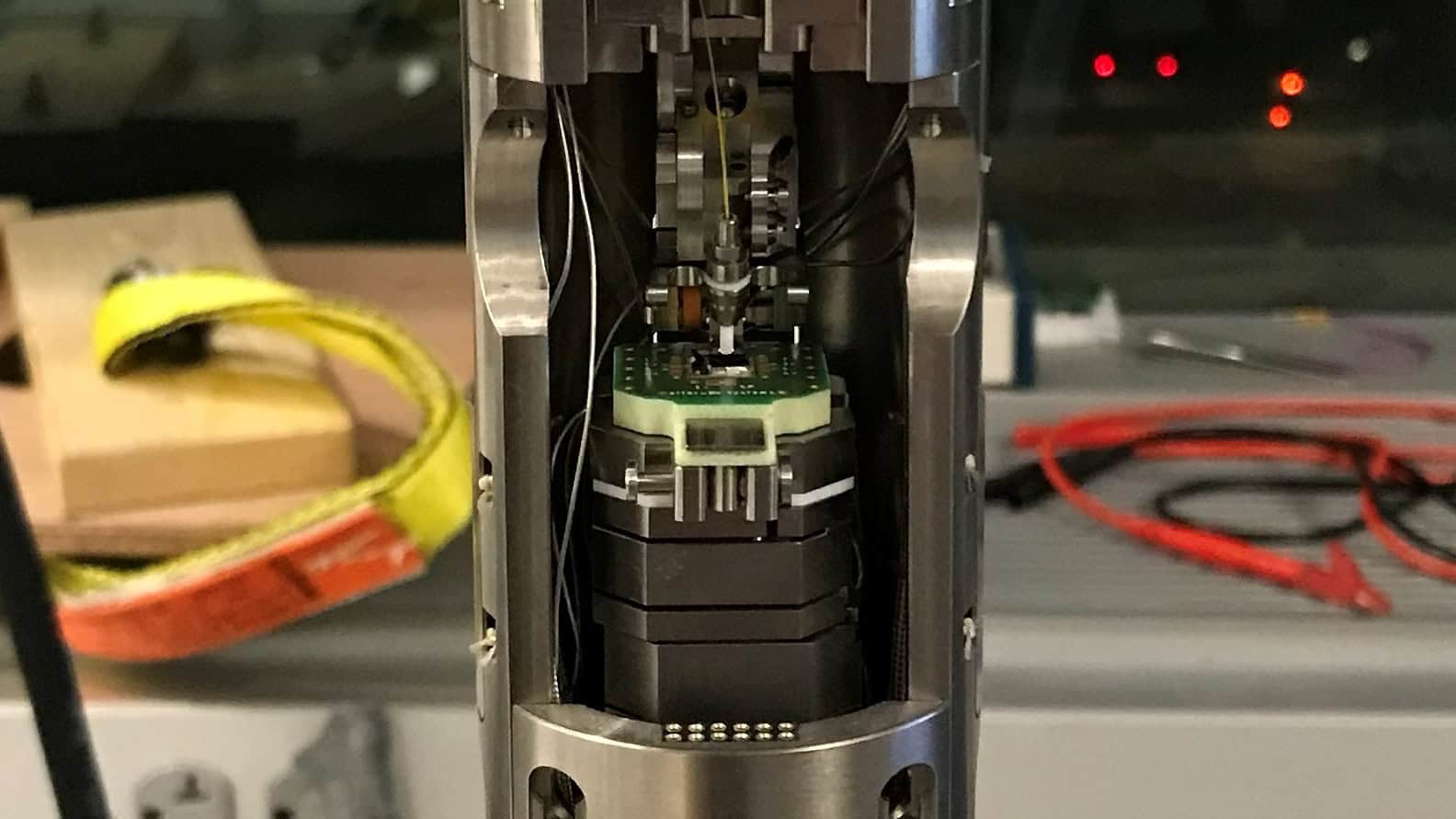
The team also investigated the optical properties of the cavity using scattering-type scanning near-field optical microscope (s-SNOM). This involves firing tightly-focused laser light at an atomic force microscope (AFM) tip that is tapping on the surface of the cavity. The scattered light is processed to reveal the near-field component of light from just the region of the cavity below the tip .
Electrons in graphene drag light in their wake

The tapping tip creates phonon polaritons in the cavity, which are particle-like excitations that couple lattice vibrations to light. Analysing the near-field light across the cavity confirmed that the carbon stretching mode of κ-ET is coupled to the cavity. Calculations done by the team suggest that cavity coupling reduces the amplitude of the stretching mode vibrations.
Physicists know that superconductivity can arise from interactions between electrons and phonons (lattice vibrations), So, it is possible that the reduction in superfluid density is related to the suppression of stretching-mode vibrations. This, however, is not certain because κ-ET is an unconventional superconductor, which means that physicists do not understand the mechanism that causes its superconductivity. Further experiments could therefore shed light on the mysteries of unconventional superconductors.
“We are confident that our experiments will prompt further theoretical pursuits,” the team tells Physics World. The researchers also believe that practical applications could be possible. “Our work shows a new path towards the manipulation of superconducting properties.”
The research is described in Nature.