We are all familiar with the fact that heat flows from warmer regions to colder ones. A team of researchers at the EPFL in Switzerland has now shown that the reverse can happen in many highly ordered materials, without violating the laws of thermodynamics. Besides the fundamental scientific appeal of this finding, the researchers say their work could help in the design of electronic devices in which heat flow could be guided, potentially minimizing heat losses.
Scientists have always thought of heat as following Fourier’s law of diffusion, explains physicist Nicola Marzari, who led this new study. Fourier built his law on earlier work by Newton and established that heat transfer through a solid depends on an intrinsic material property (how easily the material conducts heat) and on the temperature difference (more precisely, the gradient) between a hot and a cold region. “The minus sign between the heat current and the temperature gradient in his equations captures the fact that heat always flows from hot to cold regions,” Marzari explains.
In the 1960s, however, theory argued – and experiments in solid helium revealed – that heat could also propagate like a wave; this behaviour was called “second sound”, in analogy with an acoustic wave travelling through a solid. “At the time, the phenomenon was considered fairly exotic and could only occur at very low temperatures – just a few Kelvin above absolute zero,” says Marzari. “But, in 2015, we showed that this behaviour could be found in many materials – from two-dimensional monolayers to graphite and diamond – and at much higher temperatures. Indeed, experiments on graphite in 2019 and 2022 confirmed these predictions at 100 K and 200 K.”
“Directing heat as we want”
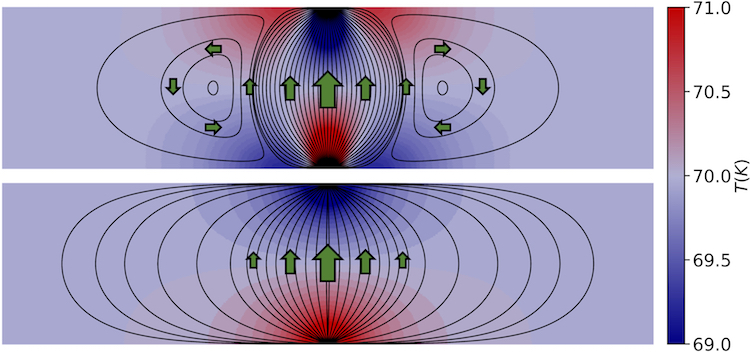
This mode of heat propagation, which could also occur at room temperature, is known as phonon hydrodynamics because heat is now considered as moving like a fluid, Marzari adds. Phonons are the extended atomic vibrations that transport heat. Normally, interference or collisions between these cause heat to dissipate slowly, following Fourier’s law. “However, the emergence of fluid-like behaviour means that vortices can appear and that obstacles can send fluid backwards – from a cold region to a hot one,” he explains. “This is very counterintuitive, but doesn’t break thermodynamics. It also means we can start thinking of guiding and directing heat as we want, or maybe build thermal diodes in which heat can only flow in one direction.”
Back in 2020, the researchers derived a unified theory of heat propagation that encompassed Fourier diffusion and the hydrodynamic regime. This was a feat in itself, says Marzari: Fourier’s law dates from 1822 and the microscopic theory of heat (the Peierls-Boltzmann transport equation) from 1929. “Our new ‘viscous heat equations’ from 2020 are both accurate and reasonably simple to solve, so there was a lot of excitement at being able to try and look at what would they predict.”
“Simple” here is relative, he admits. “But the community has learnt a lot from the study of hydrodynamics phenomena in real fluids – for example, how ships, airplanes and even bumblebees stay afloat – and we used some of that knowledge in our new work.”
Temperature profile of a hydrodynamic system contains two contributions
Reporting their work in Physical Review Letters, the EPFL researchers showed how they could maximize hydrodynamic flow in a strip of graphite using a Fourier-space framework. They knew that the temperature profile of a hydrodynamic system contains two contributions: vorticity (how heat flow swirls) and compressibility (how heat flow is squeezed). They were therefore able to show how compressibility plays a critical role in phonon fluids. This, says team member Enrico Di Lucente, provides an explanation for why heat backflow is at a maximum when compressibility is minimized: incompressible heat flow cannot be squeezed when it encounters resistance, but is instead redirected backwards.
In such hydrodynamic heat backflow, heat flows from cooler regions to warmer ones, leading to a negative temperature difference and overall negative thermal resistance across the device. While the effect observed is very small, Di Lucente says that he and his colleagues could now design experiments to maximize it, “potentially changing how we think about energy loss in electronic systems”. For example, “you could imagine a smartphone with a hydrodynamic shield to direct thermal energy away from the battery, so it doesn’t overheat”.
When heat moves sideways
Looking ahead, the researchers are now working with experimental colleagues who are able to carve very precise microscopic structures that could confirm the predicted phenomena . “We will also explore novel geometries and architectures, to make the effects we have observed larger and larger,” says Marzari. “These comes with fancy names – such as Christmas trees and Tesla valves – so, stay tuned.”
Di Lucente has now moved to Columbia University to work in Michele Simoncelli’s team, who was involved in the earlier studies for the viscous heat equations. And Marzari is moving to the Cavendish Laboratory at the University of Cambridge, where he has been elected as the new Cavendish Professor of Physics.