The ability to control the direction in which a signal travels – without external switching, without added circuitry – is a longstanding goal in the design of compact magnetic devices. Magnetochiral anisotropy offers exactly that: a material-level asymmetry in which magnetic waves (known as magnons) travelling in opposite directions are physically inequivalent, opening a route to magnetic logic operations and memory that retains data without a continuous power supply.
The effect has been understood in principle for decades, but always felt like a phenomenon that nature deliberately made inconvenient. Accessing magnetochiral anisotropy required materials that are chiral at the crystalline level – compounds like Cu2OSeO3, where the Dzyaloshinskii-Moriya interaction (DMI, a quantum mechanical force that pushes neighbouring magnetic moments to twist relative to each other) emerges only from a non-centrosymmetric crystal lattice that takes considerable effort to synthesize.
And even after synthesis, the device still needs cooling to cryogenic temperatures and application of an external magnetic field just to function. As a result, a phenomenon with genuine technological promise has spent most of its life confined to fundamental research, perpetually interesting and perpetually out of reach.
A research team headed up at École Polytechnique Fédérale de Lausanne (EPFL) has come up with a way to move this technology closer to real-world application. The idea is deceptively simple: stop asking which material can provide chirality, and start asking whether the shape of the structure itself can do the job instead. It turns out it can – as the team demonstrated, not just in a theoretical prediction, but as an actual measurement, at room temperature and with zero applied magnetic field.
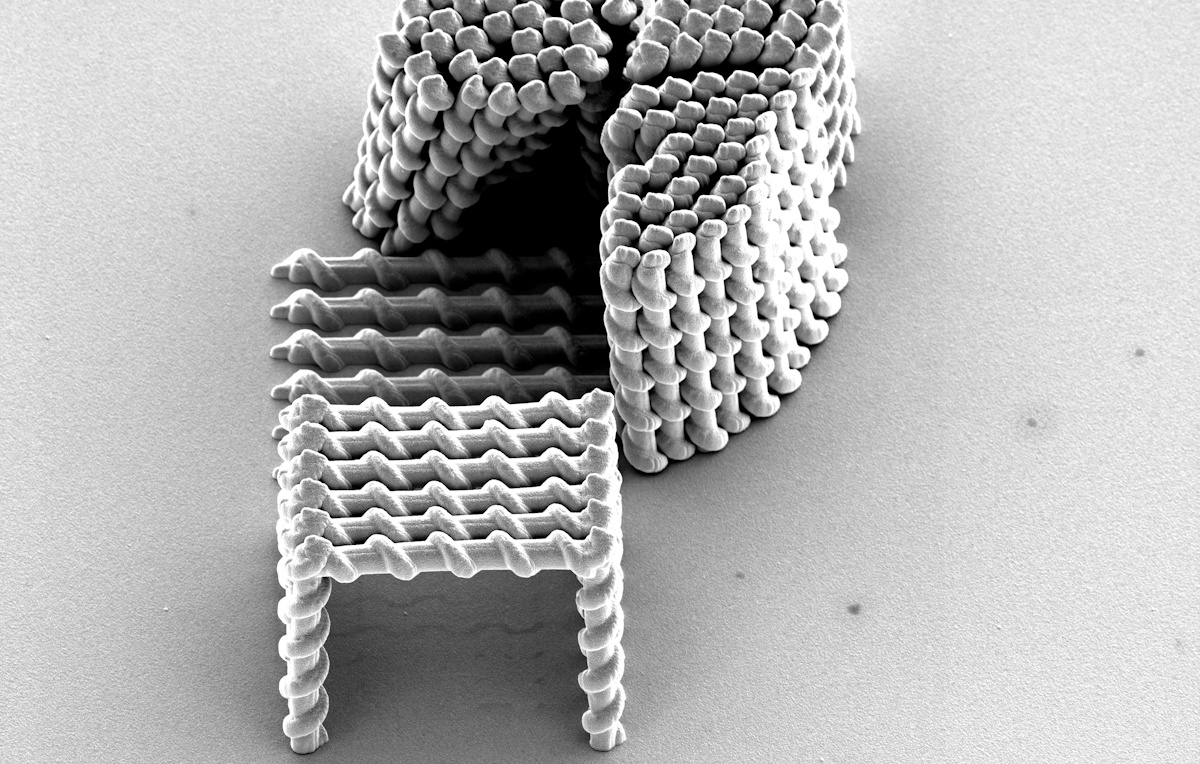
Dirk Grundler, head of EPFL’s Laboratory of Nanoscale Magnetic Materials and Magnonics, and collaborators showed that a structural twist, in the form of a helical surface relief printed onto an otherwise ordinary polycrystalline nickel nanotube, is sufficient to induce chirality. The torsion and curvature of the twist generate a shape anisotropy and force the magnetic ground state into a spiralling spin texture. Its toroidal moment does exactly what the DMI does in a natural chiral crystal – it breaks the symmetry of the magnon dispersion relation, which describes how the energy of a magnetic wave depends on its direction of travel.
These twisted structures, termed artificial chiral magnets (ACMs), satisfy three conditions that no natural chiral magnet has jointly met: room temperature stability, zero field operation and realization in polycrystalline nickel – a material that is naturally achiral.
ACM outperforms a natural chiral crystal
The researchers used two-photon lithography to write the twisted polymeric scaffold and atomic layer deposition to coat it with a conformal 30-nm thick nickel shell. The handedness of the design is directly inherited by the magnetic ground state – as confirmed by X-ray magnetic circular dichroism microscopy – and can be flipped by field history, producing opposite helicity states in the same structural device on demand.
The team also performed microfocused Brillouin light scattering spectroscopy to resolve the magnon dynamics. At zero field and room temperature, the intensity non-reciprocity parameter (the difference in signal strength between waves travelling in opposite directions) reached 35.7%, switching reproducibly between two stable configurations (spin texture spiralling clockwise or anticlockwise) under field cycling without drift or degradation. At ±250 mT, the frequency non-reciprocity parameter (how much the frequency of a magnetic wave changes depending on which way it travels) peaked at 5.4×10⁻², nearly three times the value reported for the bulk chiral material Cu2OSeO3 at cryogenic temperature.
Overall, the geometrically engineered nickel tube at room temperature outperformed a natural chiral crystal at low temperature. Using micromagnetic simulations and analytical modelling, the team traced the origin of this non-reciprocity to two cooperating mechanisms, both of which are tied to the geometry of the tube rather than the chemistry of the material, and both of which scale with decreasing tube radius. This implies that the numbers reported in this study are not a ceiling – they are a starting point.
A scalable blueprint for chirality-engineered magnonics
The most important factor in this result is not the nickel. While nickel was the material used, the principle does not belong exclusively to nickel. Because the chirality here is geometric – written into the shape of the structure rather than the chemistry of the lattice – it is transferable to any ferromagnet that can be deposited conformally over a three-dimensional scaffold.
Analytical calculations predict that permalloy, a nickel–iron magnetic alloy with higher saturation magnetization and exchange stiffness than nickel, should produce stronger non-reciprocity in an identical geometry. And since non-reciprocity scales with decreasing tube radius, sub-100-nm geometries accessible through next-generation two-photon lithography represent a direct route to significantly amplified effects.
Moreover, this ACM structure is multifunctional by design. Spin waves travelling through the helical magnetic structure behave differently depending on their characteristics. Some move quickly and directionally, making them suitable for carrying signals. Others are nearly stationary and strongly asymmetric – they travel in one direction and are blocked in the other, which is the defining behaviour of a diode.
Inverse design configures magnon-based signal processor

The twist of the magnetic texture (clockwise or anticlockwise) can also be set by a magnetic field pulse and held indefinitely without requiring any power, functioning as a memory that stores information in the handedness of the spin arrangement rather than in a voltage or a charge. Because this directional asymmetry of magnetochiral anisotropy is a property of the geometry and not just of the spin waves, electrical current passing through the same structure is expected to experience the same effect – flowing more easily in one direction than the other.
In other words, a single nanoscale helix could simultaneously route signals, switch them, remember them and rectify them. One structure, four functions, no exotic material – the chirality was never in the crystal, it was in the geometry.
The findings are reported in Nature Nanotechnology.