Honor Powrie observes the role that AI is playing in enabling robots to become physically more human and wonders where this might lead us next
It was fantastic to see the men’s marathon world record being broken in London at the end of April when Kenya’s Sabastian Sawe became the first person to officially complete the run in under two hours. It’s an achievement that a whole generation of world-class runners had had their eyes on, with Sawe completing the race in a headline-grabbing 1:59:30.
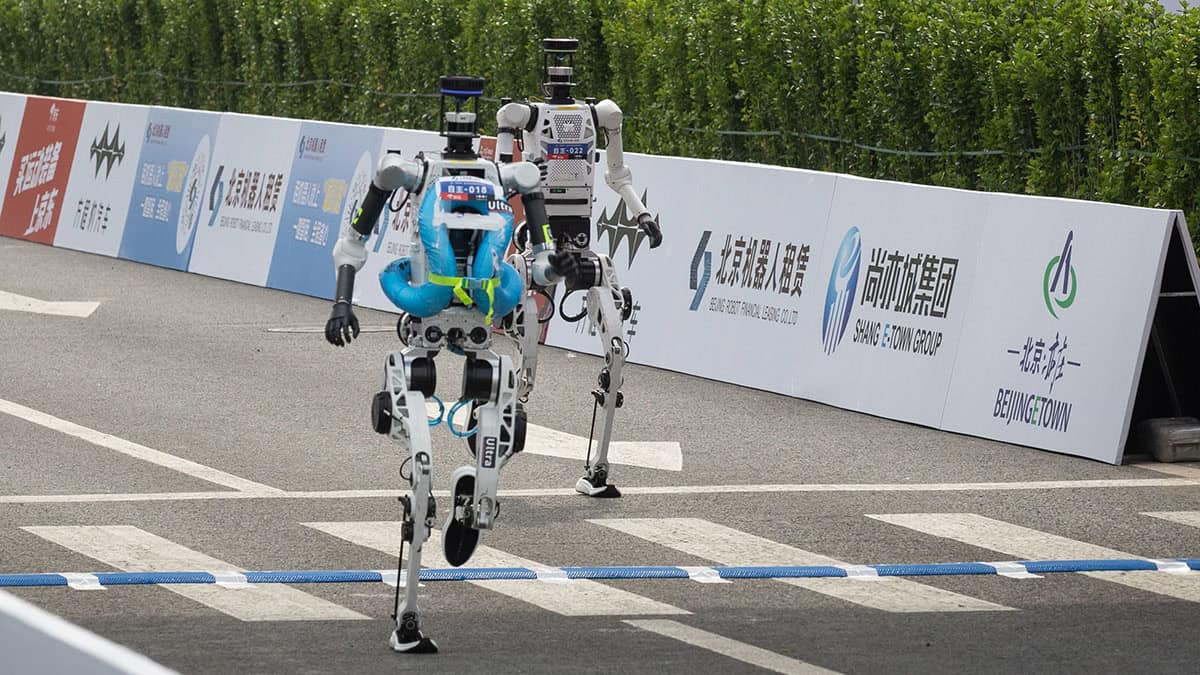
Perhaps less attention was given to another achievement a week earlier, which saw a humanoid robot run the Beijing E-Town half-marathon in 50:26, breaking the human record by almost seven minutes. What’s particularly impressive is that at the inaugural event in 2025, the robot winner took 2:40:42 to complete the race, with many robot entrants failing even to reach the finishing line.
In just one year, in other words, the robot half-marathon record has been slashed by more than two-thirds, an unthinkable feat in human terms. What’s more, the rules between the first and second robotic competitions were tightened. They now favour robots that can run on their own (rather than via remote control) and penalize those that need to be taken off course to have their batteries changed.
Giant steps
My mind began spinning, trying to work out what must have happened over the past year to realize such advancements. How did we go from remote-controlled, slow and clunky robots to autonomous, agile and sleek devices? It turns out that these increases in speed and endurance have been driven by a combination of better hardware, specialized designs and advanced algorithms.
Robots now benefit from powerful actuators enabling higher torque and faster movement of its hips and knees. Anatomical designs have also been optimizied to mirror biological efficiencies by, for example, using lightweight limbs and lower torso components to minimize the energy lost when a robot’s foot strikes the ground.
Other changes include the use of liquid cooling technologies to stop a robot from getting too hot during prolonged activity and finding ways to mimic highly efficient natural bipeds, such as an emu or ostrich. Improved AI and control software have also allowed robots to navigate varied terrain and stay stable autonomously, rather than relying on remote operation.
AI answers
Of all these developments, I believe the most significant is the expanding use of AI. To me, it seems that AI will be the enabler for robots to become more “human”. In China, humanoid robots are already being developed to automate what is dubbed the hardest task in the car industry – the final assembly stage.
This work typically consists of real people carrying out highly labour-intensive tasks such as installing wiring harnesses, fitting a vehicle’s interior trim and instruments, or bringing its engine and chassis together. Being super-precise tasks that require manual dexterity, this work has previously been thought too complex for robots.
However, through a combination of imitation learning, simulation and real-time human guidance, it’s now becoming conceivable for robotic devices to do this kind of work. Underpinning this aspiration are what are known as Vision-Language-Action (VLA) models, which process camera images together with natural language or text descriptions and translate these into physical actions.
Having emerged relatively recently from work at AI firm Google DeepMind, VLA models differ from traditional, task-specific programming robotics by offering generalization and the ability to handle novelty. They are seen as the next big thing in AI because they bridge the gap between understanding the world (vision and language) and interacting with it (action) – potentially letting robots do tasks they have not been explicitly trained on.
VLAs typically rely on existing Vision-Language-Models (VLMs), which provide a combined knowledge of text (large language models) and images (computer vision models). The VLA model is then fine-tuned on task-specific data to learn a mapping of visual observations and text instructions to create the desired robot action.
One challenge in training VLAs is getting enough data with appropriate visual and contextual information. It may be gleaned from real robots (imitation) but it can also be generated by human guidance or teleoperation – a manual process involving humans “showing” robots how to do a specific task. The task is time-consuming, having to be performed deliberately and repeatedly using equipment that captures appropriate levels of data quantity and quality.
A third option is to build virtual simulation environments to train the models and optimize robotic movements. As VLAs inherently learn to associate higher-level cognition with lower-level physical actions, the trend will be to move from fixed, pre-programmed scripts towards AI and large-scale simulation training. The result: robots that become more autonomous and versatile in real-world situations.
We are all getting used to AI becoming an increasing part of our everyday life – think how much GenerativeAI models have improved since they first appeared a few years ago. But I wonder what will be next for robots as they become capable of moving independently and spontaneously, having the ability to operate with full autonomy within dynamic human environments, such as homes and factories.
When we – eventually – experience the full physical embodiment of Artificial General Intelligence, will it be like living on the filmset of I, Robot or Blade Runner, with humans and humanoids coexisting and, in some cases indiscernible? Several years ago, this was something I did not expect to see in my lifetime. But in April it just got one giant leap – or at least one half-marathon – closer.