A new phase of water ice, dubbed ice XXI, has been discovered by researchers working at the European XFEL and PETRA III facilities. The ice, which exists at room temperature and is structurally distinct from all previously observed phases of ice, was produced by rapidly compressing water to high pressures of 2 GPa. The finding could shed light on how different ice phases form at high pressures, including on icy moons and planets.
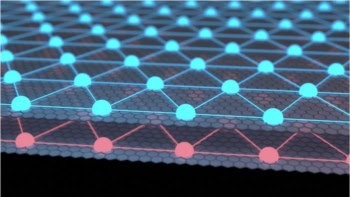
On Earth, ice can take many forms, and its properties depend strongly on its structure. The main type of naturally-occurring ice is hexagonal ice (Ih), so-called because the water molecules arrange themselves in a hexagonal lattice (this is the reason why snowflakes have six-fold symmetry). However, under certain conditions – usually involving very high pressures and low temperatures – ice can take on other structures. Indeed, 20 different forms of ice have been identified so far, denoted by roman numerals (ice I, II, III and so on up to ice XX).
Pressures of up to 2 GPa allow ice to form even at room temperature
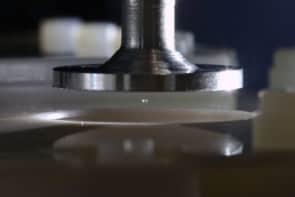
Researchers from the Korea Research Institute of Standards and Science (KRISS) have now produced a 21st form of ice by applying pressures of up to two gigapascals. Such high pressures are roughly 20 000 times higher than normal air pressure at sea level, and they allow ice to form even at room temperature – albeit only within a device known as a dynamic diamond anvil cell (dDAC) that is capable of producing such extremely high pressures.
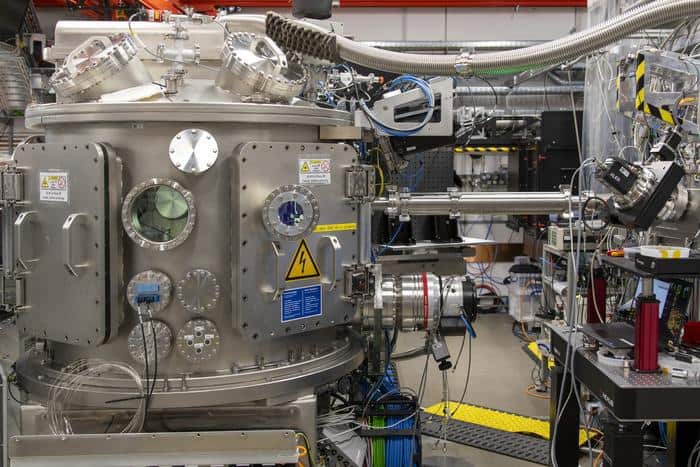
“In this special pressure cell, samples are squeezed between the tips of two opposing diamond anvils and can be compressed along a predefined pressure pathway,” explains Cornelius Strohm, a member of the DESY HIBEF team that set up the experiment using the High Energy Density (HED) instrument at the European XFEL.
Much more tightly packed molecules
The structure of ice XXI is different from all previously observed phases of ice because its molecules are much more tightly packed. This gives it the largest unit cell volume of all currently known types of ice, says KRISS scientist Geun Woo Lee. It is also metastable, meaning that it can exist even though another form of ice (in this case ice VI) would be more stable under the conditions in the experiment.
“This rapid compression of water allows it to remain liquid up to higher pressures, where it should have already crystallized to ice VI,” explains Lee. “Ice VI is an especially intriguing phase, thought to be present in the interior of icy moons such as Titan and Ganymede. Its highly distorted structure may allow complex transition pathways that lead to metastable ice phases.”
Ice XXI has a body-centred tetragonal crystal structure
To study how the new ice sample formed, the researchers rapidly compressed and decompressed it over 1000 times in the diamond anvil cell while imaging it every microsecond using the European XFEL, which produces megahertz frequency X-ray pulses at extremely high rates. They found that the liquid water crystallizes into different structures depending on how supercompressed it is.
The KRISS team then used the P02.2 beamline at PETRA III to determine that the ice XXI has a body-centred tetragonal crystal structure with a large unit cell (a = b = 20.197 Å and c = 7.891 Å) at approximately 1.6 GPa. This unit cell contains 152 water molecules, resulting in a density of 1.413 g cm−3.
Space ice reveals its secrets

The experiments were far from easy, recalls Lee. Upon crystallization, Ice XXI grows upwards (that is, in the vertical direction), which makes it difficult to precisely analyse its crystal structure. “The difficulty for us is to keep it stable for a long enough period to make precise structural measurements in single crystal diffraction study,” he says.
The multiple pathways of ice crystallization unearthed in this work, which is detailed in Nature Materials, imply that many more ice phases may exist. Lee says it is therefore important to analyse the mechanism behind the formation of these phases. “This could, for example, help us better understand the formation and evolution of these phases on icy moons or planets,” he tells Physics World.