Hints of non-gravitational interactions between dark matter and “relic” neutrinos in the early universe have emerged in a study of astronomical data from different periods of cosmic history. The study was carried out by cosmologists in Poland, the UK and China, and team leader Sebastian Trojanowski of Poland’s NCBJ and NCAC PAS notes that future telescope observations could verify or disprove these hints of a deep connection between dark matter and neutrinos.
Dark matter and neutrinos play major roles in the evolution of cosmic structures, but they are among the universe’s least-understood components. Dark matter is thought to make up over 25% of the universe’s mass, but it has never been detected directly; instead, its existence is inferred from its gravitational interactions. Neutrinos, for their part, are fundamental subatomic particles that have a very low mass and interact only rarely with normal matter.
Analysing data from different epochs
According to the standard (ΛCDM) model of cosmology, dark matter and neutrinos do not interact with each other. The work of Trojanowski and colleagues challenges this model by proposing that dark matter and neutrinos may have interacted in the past, when the universe was younger and contained many more neutrinos than it does today.
This proposal, they say, was partly inspired by a longstanding cosmic conundrum. Measurements of the early universe suggest that structures such as galaxies should have grown more rapidly than ΛCDM predicts. At the same time, observations of today’s universe indicate that matter is slightly less densely packed than expected. This suggests a slight mismatch between early and late measurements.
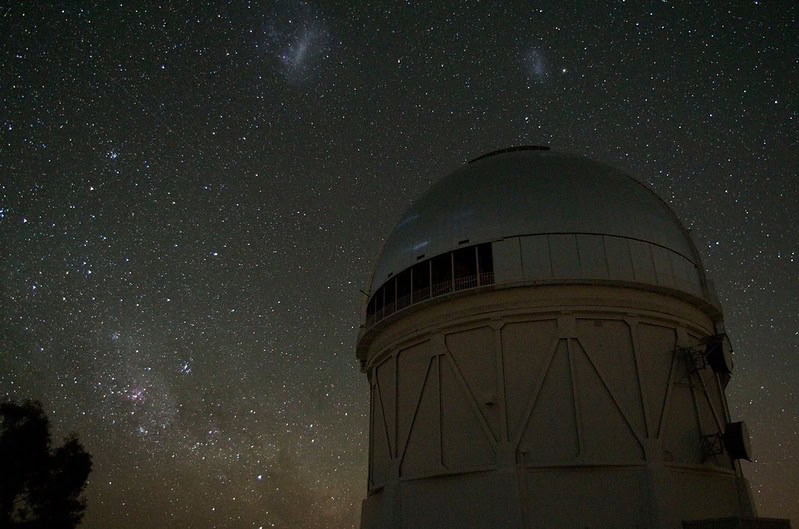
To explore the impact that dark matter-neutrino interactions (νDM) would have on this mismatch, a team led by Trojanowski’s colleague Lei Zu analysed data from different epochs of the universe’s evolution. Data from the young (high redshift) universe came from two instruments – the ground-based Atacama Cosmology Telescope and the space-based Planck Telescope, which the European Space Agency operated from 2009 to 2013 – that were designed to study the afterglow of the Big Bang, which is known as the cosmic microwave background (CMB). Data from the older (low-redshift, or z< 3.5) universe, meanwhile, came from a variety of sources, including galaxy maps from the Sloan Digital Sky Survey and weak gravitational lensing data from the Dark Energy Survey (DES) conducted with the Dark Energy Camera on the Victor M Blanco Telescope in Chile.
“New insight into how structure formed in the universe”
Drawing on these data, the team calculated that an interaction strength u ≈10−4 between dark matter and neutrinos would be enough to resolve the discrepancy. The statistical significance of this result is nearly 3σ, which team member Sming Tsai Yue-Lin of the Purple Mountain Observatory in Nanjing, China says was “largely achieved by incorporating the high-precision weak lensing data from the DES with the weak lensing component”.
While this is not high enough to definitively disprove the ΛCDM model, the researchers say it does show that the model is incomplete and requires further investigation. “Our study shows that interactions between dark matter and neutrinos could help explain this difference, offering new insight into how structure formed in the universe,” explains team member Eleonora Di Valentino, a senior research fellow at Sheffield University, UK.
Trojanowski adds that the ΛCDM has been under growing pressure in recent years, while the Standard Model of particle physics cannot explain the nature of dark matter. “These two theories need to be extended to resolve these problems and studying dark matter-neutrino interactions are a promising way to achieve this goal,” he says.
New cosmic map will put dark-matter theories to the test
The team’s result, he continues, adds to the “massive amount of data” suggesting that we are reaching the limits of the standard cosmological model and may be at the dawn of understanding physics beyond it. “We illustrate that we likely need to bridge cosmological data and fundamental particle physics to describe the universe across different scales and so resolve current anomalies,” he says.
Two worlds
One of the challenges of doing this, Trojanowski adds, is that the two fields involved – cosmological data analysis and theoretical astroparticle physics – are very different. “Each field has its own approach to problem-solving and even its own jargon,” he says. “Fortunately, we had a great team and working together was really fun.”
The researchers say that data from future telescope observations, such as those from the Simonyi Survey Telescope at the Vera C Rubin Observatory (formerly known as the Large Synoptic Survey Telescope, LSST) and the China Space Station Telescope (CSST), could place more stringent tests on their hypothesis. Data from CMB experiments and weak lensing surveys, which map the distribution of mass in the universe by analysing how distant galaxies distort light, could also come in useful.
They detail their present research in Nature Astronomy.