Strategic recruitment of international talent is helping Denmark establish itself as a research powerhouse in quantum science and technology
Denmark, it seems, is increasingly walking the walk, not just talking the talk, when it comes to quantum science and innovation. Structurally, the country’s “quantum ecosystem” is on a roll, with more than 75 organizations now actively engaged around a shared national mission via the Danish Quantum Community, a network of start-ups, scale-ups, incumbent technology companies, investors, research institutions and government agencies.
Money is greasing the wheels. In October last year, Denmark launched 55North, the world’s largest venture-capital fund dedicated exclusively to quantum technologies and applications. Headquartered in Copenhagen and backed by the Novo Nordisk Foundation and the Export and Investment Fund of Denmark (EIFO), the fund opened with a capital injection of €134 million (and a target base of €300 million) to back high-growth companies in the nascent quantum supply chain – within Denmark and beyond.
Workforce development is also mandatory – a strategic acknowledgement that Denmark must scale the “quantum talent pipeline” if it is to translate advances in fundamental science and applied R&D into next-generation quantum technologies. Capacity-building is well under way as Danish universities work with industry and government partners to train a skilled and diverse quantum workforce of “all the talents”, with recruitment of international scientists and engineers seen as fundamental to Denmark’s long-term quantum ambitions.
Joined-up thinking in quantum
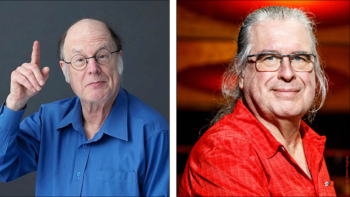
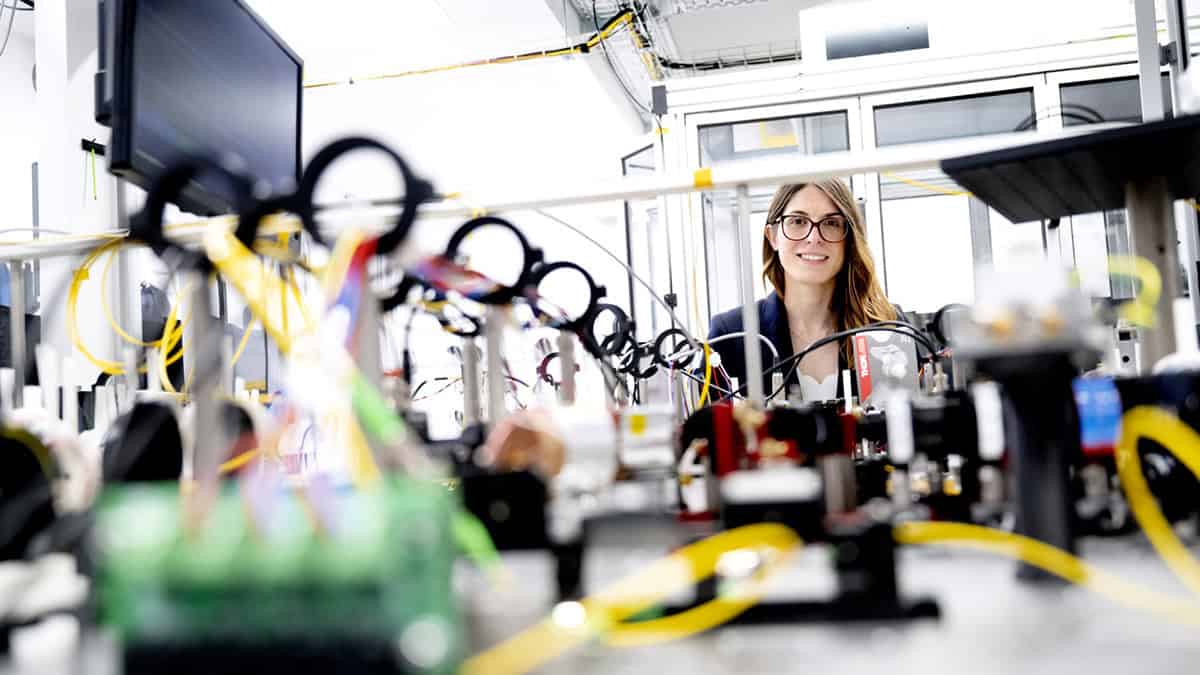
A case study in this regard is Maria Cerdà Sevilla, head of Quantum DTU, the Center for Quantum Technologies at the Technical University of Denmark (DTU). Located in Lyngby, just north of Copenhagen, Quantum DTU coordinates the research activities of around 300 quantum scientists, working across 12 departments at DTU and focused around five main research themes: quantum computing, quantum communications, quantum sensing, advanced materials as well as cross-cutting initiatives in nanofabrication and next-generation quantum chips.
“The goal is to ensure that DTU is not merely participating in quantum science but also shaping the trajectory of technology translation and commercial innovation in the field,” explains Cerdà Sevilla. Put another way: Quantum DTU is all about outcomes versus three broad-scope metrics: scientific depth (world-class research in quantum physics and engineering); building the quantum ecosystem (integrating diverse research disciplines, developing infrastructure, plus education and training); and, finally, readiness for market deployment (meaning responsible and scalable implementation of quantum technologies).
“Our success will be defined not only by high-impact publications and prototypes, but whether DTU – and, by extension, Denmark – has established ‘durable capacity’ in quantum technologies and applications,” says Cerdà Sevilla.
It’s better to travel
For her part, Cerdà Sevilla is the quintessential pan-European scientist, albeit taking the “road less-travelled” to her role at Quantum DTU. After completing a PhD in particle physics at the University of Liverpool, UK, she moved on to postdoctoral research positions in Germany – at Humboldt University of Berlin and the Technical University of Munich – before a mid-career pivot into research strategy and innovation management.
“While I no longer do research myself, I work with quantum scientists every day at DTU,” explains Cerdà Sevilla. That engagement extends to other stakeholders, including policy-makers, funding agencies, manufacturers in the quantum supply chain, as well as industrial end-users looking to deploy quantum technologies. “My role is essentially about leadership and strategic alignment,” she adds. “That means defining research priorities, understanding what we’re doing at a granular level, and ensuring Quantum DTU’s scientific efforts translate into a joined-up action plan across diverse specialisms.”
One of the most powerful aspects of Quantum DTU – indeed the wider quantum sector in Denmark – is this sense of shared purpose. “The quantum community here is internationally connected and recognized as well as being locally cohesive,” notes Cerdà Sevilla. “As an international scientist, it’s a given that you will get to conduct leading-edge research here; at the same time, you will also have a voice in shaping priorities at the departmental, institutional and even national level.”
By extension, institutional and interpersonal trust are defining features of Denmark’s research culture, enabling scientific collaborations and long-term initiatives to take shape organically without undue friction or hierarchical blockers. That same mindset informs life outside the laboratory and the workplace.
“The work-life balance in Denmark is great, though productivity is mandatory,” says Cerdà Sevilla. “Danish people work very hard, but they also understand the need for downtime with family and friends to ensure creativity and clarity of thinking. Overall, there’s a culture of psychological safety in the research community – an implicit acknowledgement that teams function best when individuals feel secure with their colleagues and management.”
Heading north
Another international scientist making an out-sized impact in the Danish quantum community is Francesco Borsoi, an assistant professor of physics and spin qubit pilot-line lead within the Novo Nordisk Foundation Quantum Computing Programme (NQCP), part of the renowned Niels Bohr Institute (NBI) at the University of Copenhagen (KU).
The NQCP is a 12-year collaborative research effort, backed with €200 million of funding through till 2035, to develop fault-tolerant quantum computing hardware and quantum algorithms for chemical and biological challenges in the life sciences. Underpinning the programme is a technology-agnostic approach to hardware development and the infrastructure required to support it (and currently implemented across four qubit pilot lines).
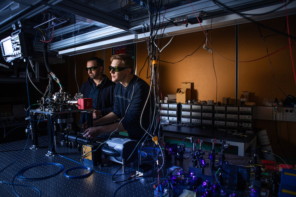
“Right now, my research at NBI explores the development, control and scaling aspects of solid-state quantum devices and investigation of the properties that may enable universal quantum computing,” explains Borsoi. While his focus, in large part, is on quantum-confined spins in semiconductor quantum dots, Borsoi works closely with the other three NQCP pilot-line teams developing platforms based on superconducting, photonic and neutral-atom technologies.
As an assistant professor, Borsoi also plays a proactive role in training the next generation of quantum scientists and engineers. Notably, he is the lead creator of a hands-on experimental course on advanced qubit technologies – part of a joint KU/DTU Masters programme in quantum information science that’s helping Denmark to scale its quantum workforce.
Here for the long term
Like Cerdà Sevilla at Quantum DTU, Borsoi’s back-story reflects the pan-European mobility of scientific talent. He received his MSc in condensed-matter physics from the University of Pisa, Italy, in 2016, before moving on to QuTech at the Delft University of Technology, The Netherlands, where he completed a PhD in applied physics (on semiconductor/superconductor quantum heterostructures) followed by three years of postdoctoral research (and a shift in direction to focus exclusively on semiconductor quantum-dot qubits).
After six years at QuTech, Borsoi wasn’t actively seeking a move to another institution – let alone another country – but was attracted by the NQCP opportunity and, as he puts it, “the chance to build from the ground up and be part of something this ambitious”.
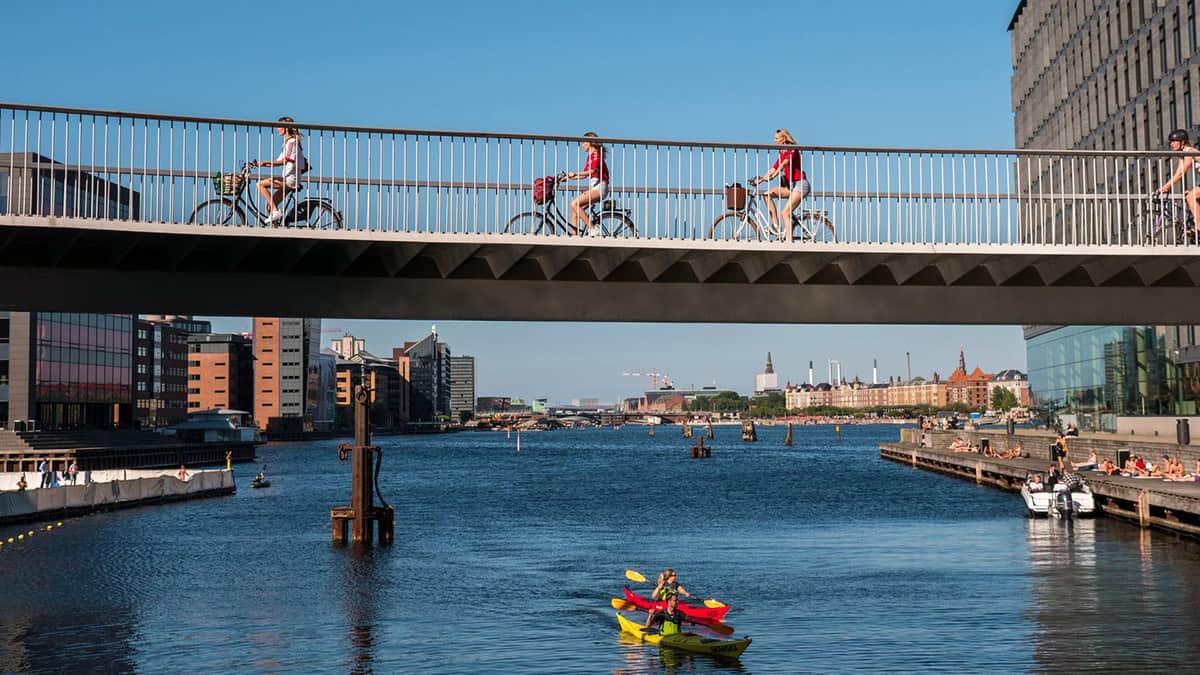
He’s been in Copenhagen for 18 months and has settled well, both within NBI and outside. “Day to day,” he says, “I get to work with talented colleagues and students across NBI and KU, plus I get to develop my career in one of the world’s most liveable, sustainable cities. Five-star food scene, amazing architecture, lots of green space and excellent public transport – what’s not to like?”
Back in the laboratory, meanwhile, Borsoi also engages extensively with domain experts working on the three other qubit pilot lines – a systematic and collaborative research model that underpins NQCP’s approach to quantum science. “The core enabling technologies may differ,” notes Borsoi, “but many of the design, engineering and scalability challenges are common to all the pilot lines. I guess we all talk the same language when it comes to the NQCP mission.”
For Borsoi, the transition to NBI and Denmark’s quantum community could hardly have gone better and already feels like a long-term commitment. “Government, private equity and philanthropic foundations are all making big investments in quantum,” he concludes, “so there’s no shortage of opportunities in Denmark for talented quantum scientists and engineers seeking to develop their careers in a university or industry setting.”
- Visit Science Hub Denmark for more information on quantum job opportunities in Denmark. This nationally coordinated initiative aims to enhance the global visibility of Danish research and career opportunities in the natural sciences, engineering and life sciences. Delegates attending the APS Global Physics Summit (15-20 March) in Denver, Colorado, can find out more by visiting the Danish Quantum Pavilion at the co-located industry exhibition.