Robert P Crease reviews The Boundless Deep: Young Tennyson, Science and the Crisis of Belief by Richard Holmes
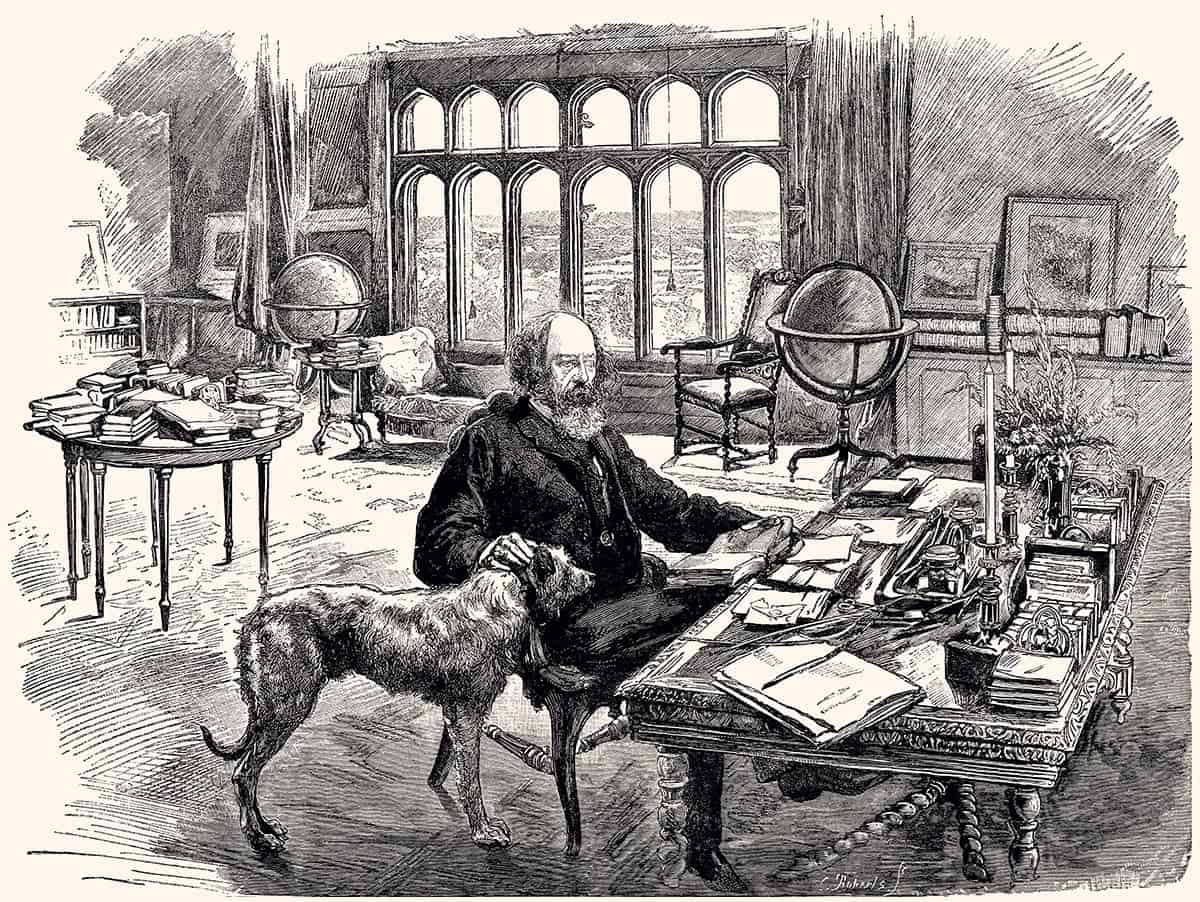
Alfred Tennyson was “the only poet since the time of Lucretius who has taken the trouble to understand the work and tendency of the men of science” said the English biologist Thomas Huxley on the occasion of Tennyson’s burial in the Poets’ Corner of Westminster Abbey on 12 October 1892. Tennyson’s acquaintance with science and its impact on his poetry is the subject of historian and broadcaster Richard Holmes’s new book The Boundless Deep: Young Tennyson, Science and the Crisis of Belief.
Born in 1809 – the same year as Charles Darwin – Tennyson matured at a time when science was transforming ideas about the universe. “It was stranger and vaster than previously thought,” writes Holmes, “and yet more vulnerable and paradoxically, more temporary. There were no Biblical eternities anymore.”
As a teenager Tennyson looked through telescopes and microscopes, and read books on physics, chemistry, botany and astronomy. In notebooks he interspersed poetic verses with careful observations of plants, birds, animals and other natural phenomena. In one poem he imagined himself on the Moon’s surface, in another as a microscopic creature. His verses expressed both wonder and suspicion. “O suns and spheres and stars … are you realities or semblances?” wrote the 14-year-old poet.
An unbreakable bond
While studying at the University of Cambridge, Tennyson met Arthur H Hallam and the two became inseparable, sharing interests in nature, poetry and science. In 1833 they spent a “science week” in London, visiting the new London Zoo in Regent’s Park, the Gallery of Practical Science in Piccadilly, and displays of magnets, microscopes and steam cannons.
That year several books on astronomy appeared, including one by Tennyson’s Cambridge tutor William Whewell, who coined the term “scientist”. The publications acquainted readers, including Tennyson and Hallam, with newly discovered star systems and “the nature of their formation, their growth over immense and previously inconceivable periods of time, and finally their slow but inevitable extinction”, as Holmes describes. “These ideas of so-called deep time and deep space were gradually transforming the whole notion of the material universe.”
That autumn, at age 22, Hallam unexpectedly died from a brain haemorrhage. It was the most traumatic event of Tennyson’s life, “a particular extinction from which he never recovered”, writes Holmes. Tennyson spent nearly two decades coping by writing In Memoriam A H H, published in 1850. In several sections near the poem’s midpoint, Tennyson seems to invoke nature as a possible source of solace in imagery that has challenged scholars ever since.
“Every evolutionist can cite the line,” wrote the evolutionary biologist Stephen J Gould in his 1995 book Dinosaur in a Haystack. “We would draw and quarter any imposter who couldn’t.” Gould was referring to the line “Nature red in tooth and claw”, a phrase from In Memoriam that many scholars think anticipates Darwinian evolution and consoled Tennyson. But Gould instead finds that the line only reflects the biological and geological catastrophism of Tennyson’s time and adds that Tennyson knew it held no comfort. “Science cannot tell us why a man should die so young,” Gould writes, “or how a grieving lover should resolve his suffering.”
Holmes gives a more nuanced interpretation, saying that Tennyson did not grieve and then seek solace in science. Rather, Tennyson’s grief began with his awareness that scientific truths prevented him from turning to religion; that the “death of an individual”, as Holmes writes, “counted for nothing within the vast and pitiless scale of geological death and extinction”. Tennyson’s grief sprang from his experience of a conflict between science and religion, which put him in a “state of hovering, or trembling, between science and religion, between empirical evidence and traditional faith”.
Life, poetry and science
Holmes has spent his career writing about Romantic poets and their world. For example, one of his previous books was The Age of Wonder: How the Romantic Generation Discovered the Beauty and Terror of Science. Holmes’s vast command of the era shows in his ability to identify the people from whom Tennyson learned what he knew.
He introduces us to Jane Marcet, an innovative scholar and writer whose books about physics and chemistry inspired not only Tennyson but also embarked the geologist Charles Lyell and physicist Michael Faraday on their scientific careers. Marcet would have been elected to the Royal Society, Holmes writes, “except for the slight hindrance that no female Fellow was admitted until 1921”. (Marcet’s husband, a Swiss doctor, made it in.) Meanwhile, the mathematician Mary Somerville – said to be “one of the only six persons in England who understands Laplace” – was a polymath whose books acquainted Tennyson with the entire spectrum of hard sciences.
Science, Holmes shows, is not a privileged knowledge that poets must bow before, nor a set of facts to accept or deny. Rather, its constant development reshapes our experience of the world as much as families and friendships, mentors and myths. The Boundless Deep is as instructive about the science found in Tennyson’s poetry as it is about science in human experience.
- 2025 William Collins 448 pp; £25.00 hb; £14.99 ebook