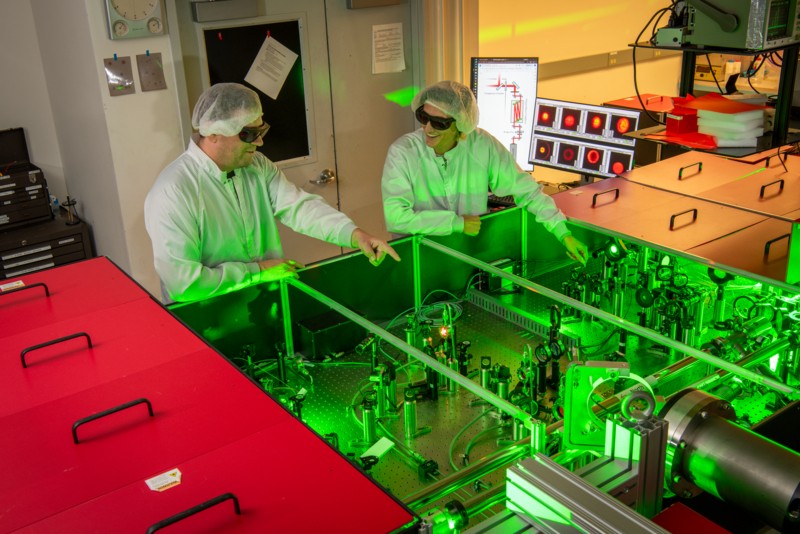
A laser plasma accelerator (LPA) has been used to power a free electron laser (FEL) for more than eight hours, delivering stable pulses of coherent light. The system was created in the US by researchers at the company Tau Systems and Lawrence Berkeley National Laboratory. The team says that its achievement represents a major breakthrough in stability for LPA-driven FELs, which could someday make coherent UV and X-ray pulses more accessible to academia and industry.
An FEL creates bright pulses of coherent light – usually in the ultraviolet-to-X-ray portion of the electromagnetic spectrum. These pulses are used in a wide range of research including physics, chemistry, biology and materials science.
The pulses are created by sending bunches of high-energy electrons through a device called an undulator, which applies a transverse magnetic field that alternates in direction as the bunch propagates. As the electrons are accelerated back and forth by the field they emit light. Under the right conditions the emitted light interacts with the electron bunch in such a way that the coherence and brightness of the light increases as the electron bunch travels through the undulator.
FELs require a bright and stable source of high-energy electron bunches, so today’s facilities are driven by large and expensive electron accelerators. The European X-ray Free Electron Laser, for example, is located at the end of a 3.4 km linear accelerator.
Surfing a plasma wave
High-energy electron bunches can also be created by firing high-intensity laser pulses at a plasma target. Electrons in the plasma are much lighter than the ions, so they are accelerated more by the intense electric field of the laser pulse. The result is a region of separated positive and negative charge that contains a large electric field. This region trails the laser pulse like the wake of a ship – and is called a wakefield. If electrons are injected into this wakefield, they are captured and accelerated to near the speed of light. The process is similar to how a surfer is propelled by an ocean wave.
While LPA-driven FELs would require expensive lasers, their size and cost would dwarf that of accelerator-driven facilities. Today, however, the electron pulses delivered by LPAs are not good enough to drive a FEL. Some shortcomings are related to fluctuations in the focal point of the laser and well as changes in the pulse energy and duration. These fluctuations can be caused by mechanical vibrations, temperature fluctuations and other environmental disturbances.
Founded in 2021, the Texas-based company Tau Systems is developing practical LPAs for a range of applications including FELs. Now, the company has joined forces with researchers at Berkeley Lab’s BELLA Center to implement a set of laser-stabilization technologies on BELLA’s Hundred Terawatt Undulator beamline.
The team implemented five active systems that worked together to stabilize the focal point of the powerful laser. Some of this was done using a “ghost” beam – a low-power copy of the driving beam – to observe subtle fluctuations that would not be apparent by monitoring the main beam.
High-quality bunches
As a result the system delivered bunches of 100 MeV electrons at a frequency of 1 Hz and at high stability for over 10 h. These bunches were then used to drive a self-amplified spontaneous emission (SASE) FEL based on a 4 m-long undulator that is embedded within a vacuum chamber.
The LPA–FEL delivered violet (420 nm wavelength) pulses for more than 8 h without any human intervention. The FEL gain of the system was about 1000, which is the ratio of brightness of the emitted coherent FEL pulse to the brightness of light emitted by unamplified undulation.
This run is a significant improvement on the team’s 2025 achievement of using a LPA–FEL setup to deliver pulses of similar quality for an hour.
“This is the moment the community has been working toward,” says Stephen Milton of Tau Systems. “We have shown that an LPA-driven FEL is not just a proof-of-concept experiment. It is a platform capable of delivering the stability that real scientific and industrial users demand.”
New laser-plasma accelerator could soon deliver X-ray pulses
Finn Kohrell of the BELLA Center adds, “Maintaining FEL stability for a record eight hours represents a significant advancement in LPA-driven FELs and provides deeper insights both into achieving optimal FEL performance and into validating LPAs as high-brightness injectors, which is crucial for LPA application in future light source facilities”.
During operation, the team gathered data about the stabilization process and mapped correlations between the parameters of the drive laser; the plasma source; the electron bunches; and the FEL’s output pulses. The researchers are now using this information to improve their control systems and they say that these data indicate that further gains in stability and brightness are possible.
The next experimental step will involve increasing the FEL energy to their system’s maximum value of 500 MeV.
“At this level, we can lower the undulator radiation wavelength to the 20–30 nm range, placing it in the hard ultraviolet or soft X-ray regime,” explains Kohrell. “[This would be] a crucial step toward making the technology viable for real-world applications.”
The new system is described in Physical Review Accelerators and Beams.