Through new experiments with magnetic materials, physicists in Austria and Hong Kong have overturned a simple law of friction that has held for over 300 years. Led by Clemens Bechinger at the University of Innsbruck, the team’s discovery shows how internal collective dynamics in these materials can cause friction to peak at a certain applied, load before dropping sharply. The effect could prove especially promising in applications where friction needs to be precisely controlled.
In 1699, French physicist Guillaume Amontons published his rediscovery of an effect first observed by Leonardo da Vinci: that the force of friction between two sliding surfaces is proportional to the load pressing them together. He also showed that this relationship is monotonic, meaning friction continues to grow as the load increases, forcing stronger interactions between the surfaces.
Since then, Amontons’ law has held up to close experimental scrutiny. “It is actually quite remarkable that this simple law holds across a wide range of very different materials,” Bechinger says. “At the same time, this classical picture does not account for systems where internal degrees of freedom – such as magnetic order – play an active role.”
Little microscopic insight
For all its success, Amontons’ law offers little insight into the microscopic mechanisms underlying friction. To probe these mechanisms, many studies have turned to atomic force microscopy, which measures the motion of a nanoscale tip as it is scanned across a surface. While powerful, this technique can only capture frictional mechanisms over extremely local regions. As a result, it is less well suited to systems where friction emerges from larger-scale effects.
In particular, magnetic materials host regions of aligned atomic spins that can extend across millimetres. When two magnetic surfaces slide past each other, these spins continuously reorient in response to their changing interactions. However, this reconfiguration isn’t instantaneous.
Famously, magnetic systems can display hysteresis, whereby a material’s response to an external magnetic field depends to the history of its magnetization. For two interacting magnetic surfaces, hysteresis means that spin realignments to lag behind the sliding motion, causing the system to undergo repeated cycles of delayed switching. In the process, the kinetic energy of the sliding motion is partly dissipated, increasing the overall friction experienced by the surfaces.
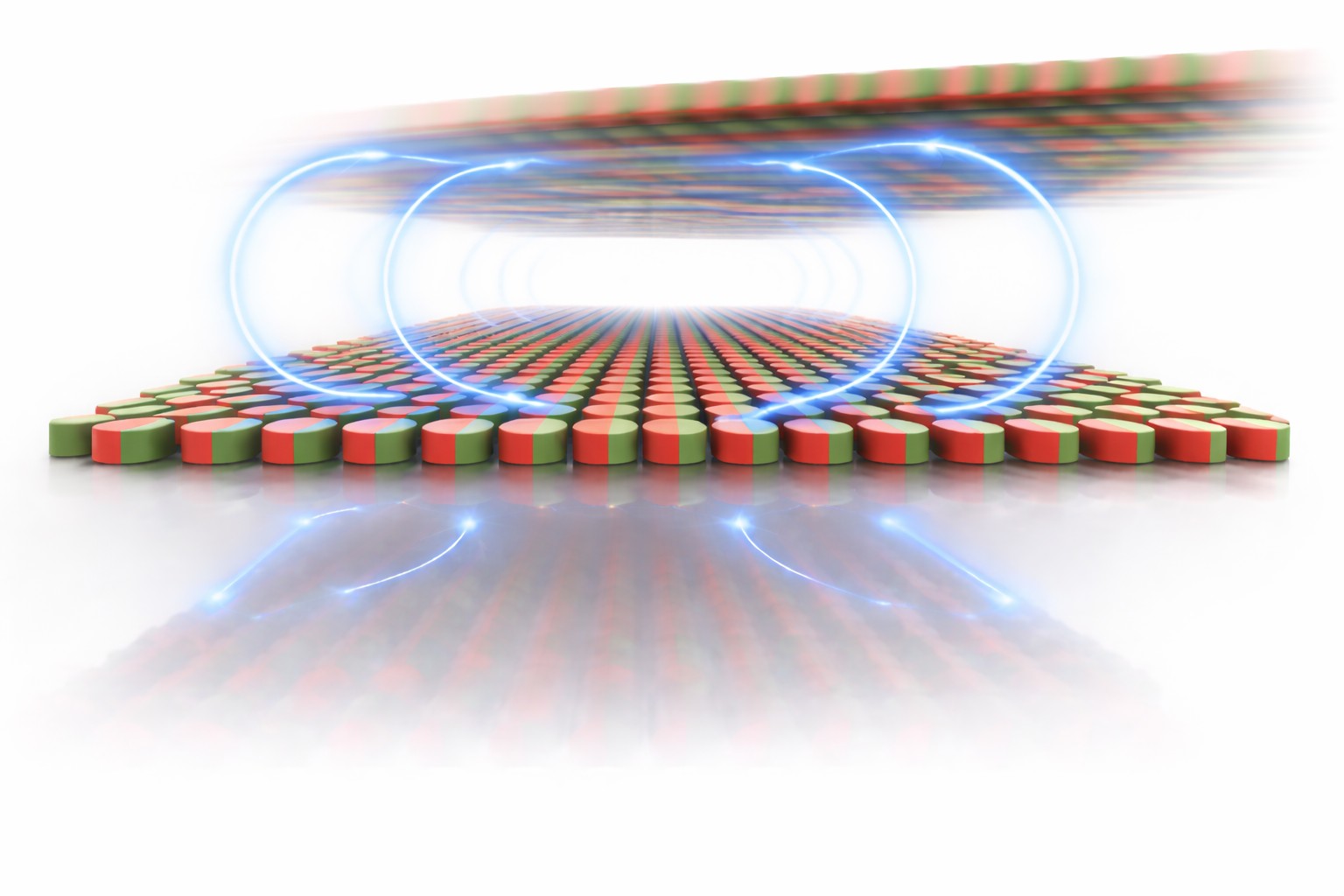
To explore these effects in more detail, Bechinger’s team developed a new experimental platform that moves beyond the constraints of conventional techniques. Instead of applying a load directly, they varied the interaction strength between two extended magnetic surfaces by precisely controlling their separation distance.
Monitoring magnetization
“Using millimetre-sized rotatable magnets, this allowed us to directly monitor the orientations of their magnetization during sliding, and to correlate these changes quantitatively with the measured friction force,” Bechinger explains.
As the surfaces were brought closer together, the researchers observed that friction initially rose, in line with the expectations of Amontons’ law. However, this trend did not continue indefinitely: at an intermediate separation distance, friction reached a maximum.
An illuminating, if imperfect, celebration of friction

“A peak occurs when competing magnetic interactions drive the system into a frustrated state,” Bechinger continues. “This causes repeated, hysteretic switching of magnetic orientations during sliding, which strongly enhances energy dissipation.”
Beyond this point, the effect was weakened by further decreases in separation distance, and friction dropped sharply: a clear departure from the monotonic behaviour predicted by Amonton’s law.
Altogether, the team’s findings show that friction can arise entirely from the internal collective dynamics of the material, rather than from direct mechanical contact alone. As Bechinger explains, the ability to tune these effects could open up new technological possibilities.
“This opens up new possibilities for designing wear-free, contactless frictional systems and suggests that friction itself can serve as a sensitive probe of microscopic ordering,” he says. “Potential applications could range from magnetic sensing to programmable metamaterials.”
The research is described in Nature Materials.