Many-body physics is the study of large ensembles of interacting particles and their collective behaviour. These systems are notoriously difficult to simulate, yet they underpin phenomena such as superconductivity and superfluidity. Thus, they are of great interest to understand. As a many-body physicist myself, I arrived at my first American Physical Society (APS) meeting with a different curiosity: understanding what the largest physics conference in the world was all about.
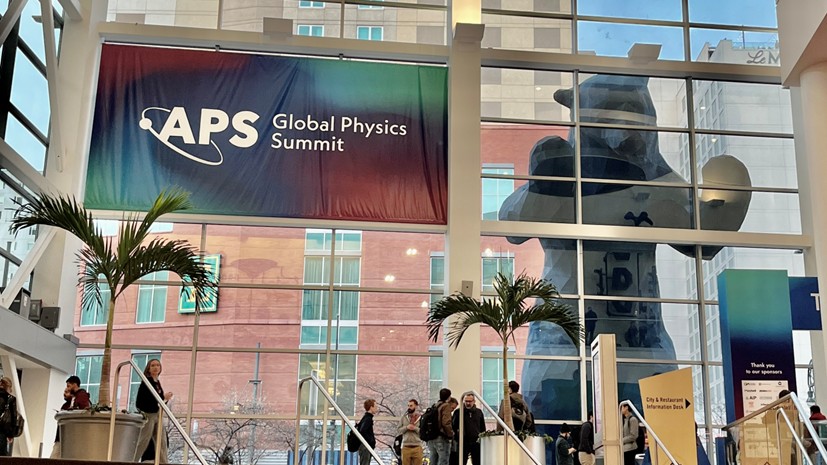
Last week, I joined a crowd of 14,000 scientists convening in Denver, Colorado for the annual Global Physics Summit, hosted by the APS.
On Sunday morning, the day before the conference, I walked alone through the streets of downtown Denver. Silence filled the frigid air. A light flurry of snow covered the empty streets in white. It seemed that the city was still asleep.
But Denver was abruptly awakened on Monday morning, as I found myself well-accompanied by the crowd collectively moving towards the Colorado Convention Center for an 8 am start. Inside, the conference was humming with its own emergent dynamics, with lines forming around coffee stations and people bustling to find their way to wherever they were going.
Throughout the day, I was faced with the repeated indecision of choosing between over 80 simultaneous sessions. Some sessions housed APS’s infamous blitz talks with speakers racing to pack as many graphs and equations into their allotted 10 min. Having barely enough time to write down the takeaways, I tried, often in vain, to fill my memory as quickly as possible.
Other sessions featured longer talks on hot topics in physics. By evening, my mind was swimming with notions of scalable quantum computing and physics funding issues and public engagement opportunities and the infiltration of AI slop into every corner of the scientific process. These sessions offered me a necessary reminder that science is not performed in a vacuum. With that said, the purely technical sessions on ultracold atomic gases served as a necessary reprieve for me that day.
Ultracold atoms, cooled to only a fraction of a degree above absolute zero, provide physicists with a clean and controllable platform for studying quantum many-body physics. At its heart, this physics is governed by interparticle correlations.
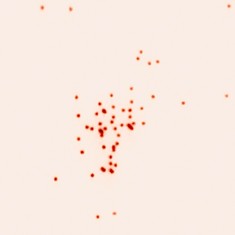
During my PhD, we measured two-body correlations and observed bosons spatially bunching together—unlike their antisocial fermionic counterparts. While the stereotypical physicist may be notoriously antisocial, the APS lanyard seemed to overturn that reputation.
Over dinner one evening, I requested a table for one. Only a moment later, I was joined by a physicist I’d never met before, and the evening unfolded behind pleasant chatter of 2D materials and the lack of vegetables in our travel diets.
Two tables down sat a professor whose work I admired. I’ll admit that I embarrassingly (or, more favourably, courageously) walked to the washroom so that I could pass by his table and say hello. I had met him once last year, but he didn’t remember me. So, I kept talking until he agreed that he remembered, and that it was nice to run into each other again. Whether true or not, I accepted it as a win. Without an APS lanyard, I probably would have avoided that conversation.
Single-atom resolution
On Thursday, a session titled “Novel imaging and quantum sensing technologies” caught my eye since I work with a quantum gas microscope. The microscope is a high-magnification imaging system that affords us the resolution of individual atoms. The microscopic information is far richer than what is obtained by a bulk imaging technique such as absorption.
Similarly, at the conference, I found the greatest value in individual conversations. Conversing with employees at the career fair, though exhausting, was far more effective than listening to panels on how to plan for careers that I couldn’t decide if I wanted.
Is ‘vibe physics’ the future?
By the end of the week, I started to recognize people I had already met over the few days prior. I saw every reunion or simple “oh! hi” as miraculous rather than a given, based on the size of the conference. People shared with me their personal journeys navigating the hardships and uncertainties of today’s world, others about the trade-offs and uncertainties in their experimental results. Some of the most fulfilling and deeply human conversations were the spontaneous ones that arose outside the doors of sessions that we had meant to be in.
When Friday rolled around, the city emptied as quickly as it had filled. For me, I retreated into the sunny Boulder mountains, mulling over the lingering resolution of singular people whose shared words and ideas were now intertwined with my own. Ignoring my fear of getting lost, I followed my instincts deeper into the dry heat of the afternoon, one step at a time.