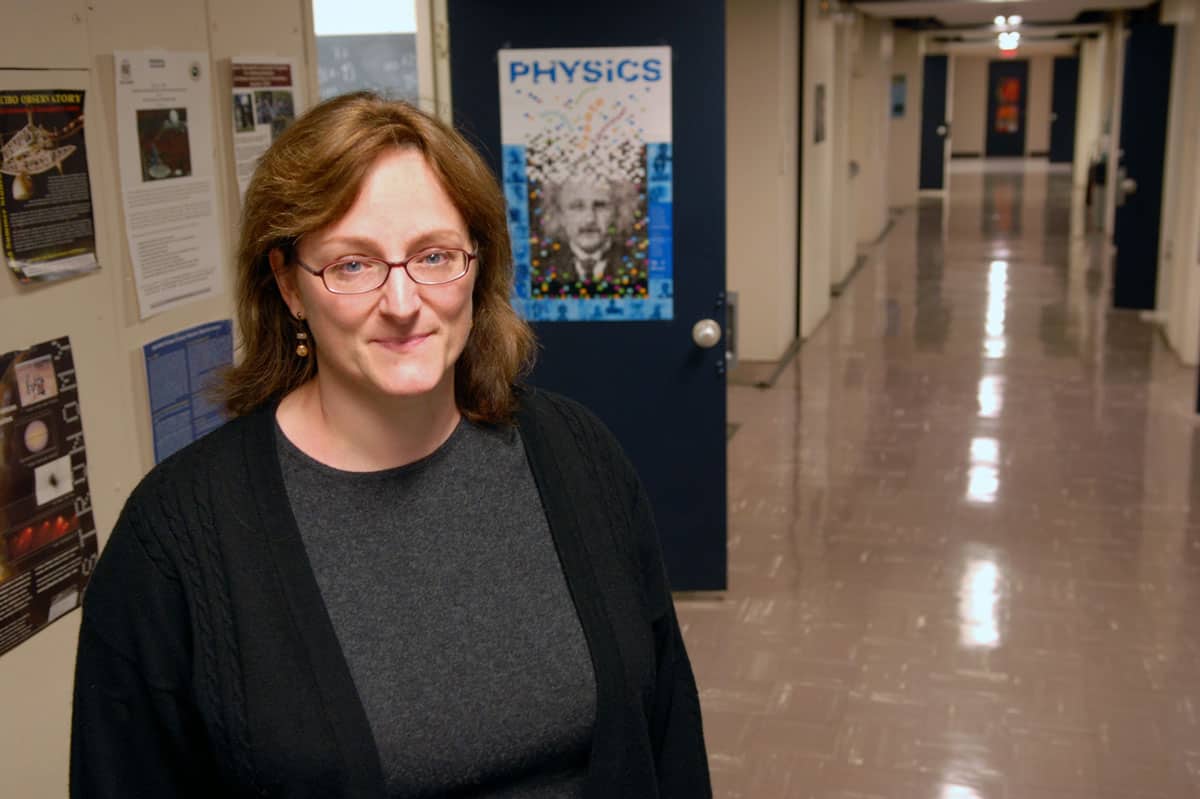
Margaret Harris speaks to Meg Urry – a veteran of the fight for equal opportunities for women in science, who is now turning her attention to an even bigger problem
Two decades ago, the US physics and astronomy communities looked pretty similar: about 10% of faculty members were female, and almost everyone was white. Since then, the picture has changed – but only in astronomy, and only for women, who now make up around 15% of tenured faculty and, by some estimates, nearly 40% of new hires in US astronomy departments. Physics, meanwhile, is stuck at around 10%, and in both fields the figures for under-represented minorities have barely budged.
This asymmetric pattern of change is both troubling and galvanizing for Meg Urry, the Yale University astrophysicist and incoming president of the American Astronomical Society (AAS). Following her election in February this year, Urry – a longtime advocate for women in science – announced that increasing participation among minorities would be a major goal of her presidency. “In the past two decades we’ve seen a revolution in the participation of women in astronomy,” she wrote. “We have yet to see comparable gains in the participation of under-represented minorities, or the sense among all members that they are fully welcome. This has been a priority for the AAS for some time, and I intend to add my voice to this issue.”
Urry’s voice matters not only because of her role in astronomy’s gender “revolution” but also because of her status as a researcher. Until recently, she was the chair of Yale’s physics department, having become its first ever tenured female faculty member when she was hired in 2001. Before that, she spent 14 years at the Space Telescope Science Institute (STScI) in Maryland, US, where her achievements included a study of active galactic nuclei that has been cited nearly 2000 times.
Urry’s scientific accomplishments have boosted what she calls her “second career” as a proponent of women’s participation in science. This career began in earnest in 1992, when Urry and an STScI colleague, Laura Danly, organized the first Women in Astronomy conference. One outcome of it was the Baltimore Charter, which identified problems such as sexual harassment and discriminatory hiring in astronomy and recommended ways of addressing them. But the conference also did something that Urry believes was even more important: it brought 150 women astronomers together in the same room. “We all were looking around and going, ‘Oh my God, I didn’t realize there were so many!’,” she recalls. “It created networks, it created a sense that we were well beyond critical mass and I think all those things combined to create a community where everyone lifted everyone else.”
Fixing the leaky pipe
Urry acknowledges that boosting the participation of minorities in physics and astronomy is “a slightly different problem”. One reason is that whereas women are under-represented in these fields by “factors of a few”, for some minority groups, she says, “it’s an order of magnitude problem”. African-Americans and Latinos, for example, receive fewer than 3% of the physics PhDs awarded in the US each year despite making up almost 30% of the population. Being part of such a small group can be isolating, says Hakeem Oluseyi, an astrophysicist at the Florida Institute of Technology and an officer of the National Society of Black Physicists. “You feel like your entire race is going to be judged on your behaviour,” he says. To combat that perception, Oluseyi adds, “You need a critical mass. If you accept students one or two at a time, you’ll have people dropping out.”
Efforts to achieve critical mass often focus on the education “pipeline” that takes students from secondary school up to PhD level. Jenni Dyer, who leads the diversity programme at the Institute of Physics, which publishes Physics World, says that in the UK, the percentage of black science students is extremely low even at secondary school. For that reason, she says, her team concentrates on getting students interested early in their education. But in the US, Urry says, the pipeline for African-Americans and Latinos also has a significant “leak” at the end of their undergraduate years, since many aspiring minority scientists attend poorly funded (often formerly all-black) institutions that do not prepare them well for postgraduate study. Oluseyi, who graduated from Mississippi’s historically black Tougaloo College, recalls that he faced a steep learning curve when he went to Stanford University for his PhD. He credits his success in part to his African-American PhD supervisor, the late Art Walker, and to a Stanford programme that accepted students like him and let them catch up by taking advanced undergraduate courses.
By excluding people from physics we have dumbed it down
Supporting programmes like that might be one way for the AAS to help boost minority participation, Urry speculates. But whichever part of the pipeline she decides to tackle, she believes that fixing the leaks is vital. “Personally, I am driven by the issue of justice and fairness,” she says. “But there is also no evidence whatsoever to believe that women or people of colour or gay people or handicapped people are less competent at physics. So, on the assumption that everyone has a similar distribution of ability, by excluding these people from the profession we have dumbed it down.” And that, Urry concludes, is “something that in the modern day, when so many problems are technical and scientific in nature, we just can’t afford to do”.