
“God does not play dice.”
With this famous remark at the 1927 Solvay Conference, Albert Einstein set the tone for one of physics’ most enduring debates. At the heart of his dispute with Niels Bohr lay a question that continues to shape the foundations of physics: does the apparently probabilistic nature of quantum mechanics reflect something fundamental, or is it simply due to lack of information about some “hidden variables” of the system that we cannot access?
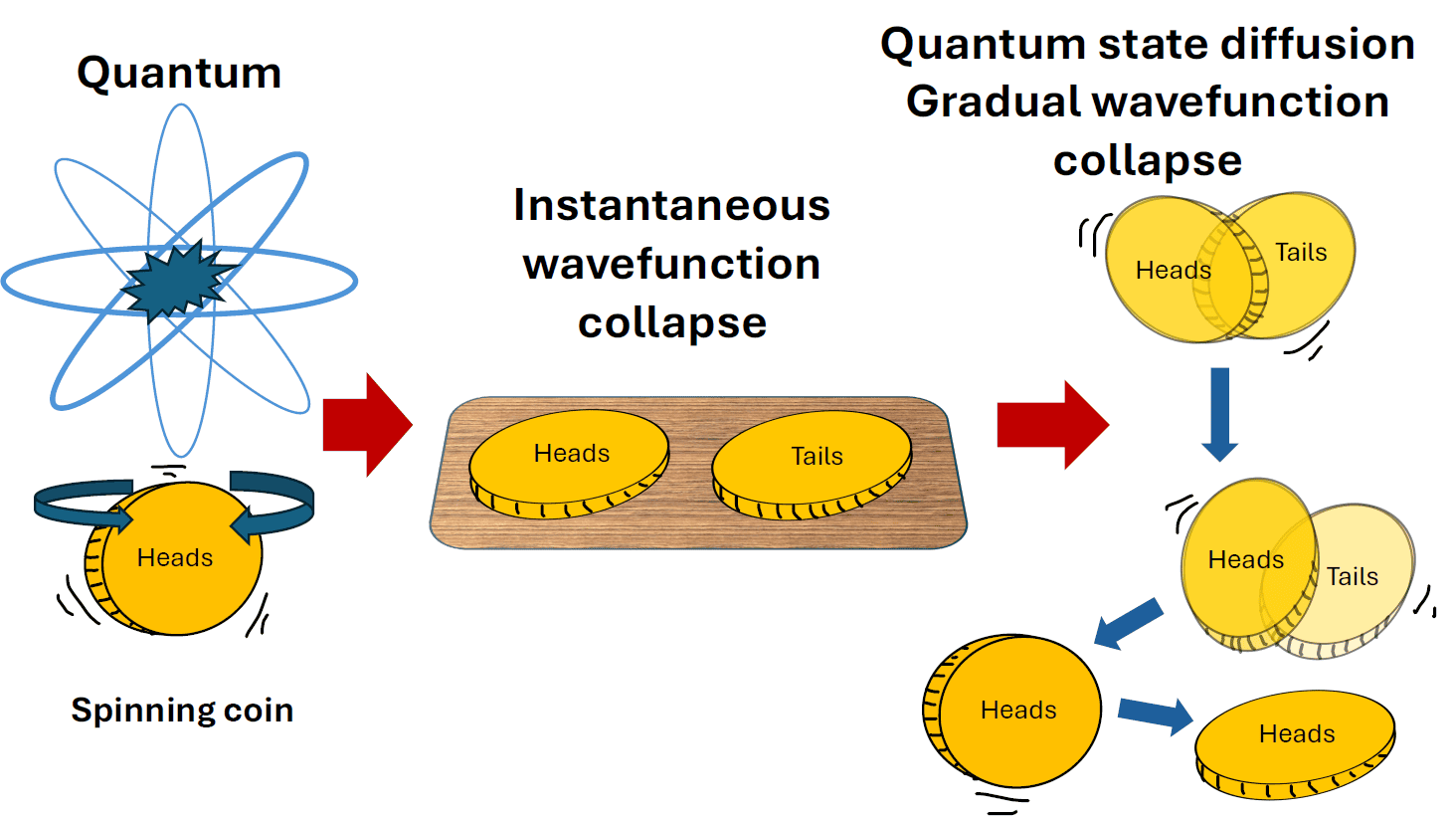
Physicists at University College London, UK (UCL) have now addressed this question via the concept of quantum state diffusion (QSD). In QSD, the wavefunction does not collapse abruptly. Instead, wavefunction collapse is modelled as a continuous interaction with the environment that causes the system to evolve gradually toward a definite state, restoring some degree of intuition to the counterintuitive quantum world.
A quantum coin toss
To appreciate the distinction (and the advantages it might bring), imagine tossing a coin. While the coin is spinning in midair, it is neither fully heads nor fully tails – its state represents a blend of both possibilities. This mirrors a quantum system in superposition.
When the coin eventually lands, the uncertainty disappears and we obtain a definite outcome. In quantum terms, this corresponds to wavefunction collapse: the superposition resolves into a single state upon measurement.
In the standard interpretation of quantum mechanics, wavefunction collapse is considered instantaneous. However, this abrupt transition is challenging from a thermodynamic perspective because uncertainty is closely tied to entropy. Before measurement, a system in superposition carries maximal uncertainty, and thus maximum entropy. After collapse, the outcome is definite and our uncertainty about the system is reduced, thereby reducing the entropy.
This apparent reduction in entropy immediately raises a deeper question. If the system suddenly becomes more ordered at the moment of measurement, where does the “missing” entropy go?
From instant jumps to continuous flows
Returning to the coin analogy, imagine that instead of landing cleanly and instantly revealing heads or tails, the coin wobbles, leans, slows and gradually settles onto one face. The outcome is the same, but the transition is continuous rather than abrupt.
This gradual settling captures the essence of QSD. Instead of an instantaneous “collapse”, the quantum state unfolds continuously over time. This makes it possible to track various parameters of thermodynamic change, including a quantity called environmental stochastic entropy production that measures how irreversible the process is.
Another benefit is that whereas standard projective measurements describe an abrupt “yes/no” outcome, QSD models a broader class of generalized or “weak” measurements, revealing the subtle ways quantum systems evolve. It also allows physicists to follow individual trajectories rather than just average outcomes, uncovering details that the standard framework smooths over.
“The QSD framework helps us understand how unpredictable environmental influences affect quantum systems,” explains Sophia Walls, a PhD student at UCL and the first author of a paper in Physical Review A on the research. Environmental noise, Walls adds, is particularly important for quantum technologies, making the study’s insights valuable for quantum error correction, control protocols and feedback mechanisms.
Bridging determinism and probability
At first glance, QSD might seem to resemble decoherence, which also arises from system–environment interactions such as noise. But the two differ in scope. “Decoherence explains how a system becomes a classical mixed state,” Walls clarifies, “but not how it ultimately purifies into a single eigenstate.” QSD, with its stochastic term, describes this final purification – the point where the coin’s faint shimmer sharpens into heads or tails.
In this view, measurement is not a single act but a continuous, entropy-producing flow of information between system and environment – a process that gradually results in manifestation of one of the possible quantum states, rather than an abrupt “collapse”.
“Standard quantum mechanics separates two kinds of dynamics – the deterministic Schrödinger evolution and the probabilistic, instantaneous collapse,” Walls notes. “QSD connects both in a single dynamical equation, offering a more unified description of measurement.”
Entangled entities: Bohr, Einstein and the battle over quantum fundamentals

This continuous evolution makes otherwise intractable quantities, such as entropy production, measurable and meaningful. It also breathes life into the wavefunction itself. By simulating individual realizations, QSD distinguishes between two seemingly identical mixed states: one genuinely entangled with its environment, and another that simply represents our ignorance. Only in the first case does the system dynamically evolve – a distinction invisible in the orthodox picture.
A window on quantum gravity?
Could this diffusion-based framework also illuminate other fundamental questions beyond the nature of measurement? Walls thinks it’s possible. Recent work suggests that stochastic processes could provide experimental clues about how gravity behaves at the quantum scale. QSD may one day offer a way to formalize or test such ideas. “If the nature of quantum gravity can be studied through a diffusive or stochastic process, then QSD would be a relevant framework to explore it,” Walls says.