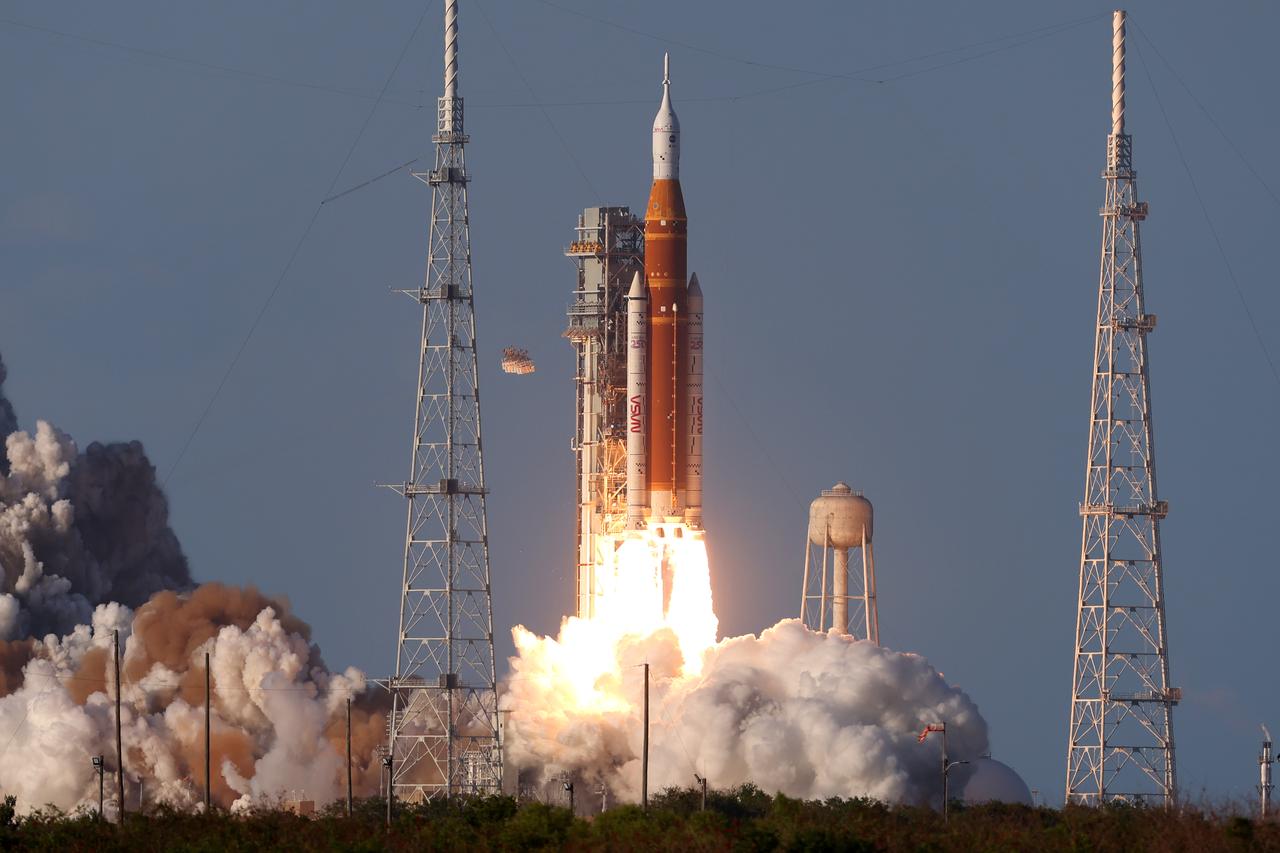
NASA has successfully launched four astronauts on a 10-day mission to the Moon. The crew – Reid Wiseman, Victor Glover, Christina Koch and Jeremy Hansen – were aboard the Orion spacecraft that was launched yesterday by a Space Launch System rocket from NASA’s Kennedy Space Center in Florida.
The mission is the first crewed lunar flyby in more than 50 years but it also represents a number of significant firsts with Koch, Glover and Hansen set to be the first woman, Black person and Canadian, respectively, to travel to the Moon.
Following launch, the Orion capsule was put into Earth orbit and after five hours into the flight, the craft deployed four CubeSats – from Argentina’s Comisión Nacional de Actividades Espaciales; the German Aerospace Center; the Korea AeroSpace Administration; and the Saudi Space Agency – that will conduct scientific investigations and technology demonstrations.
The craft is now set to carry out a six-minute rocket firing that will send the spacecraft towards the Moon.
During a lunar flyby on 6 April, the astronauts will take photographs and provide observations of the Moon’s surface being the first people to see some areas of the far side. NASA’s new rocket successfully fires Orion capsule towards the Moon
Some four days later, the craft will then return to Earth and splash down in the Pacific Ocean.
This mission follows the Artemis I mission, which carried a simulated crew of three mannequins wired with sensors, that completed a flyby of the Moon in 2022.
Artemis III, meanwhile, is currently ear-marked for launch in 2027, planning to be the first crewed lunar landing since the Apollo missions in the 1960s and 70s.
Will the Artemis programme instil the same sense of awe as the Apollo missions?
In the summer of 1969 I was four years old and I have a very distinct memory of my mother calling me and my brother in from the garden to watch something on television. That something had to do with NASA’s Apollo 11 mission to the Moon.
For years, I thought that I had watched Neil Armstrong take his first steps on the Moon on live TV. I now realize that the timing was all wrong. I was in Montreal and it was daytime – whereas the walk occurred at about 11 p.m. EDT, well after my bedtime. So I was (probably) not one of the estimated 500 million people worldwide (including Pope Paul VI) who witnessed this momentous event as it happened.
Regardless of whether I watched it live or not, the first human steps on the Moon made a great impression on me – and who knows, maybe that early exposure to the cutting edge of science and technology encouraged me to pursue a career in physics.
I could be wrong, but I don’t think that the Artemis missions will instil the same awe in people as did the Apollo missions. I didn’t watch the Artemis II launch and I had a distinctly “been there, done that” feeling when I heard about its success.
Indeed, I have been left wondering exactly why the US has decided to return to the Moon now. Is it for reasons of science and exploration (possibly setting the scene for a human mission to Mars), or is this more about nationalism and colonialization? I hope it is the former, because for me sending humans to the Moon and beyond is akin to blue-sky research in physics – probing the universe to expand knowledge, with the confidence that this will result in a better world.
Hamish Johnston is an online editor of Physics World