Hamish Johnston speaks to cosmologist Neil Turok, who wants to change how advanced scientific training is done worldwide, and believes that Africa can play a vital role in shifting entrenched views
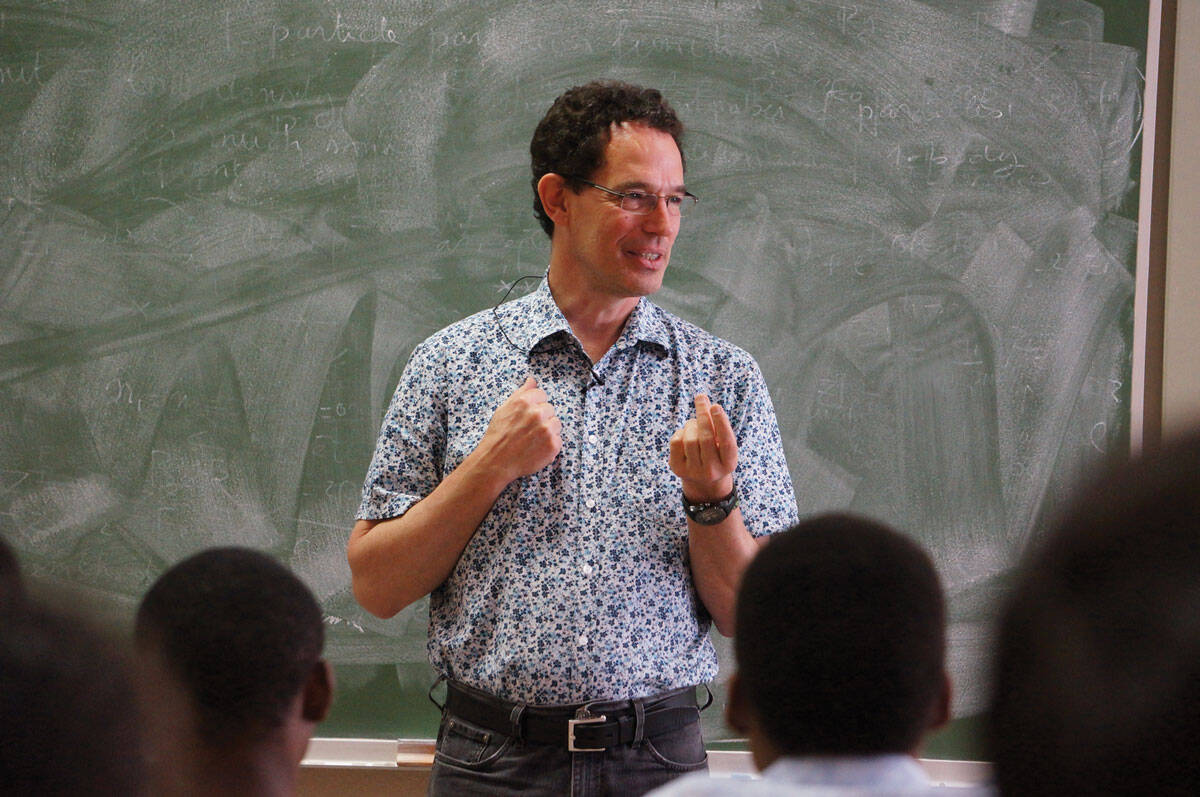
For the cosmologist Neil Turok, Africa represents “the world’s greatest untapped pool of scientific and technical talent”. He should know: the director of Canada’s Perimeter Institute for Theoretical Physics was born in South Africa, and credits his political-activist parents with giving him a “very strong sense of commitment and obligation” to improving education for people across the continent. Indeed, Turok’s parents convinced him to found the African Institute for Mathematical Sciences (AIMS), which has trained some 460 postgraduates in advanced mathematics since its inception in 2003.
Each year, AIMS brings 50–60 postgraduates from more than two dozen African countries to its campuses in South Africa, Ghana and Senegal to learn how mathematics can be used to solve scientific problems. The year-long MSc programme begins by boosting students’ skills and filling in the sometimes huge gaps in their previous education. “These are bright people but they have not always been through good universities,” Turok explains, adding that AIMS seeks to “shock” students out of what he calls an “undergraduate way of thinking”.
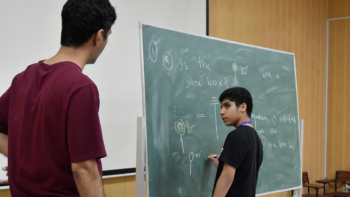
Rather than sitting through conventional lectures, AIMS students learn to think on their feet. This is not easy, Turok says, with some students becoming “very unhappy” and questioning why they are there. “But after about two months, they get it – ‘this is about me thinking’,” he says.
AIMS students are also exposed to a wide range of cutting-edge research via three-week survey courses. The idea is to help students make an informed decision about topics they want to pursue in their PhDs.
Morenikeji Deborah Akinlotan from Nigeria is about to embark on a PhD in biomathematics because of her experience at AIMS: “I discovered that mathematics is not only extremely useful in all spheres of life, but also that I can actually apply mathematics in medical-related projects.”
Of course, African students are not the only ones who need to shed their “undergraduate thinking” and Turok believes that every university in the world ought to run similar year-long programmes. He argues that they let students think about what they want to specialize in rather than just plunging into a PhD. Governments have also become short-sighted, he adds, concentrating only on economically relevant science and engineering. “The focus should be on developing students as independent and innovative thinkers – that is the most valuable thing a university can do.”
Africa is the ideal place to reinvent advanced education
“My experience in founding AIMS has convinced me that Africa is the ideal place to reinvent advanced education. The students are more motivated than anywhere else because they have such adversity in their lives. They are also more diverse, and the energy you get from students in Africa is quite extraordinary.” When Turok arrived at the Perimeter Institute in 2008 he set up the Perimeter Scholars International MSc programme, which, much like AIMS, exposes students to a wide range of theoretical physics.
Turok says that although AIMS is only a decade old, it has already benefited Africa. While about 30% of its alumni have chosen to pursue further study or careers outside of Africa, others are taking leading academic, industrial and government roles across the continent and all have made a strong commitment to contribute to its prosperity. The institute is also expanding, with new facilities planned for Cameroon, Tanzania and Benin.
So far, AIMS has succeeded in attracting both funding and volunteer lecturers. However, Turok believes that AIMS’s ultimate success will be in changing cultural attitudes about Africa. Before AIMS was established, he says, “the international development community had overlooked advanced training in Africa, mostly focusing on primary school”. But Turok thinks it is vital to have people in government who can think for themselves and plan and structure an economy. “Above all, you need role models,” he says. “You have to create a situation where the brightest African students are succeeding in higher education and getting advanced degrees.”
Trust Chibawara, who is from Zimbabwe and attended AIMS in 2007, was one such student. “I was far better equipped for making my future decisions after AIMS,”he says. “AIMS taught me, most importantly, that I can learn, that I can attempt anything I put my mind to and be very successful.”
In 2008 Turok said that he wanted the next Einstein to be African, and the goal of creating 15 campuses across the continent is an important part of the AIMS Next Einstein Initiative. “Theoretical physics has always been the pinnacle of human achievement and seeing Africans do theoretical physics will do much to undermine racism,” he says. “An individual can do incredible things.”