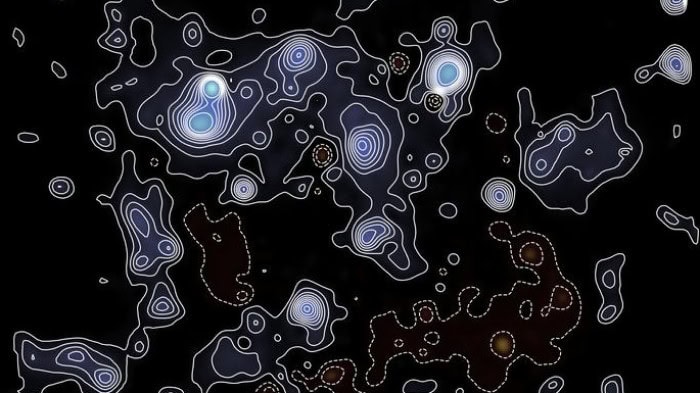
Astronomers have created the most detailed map to date of the vast structures of dark matter that appear to permeate the universe. Using the James Webb Space Telescope (JWST), the team, led by Diana Scognamiglio at NASA’s Jet Propulsion Laboratory, used gravitational lensing to map the dark matter filaments and clusters with unprecedented resolution. As a result, physicists have new and robust data to test theories of dark matter.
Dark matter is a hypothetical substance that appears to account for about 85% of the mass in universe – yet it has never been observed directly. Dark matter is invoked by physicists to explain the dynamics and evolution of large scale structures in the universe. This includes the gravitational formation of galaxy clusters and the cosmic filaments connecting them over 100-million-light–year distances.
Light from very distant objects beyond these structures is deflected by the gravitational tug of dark matter within the clusters and filaments. This can be observed on Earth as the gravitational lensing of these distant objects. This distorts images of the distant objects and affects their observed brightness. These effects can be used to determine the dark-matter content of the clusters and filaments.
In 2007, the Cosmic Evolution Survey (COSMOS) used the Hubble Space Telescope to create a map of cosmic filaments in an area of the sky about nine times larger than that occupied by the Moon.
“The COSMOS field was published by Richard Massey and my advisor, Jason Rhodes,” Scognamiglio recounts. “It has a special place in the history of dark-matter mapping, with the first wide-area map of space-based weak lensing mass.”
However, Hubble’s limited resolution meant that many smaller-scale features remained invisible in COSMOS. In a new survey called COSMOS-Web, Scognamiglio’s team harnessed the vastly improved imaging capabilities of the JWST, which offers over twice the resolution of its predecessor.
Sharp and sensitive
“We used JWST’s exceptional sharpness and sensitivity to measure the shapes of many more faint, distant galaxies in the COSMOS-Web field – the central part of the original COSMOS field,” Scognamiglio describes. “This allowed us to push weak gravitational lensing into a new regime, producing a much sharper and more detailed mass map over a contiguous area.”
With these improvements, the team could measure the shapes of 129 galaxies per square arcminute in an area of sky the size of 2.5 full moons. With thorough mathematical analysis, they could then identify which of these galaxies had been distorted by dark-matter lensing.
“The map revealed fine structure in the cosmic web, including filaments and mass concentrations that were not visible in previous space-based maps,” Scognamiglio says.
Peak star formation
The map allowed the team to identify lensing structures out to distances of roughly 5 billion light–years, corresponding to the universe’s peak era of star formation. Beyond this point, galaxies became too sparse and dim for their shapes to be measured reliably, placing a new limit on the COSMOS-Web map’s resolution.
Light from the cosmic web maps filaments across millions of light-years
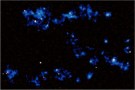
With this unprecedented resolution, the team could also identify features as small as the dark matter halos encircling small clusters of galaxies, which were invisible in the original COSMOS survey. The astronomers hope their result will set a new, higher-resolution benchmark for future studies using JWST’s observations to probe the elusive nature of dark matter, and its intrinsic connection with the formation and evolution of the universe’s largest structures.
“It also sets the stage for current and future missions like ESA’s Euclid and NASA’s Nancy Grace Roman Space Telescope, which will extend similar dark matter mapping techniques to much larger areas of the sky,” Scognamiglio says.
The observations are described in Nature Astronomy.