One of my favourite books about physics is The Second Kind of Impossible: the Extraordinary Quest for a New Form of Matter by Paul Steinhardt. It chronicles how the physicist and his colleagues established the extra-terrestrial provenance of a mysterious quasicrystal sample and then trekked to its likely place of origin in the Siberian wilderness.
That sample was first identified by the Italian geologist Luca Bindi, who features throughout the book and specializes in the discovery of new minerals. I was delighted to see that Bindi has a new paper out that identifies a hitherto unknown material. That excitement was tempered by the fact that the alloy was created by the catastrophic nuclear explosion over the Japanese city of Hiroshima.
On this day in 1945, an atomic bomb was detonated at 580 m over the city, creating a fireball where temperatures exceeded 7000 °C. As many as 140,000 people were killed by the bomb, which destroyed about 70% of the city’s buildings.
Rapid condensation
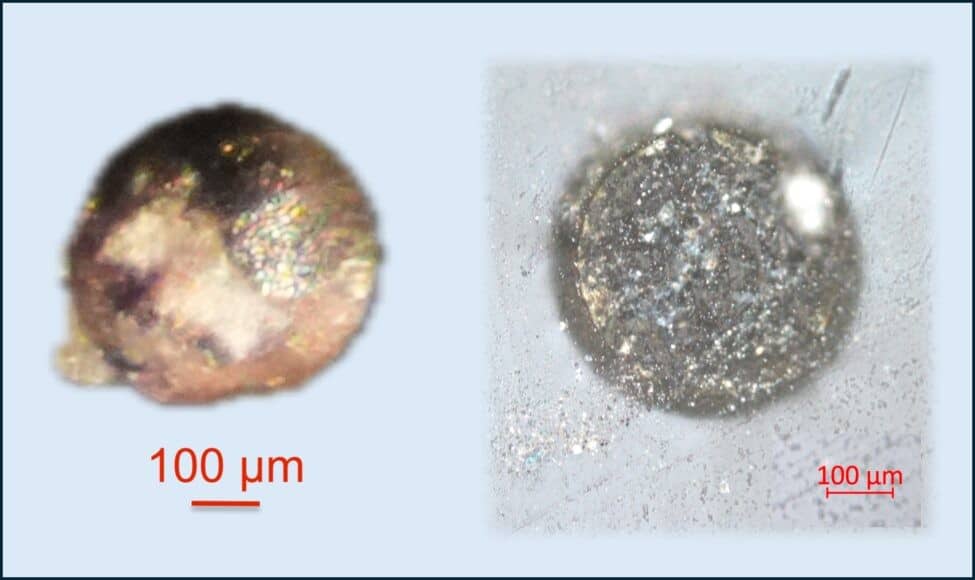
The fireball was a turbulent plasma of vapourized material from the city. This included building materials, metals, soil, water and, we mustn’t forget, some of the city’s residents. The plasma condensed rapidly creating glassy particles of micron–millimetre size that rained down on the Hiroshima area. These “hiroshimaite” particles mostly comprise of calcium, aluminium and silicon and can be found in the sandy beaches of Hiroshima Bay.
“The fireball left behind materials that never existed before,” says Bindi – who is based at the University of Florence. He adds that these hiroshimaites are helping scientists understand how matter behaves under extreme conditions – describing the fireball as a “giant accidental material-science laboratory”.
Unusual structure
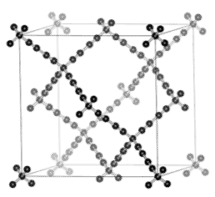
In this latest study, Bindi and colleagues in Italy, the US and Switzerland have identified a new metal alloy in a piece of hiroshimaite. The metallic grain is about one micron in size and is a homogenous mixture of six metals and silicon. X-ray diffraction shows that the alloy has an unusual crystal structure. This, along with the alloy’s high silicon content, make it a special material that has never been seen before.
Kamchatka or bust: Paul Steinhardt’s quest for quasicrystals from outer space

According to Bindi, the alloy was formed by the condensation of a complex metallic vapour that was created by a range of materials that were caught up in the nuclear fireball. As the fireball cooled rapidy, a tiny droplet of metals and silicon condensed from the plasma. Then as the temperature dropped at an extraordinary rate, the droplet solidified and its metastable crystal structure was frozen in. This violent quenching prevented the alloy from evolving to a more common crystal structure.
This is not the first time that Bindi has found a new material in the debris of a nuclear explosion. A few years ago his was part of a team that discovered a quasicrystal in a piece of trinitite – glassy material that was created in July 1945 by the Trinity nuclear bomb test in New Mexico.
Bindi and colleagues report their results in Science Advances.