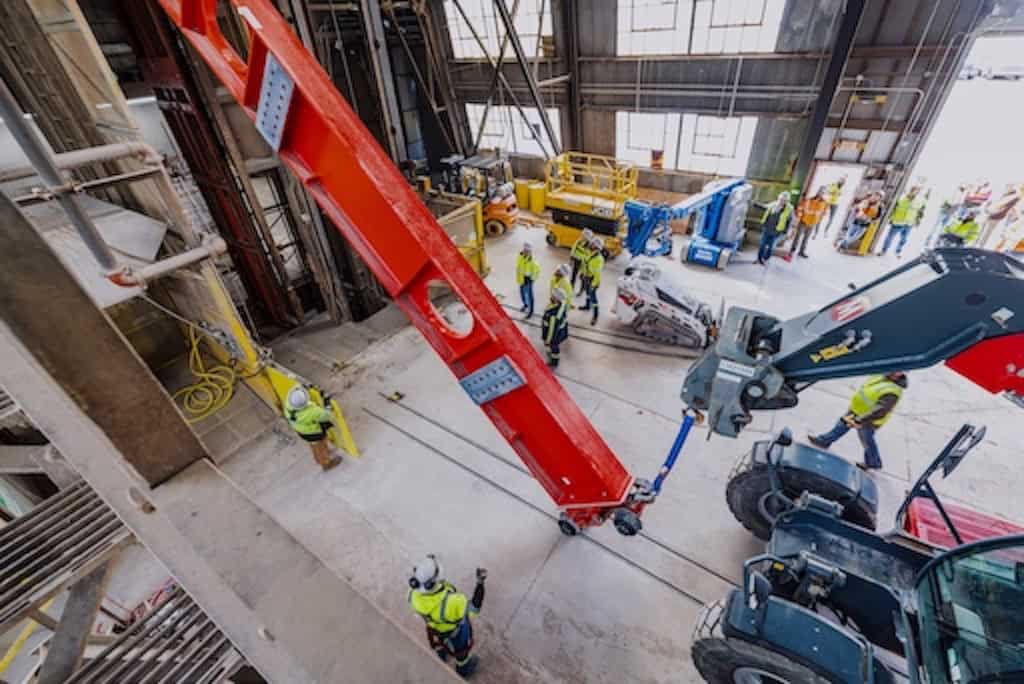
A vast complex of steel beams for a next-generation neutrino detector has begun its descent underground in what officials have called a “pivotal phase” towards construction of the $3.3bn Deep Underground Neutrino Experiment-Long-Baseline Neutrino Facility (DUNE-LBNF).
An event was held yesterday – attended by senior officials including CERN director-general Mark Thomson and Dario Gil, undersecretary for science at the US Department of Energy (DOE) – to commemorate the start of moving 4.5 million kilograms of steel beams underground that will be used to hold DUNE’s detectors in place.
In February 2024, excavation work finished on two huge underground spaces for DUNE. Located 1.6 km underground at the Sanford Underground Research Facility in South Dakota and are some 150 m long and seven storeys tall, the spaces will be used to house DUNE’s four neutrino detector tanks that are each filled with 17,000 tonnes of liquid argon and cooled to 88 K.
When complete in 2031, DUNE-LBNF will study the properties of neutrinos in unprecedented detail, as well as the differences in behaviour between neutrinos and antineutrinos.
DUNE will measure the neutrinos that are generated by Fermilab’s accelerator complex, which lies around 1300 km away just outside Chicago.
The cryostat materials, which have been contributed by the CERN, are now scheduled to be moved underground and installed in the next few months.
“Today represents the start of a pivotal phase for DUNE, the development of the far detector structures in South Dakota,” noted Fermilab director Norbert Holtkamp. “Our focus remains on safety, quality and schedule — in that order — to ensure we successfully deliver on behalf of the US Department of Energy, our nation and the world.”