Researchers in France have developed a novel method to investigate how pollen is dispersed from trees when the wind blows – paving the way for new approaches to urban planning that could help alleviate the symptoms of seasonal hay fever.
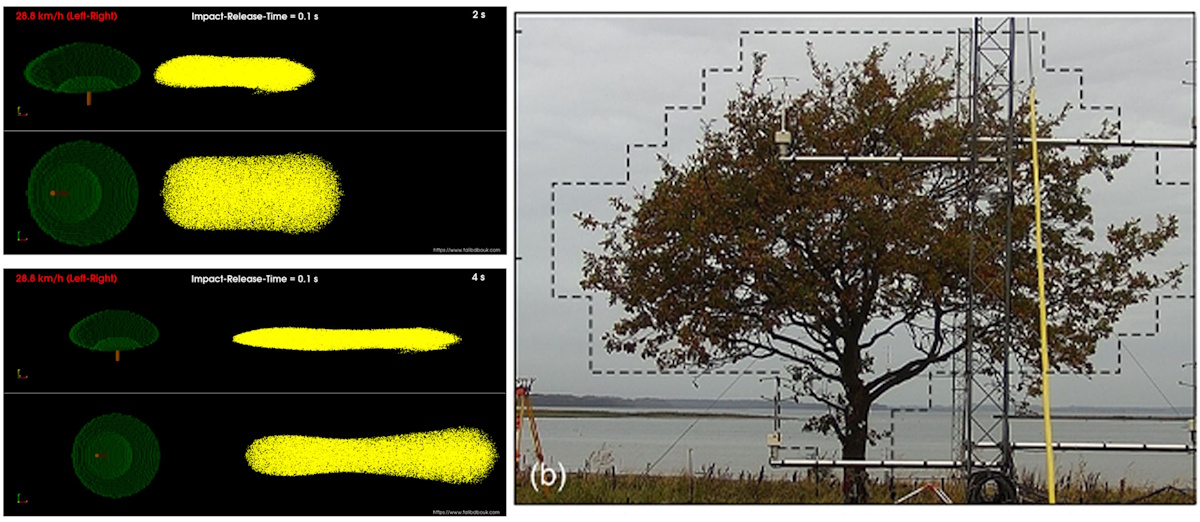
A project team headed up at the University of Rouen Normandy has discovered for the first time that different trees can exhibit different local dynamics for the transport of pollen grains – for example, when pollen is dispersed by wind – and that that this behaviour depends on the local detachment force of pollen grains occurring at the scale of each flower inside the tree.
As part of the project, outlined in the paper Flow and plants: On the dispersion of wind-induced tree pollen, published in Physics in Fluids, the researchers developed an innovative direct-forcing porous immersed boundary method (DF-PIBM) to explore the wind-driven pollen dispersion and transport phenomena from green trees.
“The research investigates, through advanced physics-based modelling and simulations, the impact of tree types and their interaction with wind on the local dispersion of pollen grains in the surrounding environment,” says lead author Talib Dbouk, a researcher in the CORIA Lab, CNRS, at the University of Rouen Normandy.
As Dbouk explains, the team’s approach involved the use of a range of advanced computational fluid dynamics (CFD) modelling and simulation techniques to solve the local air flow around and within the trees, taking into account the interaction between the air flow and the pollen grains in and/or on the tree flowers.
“The DF-PIBM is an advanced numerical technique developed in order to accurately solve the local resistance of a tree to wind by assuming the tree leaves lead to the fact that a tree can [act] as a porous medium, where the local porosity inside the tree will depend on its leaf area density,” he adds.
According to Dbouk, this method was “derived, implemented and validated in an in-house CFD code”, first by testing different flow configurations around and within porous spherical particles – and then by extending and applying it to different types and structures of trees.
A digital twin
In Dbouk’s view, the key advantage of using DF-PIBM compared with other approaches is that it allows researchers to accurately solve the local air flow velocity and the local pressure inside the tree.
“DF-PIBM has a number of current and potential applications – including prediction of the behaviour of airborne pollen grains and support for future applications involving vegetation–flow interactions in urban settings,” he says. “The currently developed DF-PIBM allows us to accurately predict all the phenomena of the detachment, dispersion, resuspension and local transport of airborne pollen grains when emitted from a green space – for example, trees and grass – and thus any vegetation zones inside urban environments under different weather conditions.”
Meanwhile, co-author Julien Reveillon confirms that the next steps for the research team will involve the integration of all its physics-based models into a new advanced digital twin of the Rouen-Normandy Metropolitan region in Normandy, France.
Organic aerosols from forests could help cool the planet

“This is with the intention of developing a new advanced multi-risk assessment digital platform that can help our local public authorities in their future territorial management and planning strategies – for example, to better anticipate and fight climate change phenomena, especially those related to local heat islands and aero-allergens like pollen, in addition to environmental pollution of air, water and soil,” he says.
“Moreover, huge efforts are also [being] made in order to develop and integrate advanced models related to predicting and simulating airborne pollutant particle dispersion in our region, for example those related to emissions from both natural fires and industrial accident fires,” co-author Béatrice Patte-Rouland tells Physics World.