Could a new pressure quenching technique help researchers move forward on the road to reaching room-temperature superconductivity? Researchers at the University of Houston are pinning their hopes on this approach and say they have already used it to achieve a record-high superconducting transition temperature (Tc) of 151 K at ambient pressure in a metastable phase of HgBa2Ca2Cu3O8+δ (or HBCCO) The phase remains stable for around at least three days when held at 77 K, although its Tc degrades when heated to above 200 K.
Achieving ambient-pressure room-temperature superconductivity remains the holy grail for scientists working in this field. This is because superconductors that work at ambient temperatures and pressures could revolutionize a host of application areas, including increasing the efficiency of electrical generators and transmission lines through lossless electricity transmission. They would also greatly simplify technologies such as magnetic resonance imaging (MRI) that rely on the generation or detection of magnetic fields.
While much progress has been made in the last decades, increasing the Tc often relies on squashing materials at extremely high pressure – usually in a device known as a diamond anvil cell (DAC). Some examples include the sulphide material H3S, which has a Tc of 203 K when compressed to pressures of 150 GPa and the cerium hydrides, CeH9 and CeH10, which boast high-temperature superconductivity at lower pressures of about 80 GPa with a Tc of around 100 K.
HBCCO is a high-temperature superconducting cuprate that has a Tc of 133 K at ambient pressure. This can be pushed to 164 K by applying a pressure of 31 GPa to it.
High-pressure-induced metastable superconducting phase
The high Tc of HBCCO is thought to come from the high electron density of states of a possible “van Hove singularity” associated with the two-dimensional CuO2 planes in it. In the new work, a team led by Ching-Wu Chu and Liangzi Deng of the Department of Physics and Texas Center for Superconductivity at the University of Houston decided to study a high-pressure-induced metastable superconducting phase in the material that they think might be able to form at ambient pressure as a result of this singularity (which leads to strong interactions between electrons) and/or other anomalies in the electronic energy spectrum.
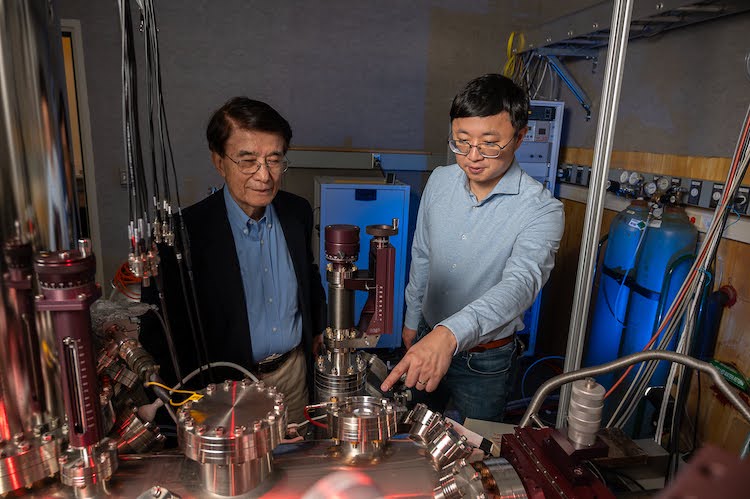
To investigate further, the researchers developed a pressure-quench protocol to stabilize this metastable phase at ambient pressure. Their process involves first identifying the target phase in a DAC under high pressures of between 10–30 GPa. Next, the material is quenched (that is, the pressure is rapidly removed) at 4.2 K.
Chu and Deng confirmed that they had indeed isolated this phase and not another using synchrotron X-ray diffraction (at the 16-ID-B beamline of the Advanced Photon Source) before removing it from the cell. These measurements also show that the pressure-quenched phase at ambient pressure retains its original crystal structure, but possibly contains defects, generated under pressure and during quenching. The researchers think that these defects might help preserve the metastable high- Tc phase.
Thanks to their technique, they say they have achieved a hitherto unreported ambient-pressure Tc of 151 K.
Tiny samples
The experiments were far from easy, however, they say. The samples were extremely small (around just 50–80 microns in size), so handling them in high-pressure experiments is inherently challenging, explains Chu. Another major difficulty was preventing the electrical leads used for the resistivity measurements from breaking during the pressure-quenching process. Recovering the samples after quenching for more detailed analyses at ambient pressures was technically demanding too.
Dark optical cavity alters superconductivity
Looking ahead, the researchers say they would now like to better understand where the high Tc in HBCCO comes from – both under pressure before quenching and at ambient pressure after quenching. “We would also like to elucidate the mechanisms that lock in the high Tc phase at ambient pressure after quenching,” says Chu.
The impact of the new work, which is detailed in PNAS, might even extend beyond superconductivity, adds Deng. “Indeed, our approach could allow us stabilize quantum metastable states at ambient pressure that have enhanced or unique properties that only emerge under pressures. Based on our experimental results, using theoretical modelling and AI-driven approaches, we would like to identify different types of quantum materials that are suitable for pressure quenching.”