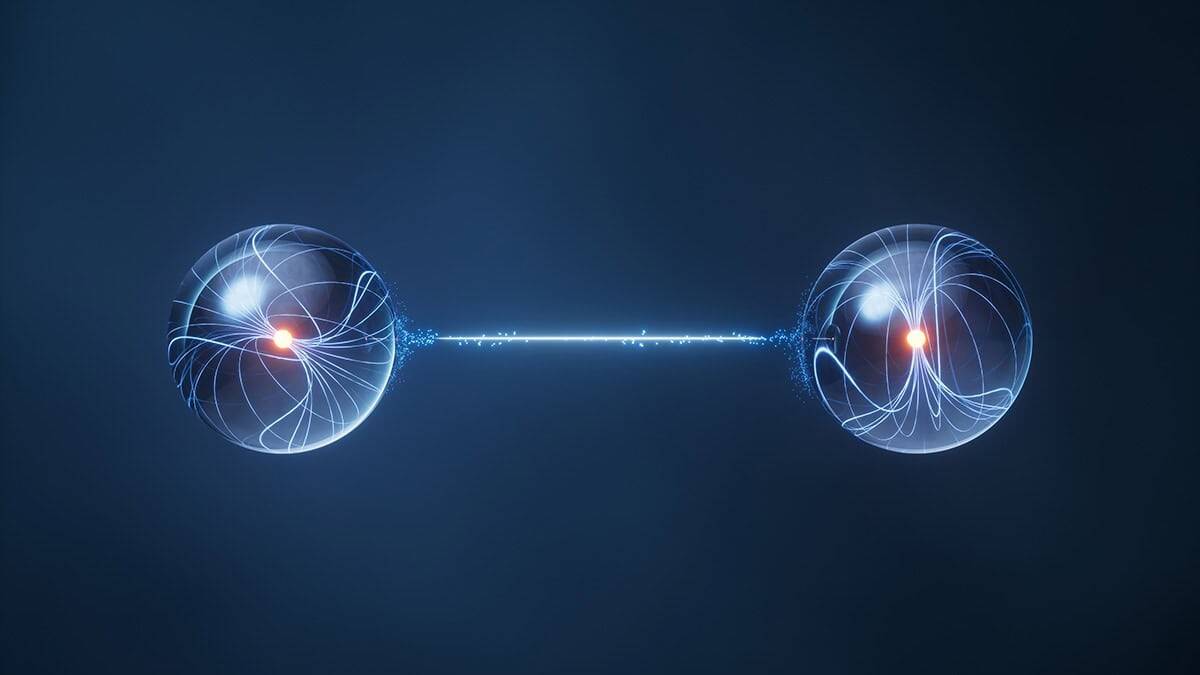
Quantum-entangled sensors placed over a kilometre apart could allow interferometric measurements of optical light with single photon sensitivity, experiments in the US suggest. While this proof-of-principle demonstration of a theoretical proposal first made in 2012 is not yet practically useful for astronomy, it marks a significant step forward in quantum sensing.
Radio telescopes are often linked together to provide more detailed images with better angular resolution than would otherwise be possible. The Event Horizon Telescope array, for example, performs very long baseline interferometry of signals from observatories on four continents to take astrophysical images such as the first picture of a black hole in 2019. At shorter wavelengths, however, much weaker signals are often parcelled into higher-energy photons. “You start getting this granularity at the single photon level,” says Pieter-Jan Stas at Harvard University.
According to textbook quantum mechanics, one can create an interferometric image from single photons by recombining their paths at a single detector – provided that their paths are not measured before then. This principle is used in laboratory spectroscopy. In astronomical observations, however, attempting to transport single photons from widely spread telescopes to a central detector would almost certainly result in them being lost. The baseline of infrared and optical telescopes is therefore restricted to about 300 m.
In 2012, theorist Daniel Gottesman, then at the Perimeter Institute for Theoretical Physics in Canada, and colleagues proposed using a central single source of entangled photons as a quantum repeater to generate entanglement between two detection sites, putting them into the same quantum state. The effect of an incoming photon on this combined state could therefore be measured without having to recombine the paths and collect the photon at a central detector.
Hidden information
“In reality, the photon will be in a superposition of arriving at both of the detectors,” says Stas. “That’s where this advantage comes from – you have this photon that is delocalized and arrives at both the left and the right station – so you truly have this baseline that helps you with improving your resolution, but to do this you have to keep the ‘which path’ information hidden.”
The 2012 proposal was not thought to be practical, because it required distributing entanglement at a rate comparable with the telescope’s spectral bandwidth. In 2019, however, Harvard’s Mikail Lukin and colleagues proposed integrating a quantum memory into the system. In the new research, they demonstrate this in practice.
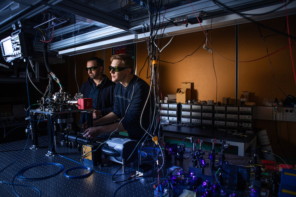
The team used qubits made from silicon–vacancy centres in diamond. These can be very long lived because the spin of the centre’s electron (which interacts with the photon) is mapped to the nuclear spin, which is very stable. The researchers used a central laser as a coherent photon source to generate heralded entanglement to certify that the qubits were event-ready. “It’s not like you have to receive the space signal to be simultaneous with the arrival of the photon,” says team member Aziza Suleymanzade at the University of California, Berkeley. “In our case, we distribute entanglement, and it has some coherence time, and during that time you can detect your signal.”
Using two detectors placed in adjacent laboratories and synthetic light sources, the researchers demonstrated photon detection above vacuum fluctuations in fibres over 1.5 km in length. They acknowledge that much work remains before this can be viable in practical astronomy, such as a higher rate of entanglement generation, but Stas says that “this is one step towards bringing quantum techniques into sensing”.
Similar work in China
The research is described in Nature. Researchers in China led by Jian-Wei Pan have achieved a similar result, but their work has yet to be peer reviewed.
Quantum-entangled photons are super-sensitive to Earth’s rotation

Yujie Zhang of the University of Waterloo in Canada points out that Lukin and colleagues have done similar work on distributed quantum communication and the quantum internet. “The major difference is that for most of the original protocols, what people care about is trying to entangle different quantum memories in the quantum network so then they can do gates on those quantum memories,” he says. “There’s nothing about extra information from the environment…This one is different in that they have to get the information mapped from the starlight to their quantum memory.” He notes several difficulties acknowledged by the researchers – such as that vacancy centres are very narrowband, but says that now people know the system can work, they can work to show that it can beat classical systems in practice.
“I think this is definitely a step towards [realizing the protocol envisaged in 2012],” says Gottesman, now at the University of Maryland, College Park. “There have been previous experiments where they generated the entanglement and they did some interference but they didn’t have the repeater aspect, which is the real value-added aspect of doing quantum-assisted interferometry. Its rate is still well short of what you’d need to have a functioning telescope, but this is putting one of the important pieces into place.”