Quantum computers could solve problems that are out of reach for today’s classical machines. However, the quantum states they rely on are prone to decohering – that is, losing their quantum information due to local noise. One possible way around this is to use quantum bits (qubits) constructed from quasiparticle states known as Majorana zero modes (MZMs) that are protected from this noise. But there’s a catch. To perform computations, you need to be able to measure, or read out, the states of your qubits. How do you do that in a system that is inherently protected from its environment?
Scientists at QuTech in the Netherlands, together with researchers from the Madrid Institute of Materials Science (ICMM) in Spain, say they may have found an answer. By measuring a property known as quantum capacitance, they report that they have read out the parity of their MZM system, backing up an earlier readout demonstration from a team at Microsoft Quantum Hardware on a different Majorana platform.
Measuring parity
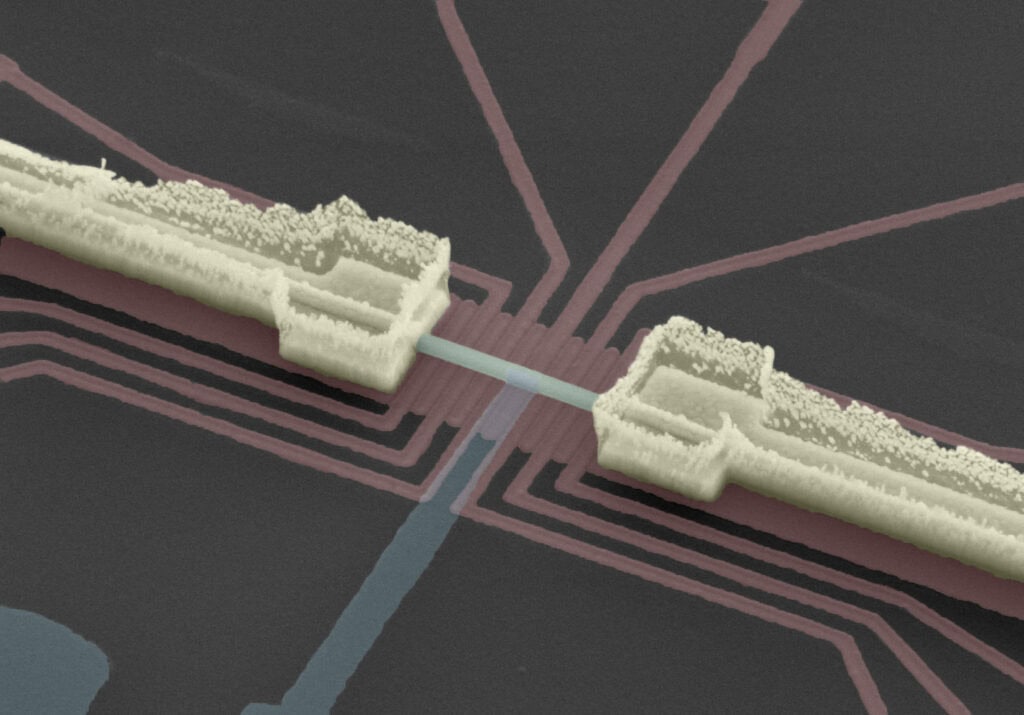
The QuTech/ICMM researchers generated their MZMs across two quantum dots – semiconductor structures that can confine electrons – connected by a superconducting nanowire. Electrons can transfer, or tunnel, between the quantum dots through this wire. Majorana-based qubits store their quantum information across these separated MZMs, with both elements in the pair required to encode a single “parity” bit. A pair of parity bits (combining four MZMs in total) forms a qubit.
A parity bit has two possible states. When the two quantum dots are in a superposition of both having one electron and both having none, the system is said to have even parity (a “0”). When the system is instead in superposition of only one of the quantum dots having an electron, the parity is said to be odd (a “1”). Importantly, these even and odd parity states have the same average value of electric charge, meaning that a charge sensor cannot tell them apart.
The key to measuring parity lies in the electrons’ behaviour. In the even-parity state, an even number of electrons can pair up and enter the superconductor together as a Cooper pair. In the odd-parity state, however, the lone electron lacks a partner and cannot flow through the wire in the same way. By measuring the charge flowing into the superconductor, the team was therefore able to determine the parity state. The researchers also determined that the lifetimes of these states were in the millisecond range, which they say is promising for quantum computations.
Competing platforms
According to Nick van Loo, a quantum engineer at QuTech and the first author of a Nature paper on the work, similar chains of quantum dots (known as Kitaev chains) are a promising platform for realizing Majorana modes because each element in the chain can be controlled and tuned. This control, he adds, makes results easier to reproduce, helping to overcome some of the interpretation challenges that have affected Majorana results over the past decade.
Van Loo also stresses that his team uses a different architecture from the Microsoft Quantum Hardware team to create its Majorana modes – one that he says allows for better tuneability as well as easier and more scalable readout. He adds that this architecture also allows an independent charge sensor to be used to confirm the MZM’s charge neutrality.
In response, Chetan Nayak, a technical fellow at Microsoft Quantum Hardware, says it is important that the QuTech/ICMM team independently measured a millisecond time scale for parity fluctuations. However, he notes that the team did not extend this parity lifetime and adds that the so-called “poor man’s Majoranas” used in this research do not constitute a scalable platform for topological qubits, as they lack topological protection.
Seeking full protection
Van Loo acknowledges that the team’s two-site Kitaev chain is not topologically protected. However, he says the degree of protection is expected to improve exponentially as more sites are added. In the near term, he and his colleagues hope to operate their qubit by inducing rotations through coupling pairs of Majorana modes. Once these hurdles are overcome, he tells Physics World that “one major milestone will still remain: demonstrating braiding of Majorana modes to establish their non-Abelian exchange statistics”.
‘Poor man’s Majoranas’ offer testbed for studying possible qubits
Jay Deep Sau, a physicist at the University of Maryland, US, who was not involved in either the QuTech/ICMM or the Microsoft Quantum Hardware research, describes this as the first measurement of fermion parity in the smallest quantum dot chain platform for creating MZMs. Compared to the Microsoft result, Sau agrees that the quantum dot chain is more controlled. However, he is sceptical that this control will apply to larger chains, casting doubt on whether this is truly a scalable way of realizing MZMs. The significance of these results, he adds, will only be apparent if the quantum dot chain approach can demonstrate a coherent qubit before its semiconductor nanowire counterpart.