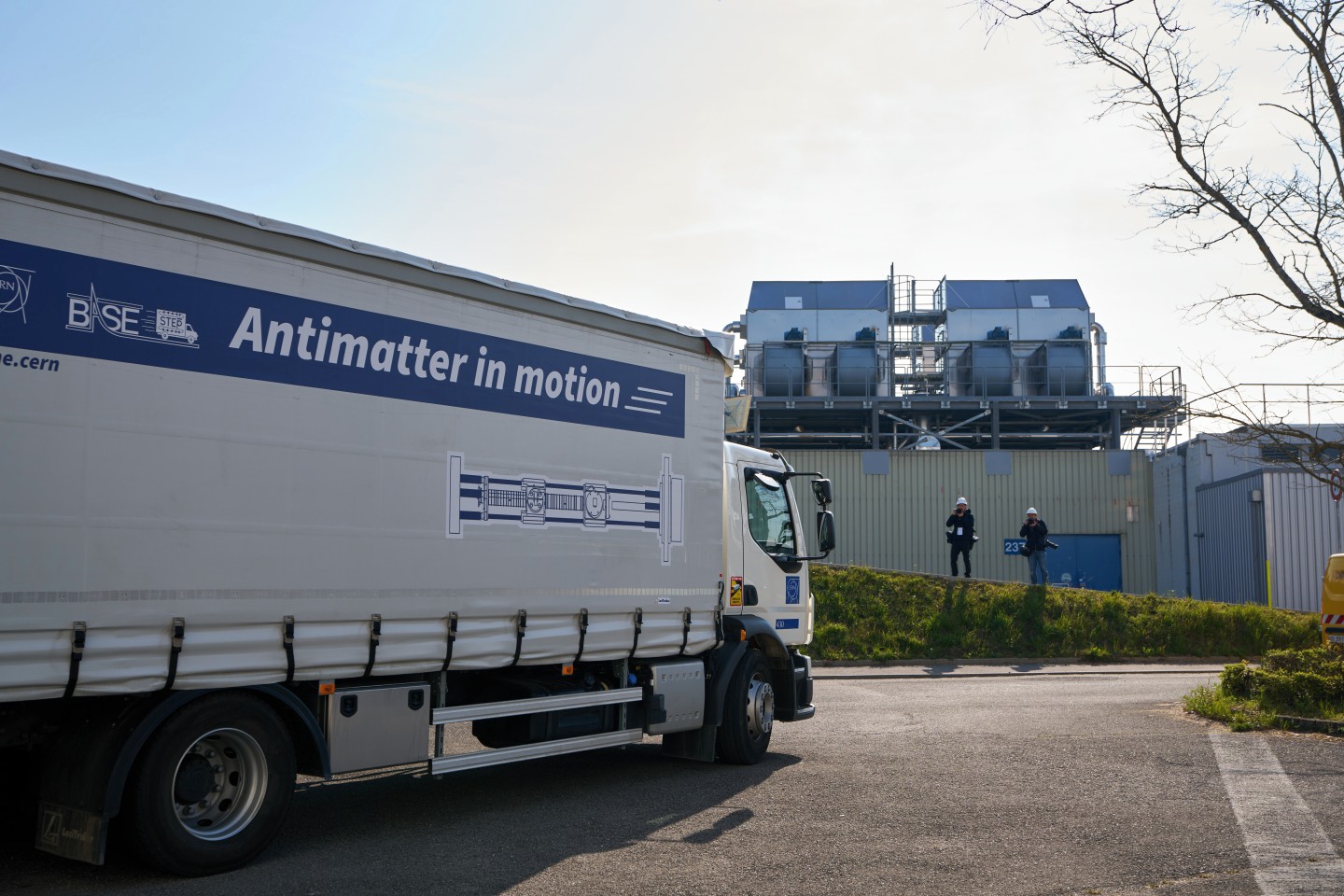
Researchers at the CERN particle-physics lab have successfully transported antiprotons in a lorry across the lab’s main site. The feat, the first of its kind, follows a similar test with protons in 2024. CERN says the achievement is “a huge leap” towards being able to transport antimatter between labs across Europe.
Antimatter is almost identical to ordinary matter except that the electric charge and magnetic moment are reversed. But if equal amounts of matter and antimatter were created in the Big Bang, as is widely believed, they would have annihilated each other, leaving an empty universe. Physicists therefore suspect there are hidden differences that may explain why matter survived and antimatter all but disappeared.
CERN’s Baryon-Antibaryon Symmetry Experiment (BASE) experiment focuses on measuring the magnetic moment (or charge-to-mass ratio) of protons and antiprotons to search for such differences.
These measurements need to be extremely precise but this is difficult at CERN’s “Antimatter Factory”, which produces the antiprotons, due to inference from nearby equipment. To carry out more precise measurements, the team therefore needs a way of transporting the antiprotons to labs further afield.
To do so, in 2020 the BASE team began developing a device, known as BASE-STEP (for Symmetry Tests in Experiments with Portable Antiprotons), to store and transport antiprotons.
It works by trapping particles in a Penning trap composed of gold-plated cylindrical electrode stacks made from oxygen-free copper that is surrounded by a superconducting magnet bore operated at cryogenic temperatures.
The device, which also contains a carbon-steel vacuum chamber to shield the particles from stray magnetic fields, is then mounted on an aluminium frame. This allows it to be transported using standard forklifts and cranes and withstand the bumps and vibrations of transport.
In 2024, BASE researchers used the device to transport a cloud of about 105 trapped protons across CERN’s Meyrin campus for four hours. Protons take to the road
After that feat, the researchers began to adjust BASE-STEP to handle antiprotons and yesterday the team successfully transported a trap containing a cloud of 92 antiprotons around the campus for 30 minutes, travelling up to 42 km/h.
With further improvements and tests, the team now hope to transport the antiprotons further afield. The first destination on the team’s list is the Heinrich Heine University (HHU) in Düsseldorf, Germany, which would take about eight hours.
“This means we’d have to keep the trap’s superconducting magnet at a temperature below 8.2 K for that long,” says BASE-STEP’s leader Christian Smorra. “So, in addition to the liquid helium , we’d need to have a generator to power a cryocooler on the truck. We are currently investigating this possibility.”
If possible to transport to HHU, physicists would then use the particles to search for charge-parity-time violations in protons and antiprotons with a precision at least 100 times higher than currently possible at CERN.