Silver iodide crystals have long been used to “seed” clouds and trigger precipitation, but scientists have never been entirely sure why the material works so well for that purpose. Researchers at TU Wien in Austria are now a step closer to solving the mystery thanks to a new study that characterized surfaces of the material in atomic-scale detail.
“Silver iodide has been used in atmospheric weather modification programs around the world for several decades,” explains Jan Balajka from TU Wien’s Institute of Applied Physics, who led this research. “In fact, it was chosen for this purpose as far back as the 1940s because of its atomic crystal structure, which is nearly identical to that of ice – it has the same hexagonal symmetry and very similar distances between atoms in its lattice structure.”
The basic idea, Balajka continues, originated with the 20th-century American atmospheric scientist Bernard Vonnegut, who suggested in 1947 that introducing small silver iodide (AgI) crystals into a cloud could provide nuclei for ice to grow on. But while Vonnegut’s proposal worked (and helped to inspire his brother Kurt’s novel Cat’s Cradle), this simple picture is not entirely accurate. The stumbling block is that nucleation occurs at the surface of a crystal, not inside it, and the atomic structure of an AgI surface differs significantly from its interior.
A task that surface science has solved
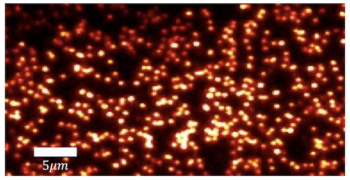
To investigate further, Balajka and colleagues used high-resolution atomic force microscopy (AFM) and advanced computer simulations to study the atomic structure of 2‒3 nm diameter AgI crystals when they are broken into two pieces. The team’s measurements revealed that the surfaces of both freshly cleaved structures differed from those found inside the crystal.
More specifically, team member Johanna Hütner, who performed the experiments, explains that when an AgI crystal is cleaved, the silver atoms end up on one side while the iodine atoms appear on the other. This has implications for ice growth, because while the silver side maintains a hexagonal arrangement that provides an ideal template for the growth of ice layers, the iodine side reconstructs into a rectangular pattern that no longer lattice-matches the hexagonal symmetry of ice crystals. The iodine side is therefore incompatible with the epitaxial growth of hexagonal ice.
“Our works solves this decades-long controversy of the surface vs bulk structure of AgI, and shows that structural compatibility does matter,” Balajka says.
Difficult experiments
According to Balajka, the team’s experiments were far from easy. Many experimental methods for studying the structure and properties of material surfaces are based on interactions with charged particles such as electrons or ions, but AgI is an electrical insulator, which “excludes most of the tools available,” he explains. Using AFM enabled them to overcome this problem, he adds, because this technique detects interatomic forces between a sharp tip and the surface and does not require a conductive sample.
Another problem is that AgI is photosensitive and decomposes when exposed to visible light. While this property is useful in other contexts – AgI was a common ingredient in early photographic plates – it created complications for the TU Wien team. “Conventional AFM setups make use of optical laser detection to map the topography of a sample,” Balajka notes.
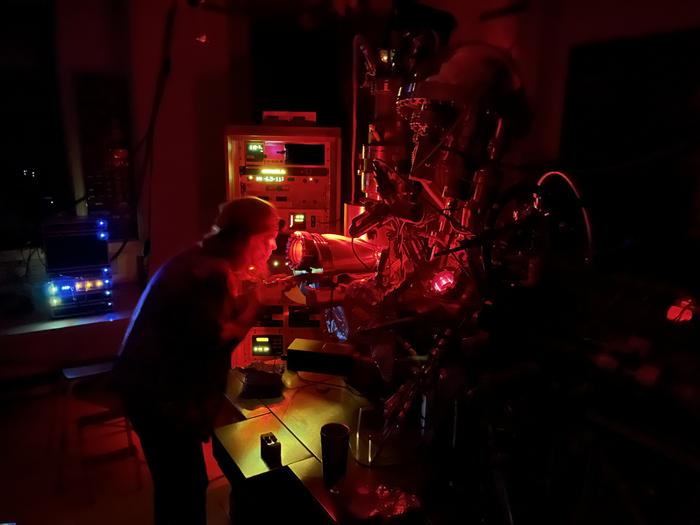
To avoid destroying their sample while studying it, the researchers therefore had to use a non-contact AFM based on a piezoelectric sensor that detects electrical signals and does not require optical readout. They also adapted their setup to operate in near-darkness, using only red light while manipulating the Ag to ensure that stray light did not degrade the samples.
Organic molecule from trees excels at seeding clouds, CERN study reveals

The computational modelling part of the work introduced yet another hurdle to overcome. “Both Ag and I are atoms with a high number of electrons in their electron shells and are thus highly polarizable,” Balajka explains. “The interaction between such atoms cannot be accurately described by standard computational modelling methods such as density functional theory (DFT), so we had to employ highly accurate random-phase approximation (RPA) calculations to obtain reliable results.”
Highly controlled conditions
The researchers acknowledge that their study, which is detailed in Science Advances, was conducted under highly controlled conditions – ultrahigh vacuum, low pressure and temperature and a dark environment – that are very different from those that prevail inside real clouds. “The next logical step for us is therefore to confirm whether our findings hold under more representative conditions,” Balajka says. “We would like to find out whether the structure of AgI surfaces is the same in air and water, and if not, why.”
The researchers would also like to better understand the atomic arrangement of the rectangular reconstruction of the iodine surface. “This would complete the picture for the use of AgI in ice nucleation, as well as our understanding of AgI as a material overall,” Balajka says.