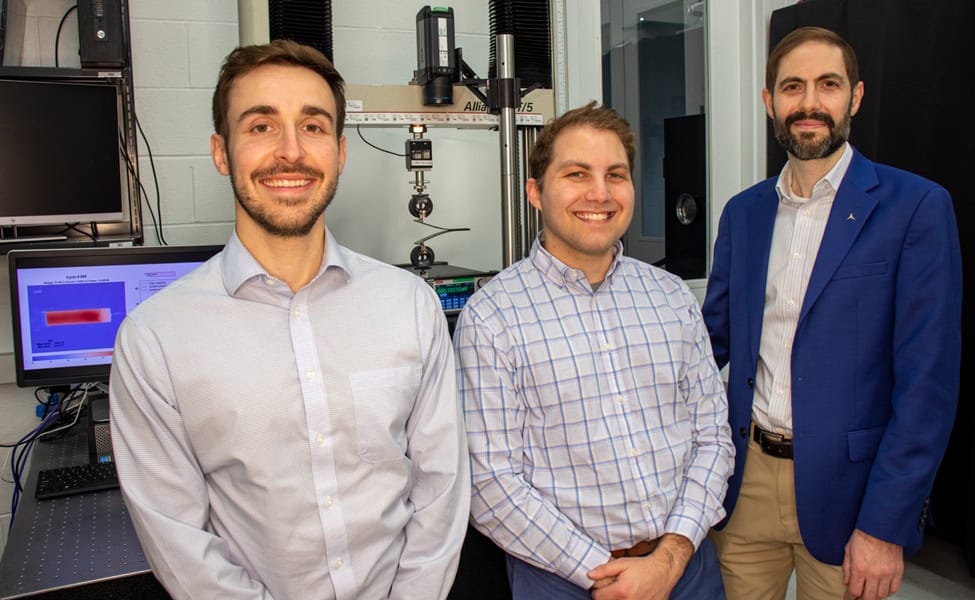
Researchers from North Carolina State University and the University of Houston have achieved sustained self-healing of a composite material. The findings promise to extend the lifetime of aircraft and automotive parts by a century, according to a recent paper published in the Proceedings of the National Academy of Sciences.
Composite materials bond two or more components to achieve balanced strength, flexibility and durability. Bone is a naturally occurring example, combining flexible collagen fibres with the stiffness of various minerals. Fibre-reinforced polymers (FRPs) are synthetic analogues that embed strong fibres within a polymer matrix to achieve similar material advantages, making them ubiquitous in aerospace, naval and wind energy sectors.
While bonding multiple layers is necessary to enforce strength, it makes the material prone to interlaminar delamination, or the separation of layers. Lead researcher Jack Turicek describes this type of delamination as “one of the most common and life-limiting failure modes in FRPs”. While nature boasts the remarkable ability to autonomously and repeatedly heal from delamination, achieving a similar feat in synthetic materials has only now become possible.
Healing by thermal remending
The researchers used a method known as “thermal remending” to enable self-healing. First, a healing agent, poly(ethylene-co-methacrylic acid) or EMAA, is embedded into a glass-fibre epoxy-matrix composite during curing. This forms strong covalent bonds between EMAA and the epoxy.
To test their materials, the researchers systematically created a fracture by applying controlled tensile loading until the fracture reached 50 mm. Then, to initiate healing, they warmed the material using built-in electrical heaters. The heat vaporized small water bubbles created during the initial curing process, which produced a microporous network that physically expanded and spread the EMAA into the fracture – the so-called “pressure delivery mechanism”.
Afterwards, 30 min of natural convective cooling to room temperature allowed the EMAA to solidify, forming new hydrogen and ionic bonds between EMAA and epoxy. The bonds reconnected the interfaces that had fractured, recovering the structural integrity of the material.
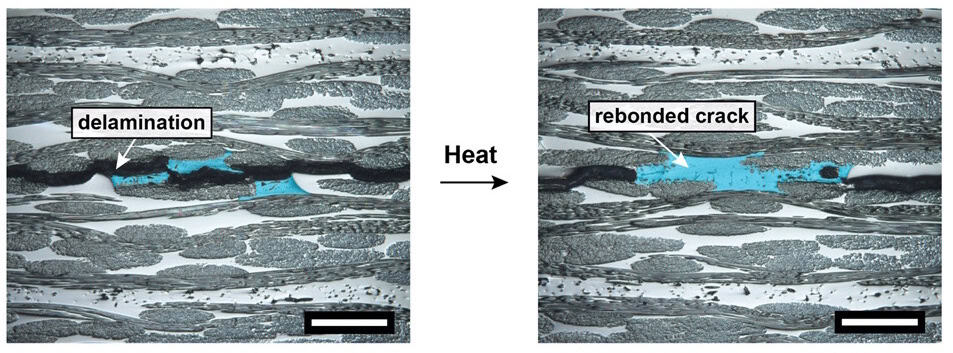
The team repeated the entire procedure over 1000 cycles. Such a prolonged study was previously infeasible due to multi-day cycle lengths. In this work, the researchers set up programmable electrical, thermal and mechanical devices that automatically initiated fracturing, sensed progress to trigger healing, and monitored the rebonded crack before repeating the cycle. This automation reduced cycle lengths to an hour and the full experiment to only 40 days.
Understanding sustained healing
The team quantified the healing effectiveness using the critical strain energy release rate (GIC), a measure of the energy required to propagate a crack. A high GIC means that the material is resilient and well-healed. The EMAA-containing material showed maximum healing at test cycle 7, with 230% the GIC value of an RFP containing no EMAA. The results declined to 180% by cycle 100 and 60% by cycle 1000. When the data was fitted to a Weibull distribution, a common model for material failure, healing asymptotically approached a lower limit of 40% – suggesting that sustained repair is possible.
Optical and electron microscopy revealed two reasons for the observed decline in healing performance. First, the repeated fracture and healing process resulted in accumulation of glass fibre debris in EMAA, which blocked bonding sites. Second, chemical reactions between EMAA and the epoxy matrix are responsible for creating strong covalent bonds between them (necessary for cohesive fracturing of EMAA) and producing the bubbles for the pressure delivery mechanism. The microscopy showed a decline in both reactions, reducing the effectiveness of fracture recovery.
From prototype to practice
Out of the 1000 cycles tested, the self-healing composite maintained over 100% fracture recovery compared with non-EMAA materials for 500 cycles. Based on a 500-cycle lifetime, parts made using the new material could last 125 to 500 years, assuming a quarterly or annual repair schedule – a timeline that far exceeds current design lifetimes of about 40 years.
Is materials science the new alchemy for the 21st century?

Integration with existing industry infrastructure is forthcoming. “We have designed both the healing agent interlayers and the resistive heaters to be easily integrated into real-world composites with existing fabrication processes. These functional components enable in situ self-healing (i.e., in the service environment) via electrical power input to the heaters,” says Turicek. “To enable autonomous self-healing, a sensing element that can detect damage is needed to automatically trigger the power on, and power off once repaired. We have such technology on the near horizon.”
The technology has been patented by Jason Patrick, the principal investigator of this research and chief technology officer of the startup company Structeryx. Patrick says that the company intends to “engage with existing and new defence/industry partners to customize the technology for various needs”, in addition to scaling manufacturing.
While we often search for ways to fix broken items, materials of the future may perhaps fix themselves.