
A collective mode of electrons predicted to exist in high-temperature superconductors, but difficult to observe in experiments has been identified by physicists at the Massachusetts Institute of Technology (MIT). The finding could advance our understanding of these materials, they say.
According to the Bardeen–Cooper–Schrieffer (BCS) theory, superconductivity occurs when electrons in a material overcome their mutual electrical repulsion to form electron pairs. These Cooper pairs, as they are known, can then travel unhindered through the material as a supercurrent without scattering off phonons (quasiparticles arising from vibrations of the material’s crystal lattice) or other impurities.
Cooper pairing is characterized by a tell-tale energy gap near the Fermi level, which is the highest energy level that electrons can occupy in a solid at absolute zero temperature. This gap is equivalent to the minimum energy required to break up a Cooper pair, and identifying it is regarded as unequivocal proof of a material’s superconducting nature.
In high-temperature cuprate semiconductors, which are layered materials, the Cooper pairs are confined to two-dimensional copper–oxygen (CuO2) planes that are only weakly coupled with respect to each other. Researchers are able to study the collective oscillations of these conduction electrons – known as plasmons – that travel perpendicular to these superconducting layers using terahertz (THz) spectroscopy at millielectronvolts energies, which is lower than the superconducting gap of the material. They can do this because the plasmons interact strongly with light.
However, doing the same for the electrons within the CuO2 layers themselves, is not so easy. This is because the collective electron behaviour occurs at energies that are much higher than the superconducting gap.
A 2D superfluid plasmon
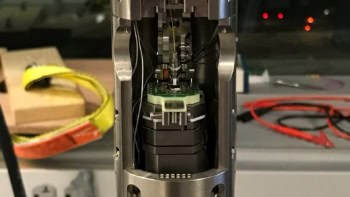
Now, a team of physicists led by Nuh Gedik say they have succeeded in identifying a 2D superfluid plasmon in the layered superconductor bismuth strontium calcium copper oxide (or “BSCCO”) using a new THz microscope they developed in their laboratory. This plasmon has energies that are lower than the superconducting gap of the material.
THz radiation spans wavelengths from 30 μm (10 THz) in the mid-infrared part of the electromagnetic spectrum to 1–3 mm (0.1–0.3 THz) in the microwave domain. This is much larger than the size of atoms and molecules, so THz light cannot be used to resolve microscale structures. To overcome this fundamental diffraction limit, which restricts spatial resolution to roughly half of the wavelength of the light being used, Gedik and colleagues used spintronic emitters, which are devices that produce sharp pulses of THz light.
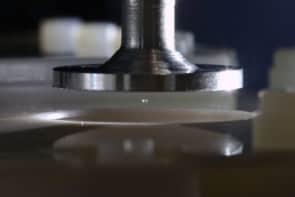
The researchers explain that when they shone this light on the multi-layered BSCCO, it triggered a cascade of effects in the electrons within each layer. By placing their sample, held at ultracold temperatures so that it became a superconductor, close to (in the near field) of the spintronic emitter, they were able to trap the THz light before it had time to spread. They were thereby able to “squeeze” it into a space much smaller than its wavelength. In this regime, the light can bypass the diffraction limit and resolve features previously too small to observe – in this case, collective THz oscillations of superconducting electrons within the material. Such a “jiggling” superfluid as the researchers have dubbed it was predicted to exist but never directly visualized until now.
Superfluid phase spotted in molecular hydrogen for the first time
“The new mode of electrons we have seen will provide a novel way of studying high temperature superconductivity in these systems,” says Gedik, “and we will now be looking into how this collective mode changes as a function of temperature, doping and sample geometry.”
The tool that we built could also be used to study the properties of 2D materials other than high temperature superconductors – for example, the optical behaviour in the THz regime for many small samples and heterostructures, he tells Physics World.
The present work is detailed in Nature.