When Scott Waitukaitis set out to understand a puzzling aspect of static electricity, he didn’t expect to find the answer in a substance colloquially known as “schmutz”. But after a painstaking series of experiments, Waitukaitis and colleagues at the Institute of Science and Technology Austria (ISTA) have strong evidence that carbon-based surface contaminants – in other words, schmutz – are, in fact, the determining factor in how electric charge flows when certain types of insulating materials come into contact. By clearing up this mystery, the ISTA scientists say that their findings, which are published today in Nature, could shed fresh light on phenomena such as lightning and protoplanetary disk formation where static electricity plays a significant role.
If you’ve ever felt a shock after rubbing your hair with a balloon or shuffling across a carpet, you’ll know that static electricity can be a real pain. But for the scientists who study it, the pain runs much deeper. “Experimentally, it’s really hard,” Waitukaitis says. “There’s just a tonne of problems with this topic.”
During his talk at the APS Global Physics Summit in Denver, Colorado this week, Waitukaitis listed a few of these problems. Measuring an object’s charge is tricky. You can’t tell whether surface charge is coming from electrons or ions. And whenever you touch the object, you change its charge in unpredictable ways. Because of these complications, Waitukaitis says that even the most careful experiments are plagued by systematic effects.
Acoustic levitation to the (partial) rescue
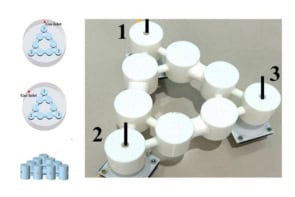
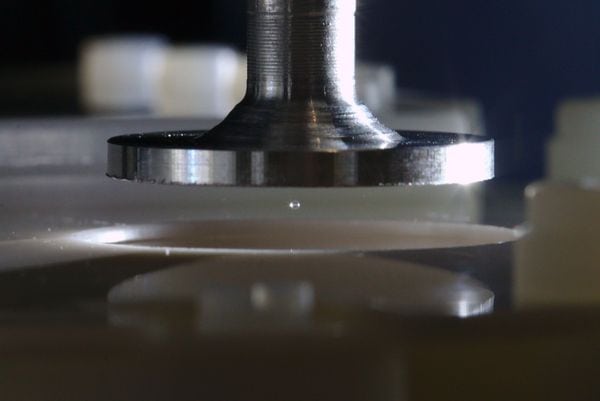
To avoid the worst of these effects, an experimental team led by Galien Grosjean built an apparatus that uses sound waves to suspend a tiny sphere of silicon dioxide above a plate made from the same material. Turning this acoustic potential off and on again enabled the team to drop the initially neutral sphere onto the plate and “catch” it on the rebound without actually touching it. By applying a varying electric field to the sphere and measuring how it oscillates during its “catch” phase, they could also measure how much charge the sphere gained or lost via contact with the plate to within 500 electrons.
It wasn’t easy, though. “Bouncing this tiny sphere on a plate and catching it again is tricky enough to achieve once, but to understand the charging behaviour, we need to repeat this hundreds or even thousands of times in a row, without ever losing the particle,” Grosjean tells Physics World.
Preparing the samples was also challenging, he continues. “We were looking for what could possibly cause same-material samples to charge differently, so it was absolutely crucial for the samples to be prepared in exactly the same conditions.”
After these careful preparations, Grosjean, Waitukaitis and colleagues observed a curious pattern. Although every individual sphere charged in a consistent way with every individual plate, some spheres became more positively charged with each bounce, while others became more negatively charged. In effect, the spheres behaved as if they were made of completely different materials.
Spectroscopic investigations
Suspecting that surface contamination could be the culprit, the ISTA scientists tried cleaning the spheres and plates with plasma and baking them at 200 C. The results were stark: the “clean” spheres all became more negatively charged with each bounce, regardless of how they’d responded before. Then, over the next day or so, the previous pattern reemerged. Whatever they’d removed, it was obviously coming back.
At this point, the ISTA scientists started working with spectroscopists to identify what, exactly was on the surfaces of their spheres. The answer? Carbon, in the form of carbon dioxide, methane and various longer-chain carbon-rich molecules. “We never get the same cocktail of carbon on the surface twice, but the fact that it’s there really matters,” Waitukaitis says. By adding or removing carbon to their spheres, he adds, “we can make everything that was charging positively charge negatively and vice versa.”
New experiments on static electricity cast doubt on previous studies in the field

What they can’t do – at least, not yet – is explain exactly how this carbon schmutz changes the spheres’ charging behaviour. “Everybody starts on this topic thinking, ‘I’m an awesome physicist, I can kick its butt in less than two years,’” Waitukaitis says. “That’s not the case.”
In a future experiment, the ISTA scientists plan to deliberately dope their spheres with specific functional groups of carbon, in effect creating their own, tailored versions of schmutz to study. “Schmutz is a pain, but for us, it’s the thing that matters,” Waitukaitis concludes.