With several dozen talks taking place at any one time, figuring out which session to attend at the American Physical Society’s Global Physics Summit is a challenge. On Wednesday, though, my choice was particularly stark. Should I depress myself by attending the session on “The Crisis in American Science”? Or restore my faith in humanity by finding out “How Early-Career Physicists Are Solving Society’s Greatest Challenges”?
A quirk of scheduling – or an APS organizer with a dark sense of humour – meant that the two sessions were practically next door to each other in Denver’s Colorado Convention Center. So, after a bit of dithering, I decided to oscillate between the two, hoping to strike a balance between cheer and gloom.
Reasons to be cheerful
The first speaker in the early-career physicists session was Rosimar Rios-Berrios, a physicist-turned-atmospheric-scientist at the US National Center for Atmospheric Research (NCAR). Located up the road from Denver in Boulder, Colorado, NCAR’s iconic, adobe-style Mesa Laboratory was designed by the architect I M Pei, and it supports the work of several hundred scientists who study weather and climate.
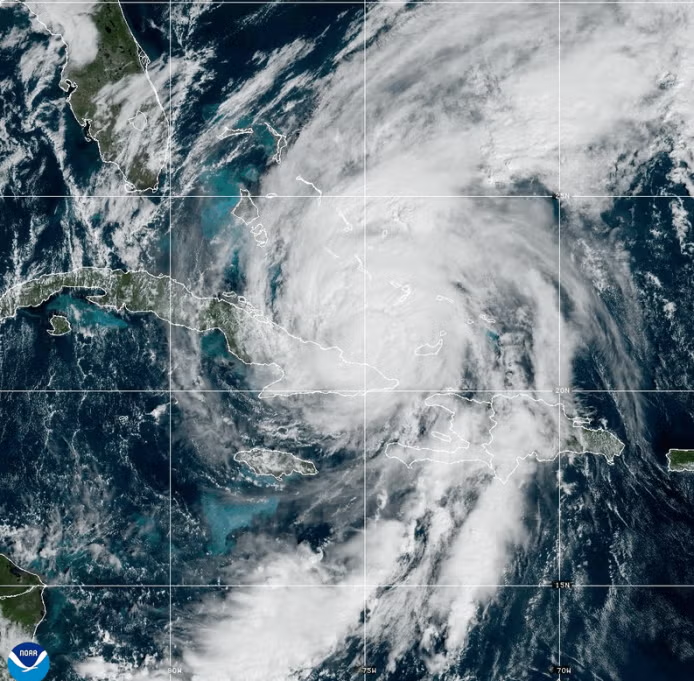
Rios-Berrios is originally from the US island territory of Puerto Rico, and her APS talk focused on a weather phenomenon that’s hugely important for anyone living on tropical islands or coasts: hurricanes. Rios-Berrios is trying to understand how these storms develop. In particular, she wants to know what happens in the atmosphere to cause gentle Caribbean breezes and fluffy white clouds to morph into devastating hurricanes like 2017’s Hurricane Maria, which killed nearly 3000 people in Puerto Rico alone, or 2025’s Hurricane Melissa, which devastated parts of Jamaica.
In previous studies, a specific type of atmospheric wave called a convectively coupled Kelvin wave had emerged as a possible hallmark of incipient tropical cyclones (a generic term for hurricanes and their Pacific Ocean equivalents, typhoons). These waves appear in the region near the equator where northeast and southeast trade winds meet, and they move eastward at around 15-20 metres per second, with wavelengths of 7000 km.
As they travel, the Kelvin waves perturb local concentrations of moisture, and their passing heralds a change in the direction of the prevailing winds. The resulting “zonal wind anomalies” are thought to play a role in spawning early-stage tropical cyclones. Observational data support this idea: two days after these waves pass through an area, there’s a noticeable uptick in tropical cyclones.
Rios-Berrios decided to investigate this correlation by developing an idealized model that captures the convective dynamics of both Kelvin waves and tropical cyclones. To simplify things, she based her model on an “Earth-like “aquaplanet” that lacks land and sea ice, and where temperatures vary only with latitude, and never with longitude or the passage of the seasons.
Despite these simplifications, Rios-Berrios found that this watery model world nevertheless produces hurricane-like swirls of wind and cloud. And after observing the full life cycle of more than 100 simulated tropical cyclones, she concluded that Kelvin waves do, in fact, influence their formation, with a two-day time lag that corresponds well to the data. “These results could help forecast active tropical cyclone periods several weeks in advance,” Rios-Berrios told the APS audience.
A gathering storm
Fortified by this promise, I picked up my laptop and walked the short distance to the “science crisis” session down the hall. I missed the session’s first talk, which aimed to draw comparisons between the Trump administration’s cuts to the National Science Foundation and the 1990s round of belt-tightening that doomed the Superconducting Super Collider project. However, I arrived in time for the second talk, in which a science historian, Zuoyue Wang, was scheduled to discuss parallels between the current situation and a succession of Cold War-era science budget crises.
To my surprise, Wang’s first slide featured a photo of NCAR’s iconic Mesa Lab – but not because of the great work being done there by Rios-Berrios and her colleagues. The fact that NCAR studies climate as well as weather means it has fallen foul of MAGA Republicans’ denial of climate change. In December 2025, the Trump White House issued a memo specifically targeting the centre and claiming that “NCAR’s activities veer far from strong or useful science”.
Lab architecture

As a consequence of this disfavour, Wang told the audience, “NCAR is being dismantled as we speak.” Though some members of the US Congress have pushed back against the administration’s cuts, Wang described the attacks on science as “never-ending”.
By the end of Wang’s talk, all the optimism I’d built up in hearing about Rios-Berrios’ efforts to protect people from tropical cyclones was blasted from its foundations. If this is the kind of science the current US regime deems “useless”, I wondered, what on Earth is going to happen to the rest of the work on show at events like the APS Summit?