The heads of university physics departments in the UK have published an open letter expressing their “deep concern” about funding changes announced late last year by UK Research and Innovation (UKRI), the umbrella organization for the UK’s research councils.
Addressed to science minister Patrick Vallance, the letter says the cuts are causing “reputational risk” and calls for “strategic clarity and stability” to ensure that UK physics can thrive.
It has so far been signed by 58 people who represent 45 different universities, including Birmingham, Bristol, Cambridge, Durham, Imperial College, Liverpool, Manchester and Oxford.
The letter says that the changes at UKRI “risk undermining science’s fundamental role in improving our prosperity, health and quality of life, as well as delivering sustainable growth through innovation, productivity and scientific leadership”.
The signatories warn that the UK’s international standing in physics is “a strategic asset” and that areas such as particle physics, astronomy and nuclear physics are “especially important”.
Raising concerns
The decision by the heads of physics to write to Vallance comes in the wake of UKRI stating in December that it will be adjusting how it allocates government funding for scientific research and infrastructure.
The Science and Technology Facilities Council (STFC), which is part of UKRI, stated that projects would need to be cut given inflation, rising energy costs as well as “unfavourable movements in foreign exchange rates” that have increased STFC’s annual costs by over £50m a year.
The STFC noted that it would need to reduce spending from its core budget by at least 30% over 2024/2025 levels while also cutting the number of projects financed by its infrastructure fund.
The council has already said two UK national facilities – the Relativistic Ultrafast Electron Diffraction and Imaging facility and a mass spectrometry centre dubbed C‑MASS – will now not be prioritized.
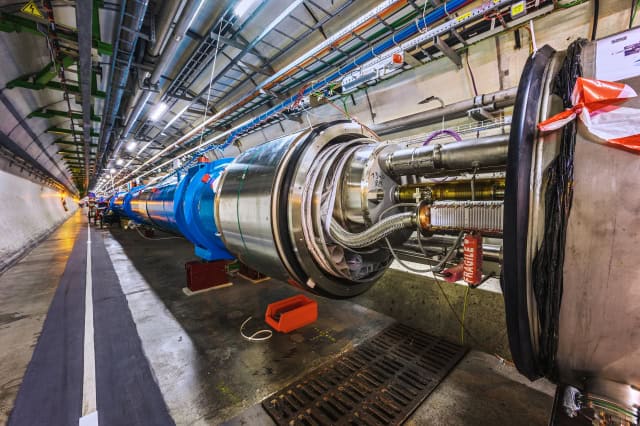
In addition, two international particle-physics projects will not be supported: a UK-led upgrade to the LHCb experiment at CERN as well as a contribution to the Electron-Ion Collider at the Brookhaven National Laboratory that is currently being built.
Philip Burrows, director of the John Adams Institute for Accelerator Science at the University of Oxford, who is one of the signatories of the letter, told Physics World that the cuts are “like buying a Formula-1 car but not being able to afford the driver”.
Burrows admits that the STFC has been hit “particularly hard” by its flat-cash settlement, given that a large fraction of its expenditure pays the UK’s subscriptions to international facilities and operating the UK’s flagship national facilities.
But because most of the rest of the STFC’s budget supports scientists to do research at those facilities, he is concerned that the funding cuts will fall disproportionately on the science programme.
CERN upgrade to LHCb experiment threatened by UK funding cuts

“Constraining these areas risks weakening the very talent pipeline on which the UK’s innovation economy depends,” the letter states. “Fundamental physics also delivers substantial public engagement and cultural impact, strengthening public support for science and reinforcing the UK’s reputation as a global scientific leader.”
The signatories also say they are “particularly concerned” about the UK’s capacity to lead the scientific exploitation of major international projects. “An abrupt pause in funding for key international science programmes risks damaging UK researchers’ competitive advantage into the 2040s,” they note.
The letter now calls on the government to work with UKRI and STFC to “stabilize” curiosity-driven grants for physics within STFC “at a minimum of flat funding in real terms” as well as protect postdocs, students and technicians from the cuts.
It also calls on the UK to develop a long-term strategy for infrastructure and call on the government to address facilities cost pressures through “dedicated and equitable mechanisms so that external shocks do not singularly erode the UK’s research base in STFC-funded research areas”.
The news comes as Michele Dougherty today formally stepped down from her role as IOP president. Dougherty, who also holds the position of executive chair of the STFC, had previously stepped back from presidential duties on 26 January due to a conflict of interest.
Paul Howarth, who has been IOP president-elect since September, will now become IOP president.