Vacuum fluctuations can enhance superconductivity in a bulk material. This is the new finding from researchers in China and the US who have put forward the concept of “vacuumtronics”. This is a new way to tune superconductivity without chemically altering a material, applying pressure to it or driving it with intense light.
In quantum electrodynamics, a vacuum is not empty but is host to fluctuating electromagnetic fields in which pairs of virtual particles are continuously being created and annihilated. Such vacuum fluctuations are thought to be responsible for phenomena like the Lamb shift, spontaneous emission and the Casimir effect.
In recent years researchers have been looking into the possibility of exploiting these fluctuations to change the properties of bulk matter. This is challenging because the fluctuations are extremely weak and produce little measurable change in macroscopic quantum states. They can, however, be amplified by a factor of 100 or even more using structures like resonant cavities. Indeed, such enhanced vacuum fields have already been exploited to modify material properties like chemical reactivity, topological states and conductivity.
In theory, vacuum fluctuations could be used to modulate superconductivity too, but until now this had never been demonstrated in an experiment.
Split-ring resonant “dark cavity”
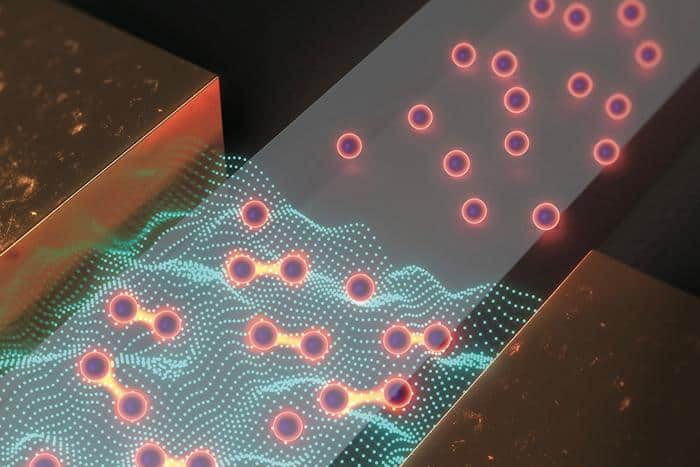
In the new work, an experimental team led by Changgan Zeng and Guanghui Cheng at the University of Science and Technology of China (USTC), partially embedded the layered superconductor niobium diselenide (NbSe2) inside a specially designed near-terahertz split-ring resonator, referred to as a “dark cavity”. The researchers then systematically compared the superconductivity of the NbSe2 outside and inside the cavity by measuring the resistance of the material as a function of temperature.
They found an increase of up to 5.4% in the superconducting critical temperature, Tc, of NbSe2 within the cavity compared with regions outside it, even although both samples came from the same NbSe2 flake.
Higher current and field
The researchers say they also observed substantial increases in the critical current and critical magnetic field near Tc. This is exciting, says Cheng, because the cavity is dark: no light shines on the material and no energy is actively pumped into it. “Instead, the effect arises from the ever-present electromagnetic fluctuations of the quantum vacuum.”
One of the challenges in the experiments, he explains, was to distinguish between genuine vacuum-fluctuation effects from more mundane explanations, such as sample inhomogeneity, strain or device fabrication-related effects. He says he and his colleagues invested considerable effort in control experiments to rule these out.
Zheng and Cheng’s theorist colleagues Qingdong Jiang from Shanghai Jiao Tong University and Frank Wilczek from the Massachusetts Institute of Technology (MIT) department of physics developed a theoretical model to explain the underlying mechanism behind the effects observed. Within a Ginzburg–Landau framework, they put forward the hypothesis that the superconducting state exchanges virtual photons with the dark cavity, which lowers the energy of this state and thereby strengthens superconductivity. And, when the characteristic energy of the cavity mode matches the low-energy superconducting fluctuations, the NbSe2 device exhibits resonant enhancement, producing the peak in superconductivity enhancement, explains Jiang.
Quantum vacuum fluctuations illuminated by new computational technique

Wilczek adds “In most practical physics experiments, the vacuum serves merely as the passive stage on which such phenomena play out”. “Our work shows that the background itself can become an actor – engineered to strengthen superconductivity and reshape the behaviour of quantum matter.”
The work establishes quantum-vacuum engineering as a new non-invasive way to tune superconductivity, Zeng tells Physics World. “Although the temperature enhancement we demonstrated is modest, it is a proof-of-principle for what could become a broadly applicable approach. It could be relevant to superconducting circuits, quantum sensors and other quantum devices, where non-invasive control of superconducting properties would be particularly valuable. More broadly, such engineered vacuum fields could also be used to control states of matter other than superconductivity.”
The China–US team says it would now like to further enhance the effect through improved cavity and material design and continue to investigate the underlying microscopic mechanisms in collaboration with theorists.