Researchers at Los Alamos National Laboratory in New Mexico, US have used visible light to both image and manipulate the domains of a chiral antiferromagnet (AFM). By “painting” complex patterns onto samples of cobalt niobium sulfite (Co1/3NbS2), they demonstrated that it is possible to control AFM domain formation and dynamics, boosting prospects for data storage devices based on antiferromagnetic materials rather than the ferromagnetic ones commonly used today.
In antiferromagnetic materials, the spins of neighbouring atoms in the material’s lattice are opposed to each other (they are antiparallel). For this reason, they do not exhibit a net magnetization in the absence of a magnetic field. This characteristic makes them largely immune to disturbances from external magnetic fields, but it also makes them all but invisible to simple electrical and optical probes, and extremely difficult to manipulate.
A special structure
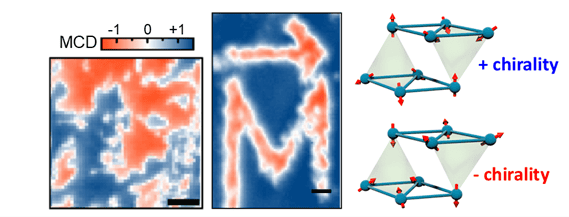
In the new work, a Los Alamos team led by Scott Crooker focused on Co1/3NbS2 because of its topological nature. In this material, layers of cobalt atoms are positioned, or intercalated, between monolayers of niobium disulfide, creating 2D triangular lattices with ABAB stacking. The spins of these cobalt atoms point either toward or away from the centers of the tetrahedra formed by the atoms. The result is a noncoplanar spin ordering that produces a chiral, or “handed,” spin texture.
This chirality affects the motion of electrons in the material because when an electron passes through a chiral pattern of spins, it picks up a geometrical phase known as a Berry phase. This makes it move as if it were “seeing” a region with a real magnetic field, giving the material a nonzero Hall conductivity which, in turn, affects how it absorbs circularly polarized light.
Characterizing a topological antiferromagnet
To characterize this behaviour, the researchers used an optical technique called magnetic circular dichroism (MCD) that measures the difference in absorption between left and right circularly polarized light and depends explicitly on the Hall conductivity.
Similar to the MCD that is measured in well-known ferromagnets such as iron or nickel, the amplitude and sign of the MCD measured in Co1/3NbS2 varied as a function of the wavelength of the light. This dependence occurs because light prompts optical transitions between filled and empty energy bands. “In more complex materials like this, there is a whole spaghetti of bands, and one needs to consider all of them,” Crooker explains. “Precisely which mix of transitions are being excited depends of course on the photon energy, and this mix changes with energy. Sometimes the net response is positive, sometimes negative; it just depends on the details of the band structure.”
To understand the mix of transitions taking place, as well as the topological character of those transitions, scientists use the concept of Berry curvature, which is the momentum-space version of the magnetic field-like effect described earlier. If the accumulated Berry phase is positive (negative), then the electron is moving in a right-handed (left-handed) spin texture chirality, which is captured by the Berry curvature of the band structure in momentum space.
Imaging and painting chiral AFM domains
To image directly the domains with positive and negative chirality, the researchers cooled the sample below its ordering temperature, shined light of a particular wavelength onto it, and measured its MCD using a scanning MCD microscope. The sign of the measured MCD value revealed the chirality of the AFM domains.
Antiferromagnets could be better than ferromagnets for some ultrafast, high-density memories

To “write” a different chirality into these AFM domains, the researchers again cooled the sample below its ordering temperature, this time in the presence of a small positive magnetic field B, which fixed the sample in a positive chiral AFM state. They then reversed the polarity of B and illuminated a spot of the sample to heat it above the ordering temperature. Once the spot cooled down, the negative-polarity B-field changed the AFM state in the illuminated region into a negative chirality. When the “painting” was finished, the researchers imaged the patterns with the MCD microscope.
In the past, a similar thermo-magnetic scheme gave rise to ferromagnetic-based data storage disks. This work, which is published in Physical Review Letters, marks the first time that light has been used to manipulate AFM chiral domains – a fundamental requirement for developing AFM-based information storage technology and spintronics. In the future, Crooker says the group plans to extend this technique to characterize other complex antiferromagnets with nontrivial magnetic configurations, use light to “write” interesting spatial patterns of chiral domains (patterns of Berry phase), and see how this influences electrical transport.