Today’s graduates face a shifting job-market influenced by AI, funding cuts and evolving industry demands – but their skills remain valuable across various numerous roles, as Sophia Chen discovers

Nothing stays static in today’s job market. Physicist Gabi Steinbach recalls that about five years ago, fresh physics PhDs could snag lucrative data-scientist positions in companies without job experience. “It was a really big boom,” says Steinbach, at the University of Maryland, US. Then, schools started formal data-science programmes that churned out job-ready candidates to compete with physicists. Now, the demand for physicists as data scientists “has already subsided,” she says.
Today, new graduates face an uncertain job market, as companies wrestle with the role of artificial intelligence (AI), and due to the funding cuts of science research agencies in the US. But those with physics degrees should stay optimistic, according to Matt Thompson, a physicist at Zap Energy, a fusion company based in Seattle, Washington.
“I don’t think the value of a physics education ever changes,” says Thompson, who has mentored many young physicists. “It is not a flash-in-the-pan major where the funding and jobs come from changes. The value of the discipline truly is evergreen.”
Evergreen discipline
In particular, a physics degree prepares you for numerous technical roles in emerging industrial markets. Thompson’s company, for example, offers a number of technical roles that could fit physicists with a bachelor’s, master’s or PhD.
A good way to set yourself up for success is to begin your job hunt two years before you expect to graduate, says Steinbach, who guides young researchers in career development. “Many students underestimate the time it takes,” she says.
The early start should help with the “internal” work of job hunting, as Steinbach calls it, where students figure out their personal ambitions. “I always ask students or postdocs, what’s your ultimate goal?” she says. “What industry do you want to work in? Do you like teamwork? Do you want a highly technical job?”
Then, the external job hunt begins. Students can find formal job listings on Physics World Jobs, APS Physics Jobs and in the Physics World Careers and APS Careers guides, as well as companies’ websites or on LinkedIn. Another way to track opportunities is to read investment news, says Monica Volk, who has spent the last decade hiring for companies, including Silicon Valley start-ups. She follows “Term Sheet,” a Fortune newsletter, to see which companies have raised money. “If they just raised $20 million, they’re going to spend that money on hiring people,” she says.

Volk encourages applicants to tailor their résumé for each specific job. “Your résumé should tell a story, where the next chapter in the story is the job that you’re applying for,” she says.
Hiring managers want a CV to show that a candidate from academia can “hit deadlines, communicate clearly, collaborate and give feedback.” Applicants can show this capability by describing their work specifically. “Talk about different equipment you’ve used, or the applications your research has gone into,” says Carly Saxton, the VP of HR at Quantum Computing, Inc. (QCI), based in New Jersey, in the US. Thompson adds that describing your academic research with an emphasis on results – reports written, projects completed and the importance of a particular numerical finding – will give those in industry the confidence that you can get something done.
It’s also important to research the company you’re applying for. Generative AI can help with this, says Valentine Zatti, the HR director for Alice & Bob, a quantum computing start-up in France. For example, she has given ChatGPT a LinkedIn page and asked it to summarize the recent news about a company and list its main competitors. She is careful to verify the veracity of the summaries.
When writing a CV , it’s important to use the keywords from the job description. Many companies use applicant-tracking systems, which automatically filter out CV without those keywords. This may involve learning the jargon of the industry. For example, when Thompson looked for jobs in the defence sector, he found out they called cameras “EO/IR,” short for electro-optic infrared instruments. Once he started referring to his expertise using those words, “I got a lot better response,” he says.
Generative AI can also assist you in putting together a résumé. For example, it can make résumés, which should be one page long, more concise, or help you better match your language to the job description. But Steinbach cautions that you must stay vigilant. “If it’s writing things that don’t sound like you, or if you can’t remember what’s written on it, you will fail at your interview,” says Steinbach.
Companies fill job openings quickly, especially right now, so Thompson also recommends focusing on networking. “It’s fine to apply for jobs you see online, but that should be maybe 20 percent of your effort,” he says. “Eighty percent should be talking to people.” One effective approach is through company internships before graduation. “We jump at the opportunity to hire former interns,” says Saxton.
Thompson suggests arranging a half-hour call with someone whose job looks interesting to you. You can find people through your alumni networks, LinkedIn or APS’s Industry Mentoring for Physicists (IMPact) program, which connects students and early-career physicists from any country with industrial physicists worldwide for career guidance. You can also attend career fairs at your university and those
organized by the APS.
Skills showcase
Once a company is interested in you, you can expect several rounds of interviews. The first will be about the logistics of the job – whether you’d need to relocate, for example. After that, for technical roles you can expect technical interviews. Recently, companies have encountered candidates secretively using AI to cheat during these interviews. They may eliminate the candidate for cheating. “If you don’t know how to do something, it’s better to be honest about it than to use AI to get through a test,” says Saxton. “Companies are willing to teach and develop core skills.”
What physics grads use AI tools for in their jobs
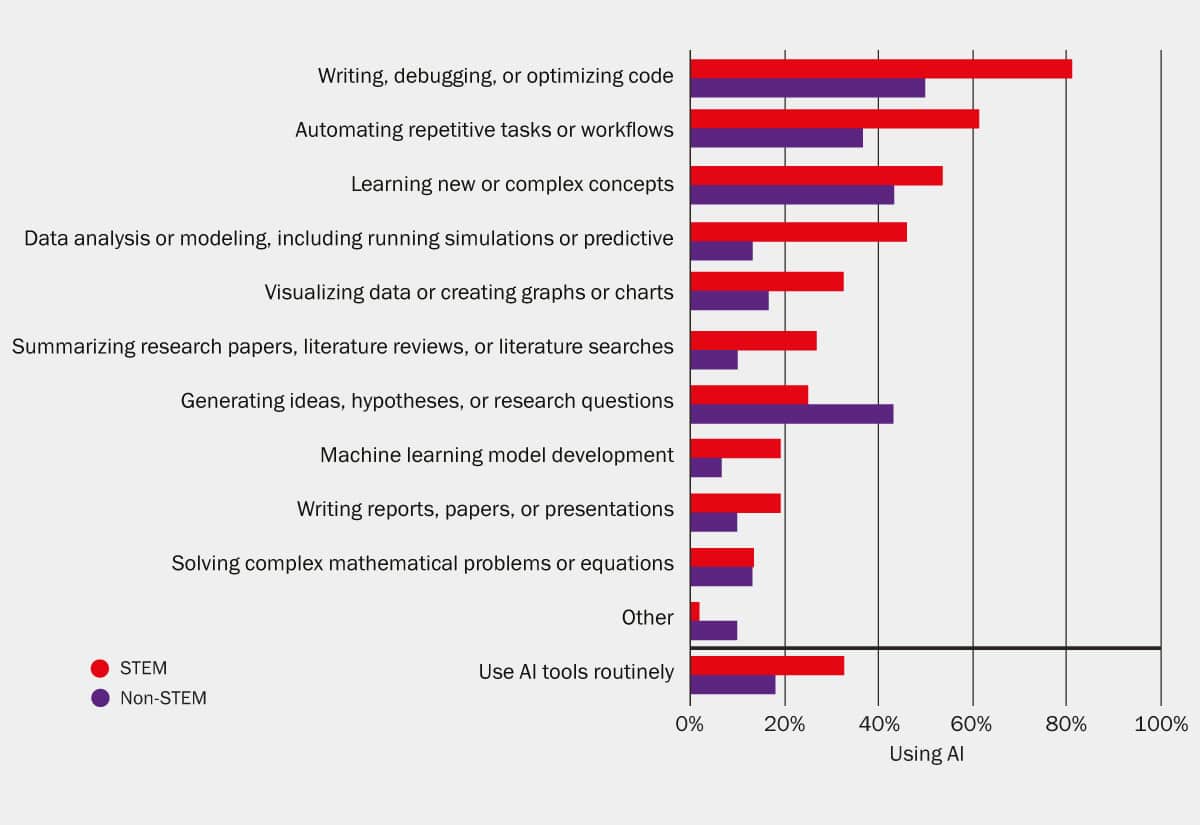
The “AI Use Among Physics Degree Recipients” report by the American Institute of Physics, published in August 2025, shows how recent physics degree recipients are engaging with AI, encompassing both its development and its application in daily professional activities. New bachelor’s graduates working in both STEM and non-STEM roles who received their degrees between 2023 and 2024 answered whether they routinely used AI tools in their day-to-day work in February 2025.
However, with transparency, showcasing AI skills could be a boon during job interviews. A 2025 survey from the American Institute of Physics found that around one in four students with a physics bachelor’s degree (see the graph) and two in five with physics PhDs routinely use AI for work. The report also found that one in 12 physics bachelor’s degree-earners and nearly one in five physics doctorate-earners who entered the workforce in 2024 have jobs in AI development.
The emerging quantum industry is also a promising job market for physicists. Globally, investors put nearly $2 billion in quantum technology in 2024, while public investments in quantum in early 2025 reached $10 billion. “You’ll have an opportunity to work for companies in their building stage, and you’re able to earn equity as part of that company,” says Saxton.
Alice & Bob are in the midst of hiring 100 new staff, 25 of whom are quantum physicists, including experimentalists and theorists, based in Paris. Zatti, in particular, wants to boost the number of women working in the field.
Currently, the pool of qualified candidates in quantum is small. Consequently, Alice & Bob can screen CVs manually, says Zatti. Both Alice & Bob and US-based QCI say they are willing to hire internationally. QCI is willing to pay legal fees for candidates to help them continue working in the US, says Saxton.
It’s important to stay flexible in today’s job market. “Don’t ignore current trends, but don’t get married to them either,” suggests Steinbach. Thompson agrees, adding that curiosity is key. “You just have to be creative. If you can open your aperture to all of private industry, there’s a lot of opportunity out there.”
- This article was first published in APS Careers 2026.