With the Trump administration having minted America’s last-ever one-cent coins, Robert P Crease wonders what the loss of the US penny will do to science education
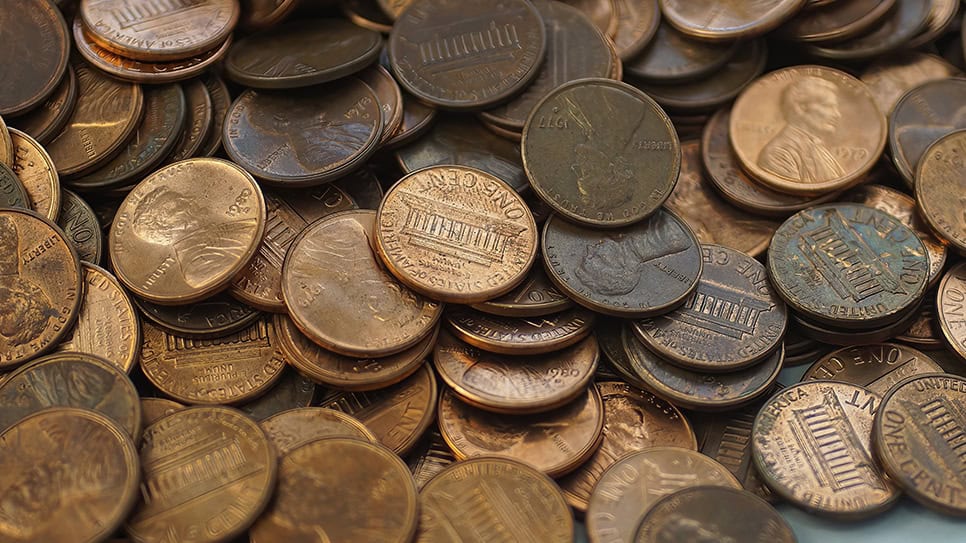
Let us mourn the demise of the American penny. With each of the one-cent coins costing about three cents to make, it was “wasteful” to keep producing them, pronounced President Trump. US pennies won’t vanish soon. While the last was minted in November 2025, about 250 billion will remain in circulation for a time despite the rising number of cash-free transactions.
The US penny has been around since 1793. Lamenting its passing is faintly obscene compared to other things that the US government has done lately, such as terminating science agencies, cutting jobs, and slashing budgets, environmental regulations and vaccine research. But I can’t stop thinking about what the penny meant to my own science education.
Science collaborators
Pennies, which until the early 1980s were 95% copper, taught me about corrosion. I learned, for instance, that the Statue of Liberty’s green colour is due to oxidized copper. At school, we were taught how to make pennies a light shade of green by immersing them in salt and vinegar; a plant food such as Miracle Gro works even better as it contains ammonia. We were then instructed to figure out how to clean off the green, discovering that an acid like lemon juice did the trick.
When I placed a drop of water on the surface of a penny, the dome-like shape it adopted – caused simply by surface tension – was an impressive sight. My first lessons on ions, meanwhile, involved placing pennies and steel nails in a bath of salt and vinegar: the nails got electroplated with copper; the pennies with zinc.
We also had to determine the density of pennies, which are 19 mm in diameter and 1.52 mm thick, by submerging them in a graduated cylinder to find their volume and the weighing them to determine their mass. From 1983 – years after my high-school career – this exercise turned more interesting still because pennies became 97.5% zinc and were only plated with copper so you had to be eagle-eyed to tell old and new apart.
Pennies were indispensable lab props too. All the kilogram weights for mechanics experiments were bags of 400 pennies (the 1983+ penny weighing exactly 2.50 g). They were great for coin-tossing in statistics classes too, although I assume other coins gave the same result, even if that was an experiment we never tried.
The humble penny wasn’t some piece of lab equipment manufactured by an educational company but a familiar part of our world.
The humble penny was effective for all these uses because it wasn’t some piece of lab equipment manufactured by an educational company but a familiar part of our world. The coins were cheap and available, and nobody cared if you lost them or took a few home.
You could stick pennies under a leg to prop up a wobbly table. They made makeshift washers if you punched in a hole and inserted nails or screws. If you were bored by the hand-cranked penny-squishing machines at tourist sites and amusement parks whose results are fully predictable, a more exciting way to deface currency would be to lay pennies on railroad tracks and hunt for the results in the stones after the train passes, though never do this because it’s dangerous.
Unit value
Pennies taught me something indirectly. After a breakup, my ex left abandoning some clothing, a cat and a large bowl containing literally thousands of pennies. The clothes I could throw out and I had to learn to love the cat. But the bowl?
I tried to put it at the bottom of my closet, but the damned thing continued to haunt me. Should I toss the bowl and its contents in the garbage? Wasteful, un-environmental and avoidant. Stuff the pennies into 50-cent coin-roll holder or take them to a coin-counting kiosk in a bank, and then present them to a teller? Psychologically unsatisfying.
No, I had to deal with the pennies doing with them what they were meant for. I must spend them. At a bar one night I tried to pay the tab using all pennies. They were legal tender, right? The bouncer was summoned. One night a taxi driver furiously threw my pennies back at me, accusing me of treating him like a waiter. I was astonished that he thought I was disrespecting him rather than engaged in post-breakup, self-absorbed infantile behaviour.
I managed to befriend a sympathetic newsstand worker who, a few times a week, was willing to let me buy the New York Times all in pennies.
I could only use the fundamental unit of US currency in anomalous circumstances that I had to generate myself. In those days the New York Times cost 35 cents and I managed to befriend a sympathetic newsstand worker who, a few times a week, was willing to let me buy it all in pennies. He’d cheerfully greet me with “Here come my pennies!” and claimed I was becoming a better person now I was greeting vendors with smiles, not scowls.
Wine, skis, clocks, bones: why Linn Hobbs lives in a material world

I learned to work the monetary system methodically. For things that cost a little over 25 cents, I used a quarter and then pennies for what was left; for things that cost a little over a dollar I handed over a bill and the rest in pennies. I’d choreograph my purchases in advance so that I could use the appropriate lesser unit of currency plus pennies.
I often exploited the fact that sales tax in the US is only added on at the till, which means that something priced $2 with a sales tax of 6.5% will be $2.13 when you pay the cashier. So I’d hunt around in my pocket for a moment, and then in feigned chagrin say that I only had pennies, and hand cashier the 13 of them that I had carefully calculated beforehand would be needed.
Soon, keeping exacting track of purchases, I managed to spend an average of about 200 pennies a week. From day to day and even week to week the pile in the bowl barely dwindled. But, finally, after a little less than a year only a handful remained. I was thrilled – it was better than seeing a therapist.
The critical point
You might think that the moral I’m about to draw is the need for faith in incremental change – that, penny by penny, you can move mountains. That’s certainly the lesson teachers urge on you if you’re learning a foreign language or playing a musical instrument.
No, I was instead moved by the humbler experience of valuing an entire system of units moored to a stable, familiar, simple but all-important base unit that you can literally count on.
I still value that lesson, though it’s less concrete than what I learned from corroded, nailed or squished pennies.