A new way of extracting energy from ocean waves has been proposed by a researcher in Japan. The system couples a gyroscope to an electrical generator and could be fine tuned to extract energy from a wide range of wave conditions. A prototype of the design is currently being built for testing in a wave tank. If successful, the system could be used to generate electricity onboard ships.
Ocean waves contain huge amounts of energy and humans have tried to harness this energy for centuries. But, despite the development of myriad technologies and a number of trials, the widespread commercial conversion of wave energy remains an elusive goal. One important problem is that most generation schemes only work within a narrow range of wave conditions – and the ocean can be a very messy place.
Now, Takahito Iida at the University of Osaka has proposed a new energy-harvesting technology that uses gyroscopic flywheel system that can be tuned to absorb energy efficiently over a broad range of wave frequencies.
“Wave energy devices often struggle because ocean conditions are constantly changing,” says Iida. “However, a gyroscopic system can be controlled in a way that maintains high energy absorption, even as wave frequencies vary.”
Wobbling top
At the heart of the technology is gyroscopic precession, whereby a torque on a rotating object causes the object’s axis of rotation to trace out a circle. This is familiar to anyone who has played with a spinning top, which will wobble (precess) when perturbed.
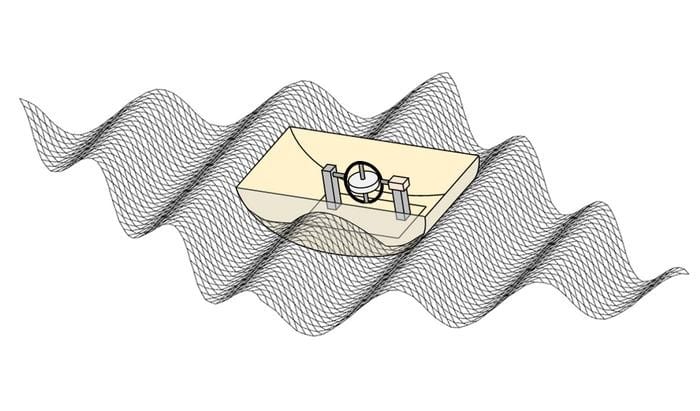
Iida’s device is called a gyroscopic wave energy converter and comprises a spinning flywheel mounted on a floating platform (see figure). On calm seas, the gyroscope’s axis of rotation points in a fixed direction thanks to the conservation of angular momentum. However, waves will cause the platform to pitch from side-to-side, exerting torques on the gyroscope and causing it to precess. It is this precession that drives a generator to deliver electrical power.
To design the system, Iida used linear wave theory to model the coupled interactions between waves, the platform, the gyroscope and the generator. This allowed him to devise a scheme for tuning the gyroscope frequency and generator parameters so that an energy conversion efficiency of 50% is achieved for a variety of wave conditions.
The effect of the generator was modelled as a spring-damper. This is a system that responds to a torque by storing and then returning some energy to the gyroscope (the spring), and removing some energy by converting it to electricity (the damper). Iida discovered that a maximum conversion of 50% occurs when the spring coefficient of the generator is adjusted such that the gyroscope’s resonant frequency matches the resonant frequency of the floating platform.
Fundamental constraint
Iida explains that 50% is the maximum efficiency that can be achieved. “This efficiency limit is a fundamental constraint in wave energy theory. What is exciting is that we now know that it can be reached across broadband frequencies, not just at a single resonant condition.”
Turning water into watts

Iida tells Physics World that a small prototype (approximately 50 cm3 in size) is being built and will be tested in a 100 m-long tank.
The next step will be the development of a system with a generating capacity of about 5 kW. Iida says that the ultimate goal is a 300 kW generator.
Iida also explains that the gyroscopic wave energy converter is designed to operate untethered to the seabed. As a result he says the system would be ideal for use as an auxiliary power system for a ship. “The target output of 300 kW is based on the assumed auxiliary power demand of a typical commercial vessel,” says Iida.
The research is described in the Journal of Fluid Mechanics.