Like ESA’s recent Hipparcos mission, FAME will use the parallax method to determine the stars’ positions: as the telescope and the Earth orbit the sun, the position of the stars will chang...
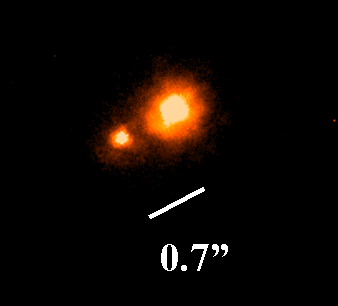
When the astronomers – Rodrigo Ibata from the European Southern Observatory, Harvey Richer and Douglas Scott from the University of British Columbia in Canada, and Ronald Gilliland from the Spac...
The image of G21.5-0.9, a supernova remnant which is 16,000 light years from Earth, shows a bright central source (the neutron star) with bright nebula and surrounded by a much larger diffuse cloud. T...
The European satellite organisation Eumetsat will update pictures every 10 minutes of the Moon’s shadow as it rushes across the globe. Meanwhile, the European Space Agency has brought together a...
The team were able to measure the distance because NGC4258 is one of 22 nearby galaxies that have active nuclei consisting of a supermassive black hole (over 100 million solar masses) surrounded by a ...
X-ray observations with Chandra will complement infrared images from the Hubble Space Telescope and higher-energy observations by the Compton Gamma Ray Observatory. Chandra will have a resolution that...
The meeting, “Preserving the Astronomical Sky,” was held in Austria a few days before UNISPACE III, a major conference sponsored by the United Nations (UN) that will look at the impact and...
Space agencies have become increasingly concerned about space debris after both the Russian Mir Space Station and the US Space Shuttle were damaged by flecks of paint travelling at over 13 kilometres ...
Gemini-North is situated on top of Mauna Kea, an extinct volcano some 4200 meters above sea level. Mauna Kea is a popular location for telescopes because of its high altitude and clear skies. The 8-me...
The results help to confirm the view that other planetary systems form in ways similar to our solar system. The Kuiper belt is a disk of dust, gas and icy comets stretching from 40 to 10000 times the ...