Shapiro steps spotted in ultracold bosonic and fermionic gases
Research could lead to a standard for chemical potential
 Read article: Shapiro steps spotted in ultracold bosonic and fermionic gases

Research could lead to a standard for chemical potential
Read article: Shapiro steps spotted in ultracold bosonic and fermionic gases
Reducing atom loss and re-using already-measured atoms enables more complex quantum computations
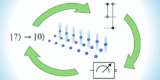 Read article: Qubit ‘recycling’ gives neutral-atom quantum computing a boost
Quantum simulator enables scientists to test laws of transport phenomena at the quantum level
 Read article: Atomic system acts like a quantum Newton’s cradle
Physicists plan to test idea in the lab
 Read article: Radioactive BEC could form a ‘superradiant neutrino laser’
Although it hasn’t detected dark matter yet, its developers say it offers an alternative path that is worth exploring
 Read article: New experiment uses levitated magnets to search for dark matter
Innovative imaging technique reveals real space correlations between atoms in quantum systems
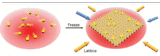 Read article: Physicists take ‘snapshots’ of quantum gases in continuous space
Further research could shed light on neutron-star glitches
 Read article: Quantized vortices seen in a supersolid for the first time
New cooling technique could help reveal physics beyond the Standard Model
 Read article: Positronium gas is laser-cooled to one degree above absolute zero
System could be used to simulate superconducting bilayer graphene
 Read article: Bilayer of ultracold atoms has just a 50 nm gap
Molecules cooled to their quantum ground state
 Read article: Individual polyatomic molecules are trapped in optical-tweezer arrays