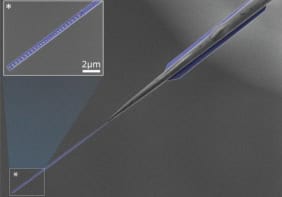

New use for photolithography could have applications for data storage
Calculations explain curious properties of some 2D materials
Finding could be important for catalysis and other thermally-activated industrial processes
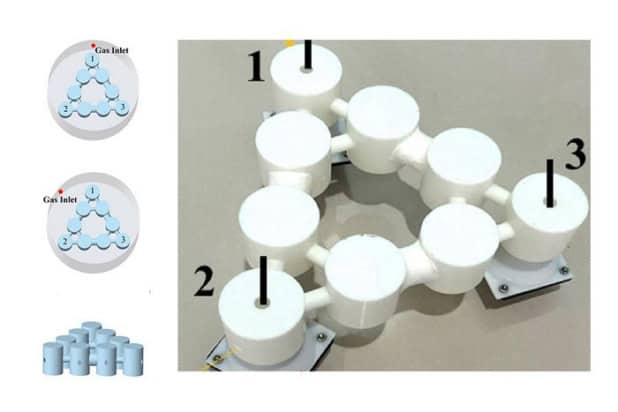
Topological kagome tubes isolate vibrations to one end, keeping the other end safe
Superconducting germanium could find application in a new generation of quantum devices
Bulk conductivity may have been hiding the dynamics of surface charge transfer, say researchers
New alloy is made by doping scandium into the well-known La-H binary system
Rayleigh–Taylor instability responsible for mushroom clouds appears in a two-component BEC
Physicists have designed a protocol to study high-temperature superconductivity on an experimentally realizable platform
Whether you’re still working out your career pathway or have a specific role in mind, we’re here to help. Bringing a diverse range of opportunities for jobseekers at all career stages, we’ll help you take the next step in your career and find your perfect job.

Low-energy electron emission spectra depend on sample thickness
 Read article: Doorway states spotted in graphene-based materials
New experiments and calculations could improve aerosol and microfluidic technologies while shedding more light on airborne disease transmission
 Read article: Physicists explain why some fast-moving droplets stick to hydrophobic surfaces
Researchers in Japan have succeeded in switching a manganese-tin nanodot using electric current pulses as short as 0.1 ns
 Read article: Antiferromagnets could be better than ferromagnets for some ultrafast, high-density memories
Physicists model vacuum tunnelling in a simple system
 Read article: Schwinger effect appears in a 2D superfluid
Effect could come in useful for a host of practical applications that call for fluid control
 Read article: Meniscus size and shape affect how liquid waves move through barriers
Accessible systems is classical and operates at room temperature
 Read article: Space–time crystal emerges in a liquid crystal
Observation of the Meissner effect could spur the development of highly sensitive quantum detectors that operate under high-pressure conditions
 Read article: Quantum sensors reveal ‘smoking gun’ of superconductivity in pressurized bilayer nickelates
Images are the first experimental evidence of long-predicted low-energy atomic vibrations called moiré phasons in twisted 2D materials
 Read article: Highest-resolution images ever taken of a single atom reveal new kind of vibrations
Superheated gold stays solid at temperatures far beyond the predicted "entropy catastrophe"
 Read article: How hot can you make a solid before it melts?
Ratcheting effect could lead to better de-icing
 Read article: Melting ice propels itself across a patterned surface
Discovery could lift theoretical constraints on calculations achievable with certain types of topological quantum computers
 Read article: Predicted quasiparticles called ‘neglectons’ hold promise for robust, universal quantum computing
Machine-learning-based molecular simulations reveal unexpected crystallization pathway
 Read article: Graphite ‘hijacks’ the journey from molten carbon to diamond
Simulations and experiments indicate that the low-density amorphous ice found on comets and icy moons is not, in fact, entirely amorphous
 Read article: Space ice reveals its secrets
Monte Carlo method combines billions of diagrams related to polarons
 Read article: Feynman diagrams provide insight into quasiparticles in solids
Evidence for “emergent photons” seen in frustrated antiferromagnet
 Read article: Hints of a 3D quantum spin liquid revealed by neutron scattering
Join the audience for a live webinar at 3 p.m. BST/10 a.m EDT on 27 August 2025
If you use or teach the Butler-Volmer equation, join us to learn the latest advances
 Read article: The Butler-Volmer equation revisited: effect of metal work function
Scanning-tunnelling microscope with a superconducting tip could help uncover materials for next-generation quantum computers
 Read article: New microscopy technique can identify topological superconductors
"Remarkable" new model of quantum double-exchange ferromagnets could produce fresh insights into these technologically-important materials
 Read article: New mechanism explains behaviour of materials exhibiting giant magnetoresistance