



Medical physicist, inventor and entrepreneur Brian Pogue is our podcast guest
New coiled device could rival expensive magnet facilities, say scientists
Carbon-rich “schmutz” determines how charge moves between objects made from identical insulating oxides
System could shed light on emergent periodic phenomena in biological systems
 Read article: Time crystal emerges in acoustic tweezers
Hidden coated materials could be detected using new technique
 Read article: Transfer learning could help muon tomography identify illicit nuclear materials
Passive system could give quantum sensors a boost
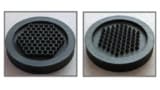 Read article: Pockets and pillars capture ricocheting molecules in vacuum pump
Electron undulator amplifies X-ray beam
 Read article: Cavity-based X-ray laser delivers high-quality pulses
Deformed nucleus makes multi-ion design easier
 Read article: Ion-clock transition could benefit quantum computing and nuclear physics
Device works by monitoring frequency of sound waves propagating through a kagome material
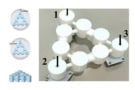 Read article: New sensor uses topological material to detect helium leaks
Science is done in just about every corner of the globe but many researchers lack access to the cutting-edge instrumentation available at large facilities such as synchrotron light sources and neutron-science centres. Widening this accessibility is an important theme running through this free-to-read briefing.

Impulsonics’ “surround sound” technology frees-up living cells
 Read article: Ultrasound system solves the ‘unsticking problem’ in biomedical research
NPL has joined forces with other leading National Metrology Institutes to shape the international standards effort in quantum technologies
 Read article: Joined-up thinking in quantum metrology: why collaboration is the secret of success
Precision timekeeper is just 5% the size of a conventional clock
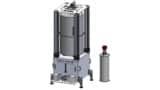 Read article: NPL unveils miniature atomic fountain clock
New device could be used to observe structures as small as individual proteins, as well as the environment in which they move
 Read article: Bidirectional scattering microscope detects micro- and nanoscale structures simultaneously
Finding could have applications in acoustic-levitation-assisted 3D printing, mid-air chemical synthesis and micro-robotics
 Read article: Physicists overcome ‘acoustic collapse’ to levitate multiple objects with sound
Devices could eliminate the strong magnetic fields currently required to define the standard unit of resistance
 Read article: Memristors could measure a single quantum of resistance
High-precision laser spectroscopy measurements on the thorium-229 nucleus could reveal new physics, say TU Wien physicists
 Read article: Looking for inconsistencies in the fine structure constant
New technique could shed light on electrification of aerosols
 Read article: Electrical charge on objects in optical tweezers can be controlled precisely
"Beamforming feedback information" in latest version of the technology can identify individuals passing through radio networks with almost 100% accuracy, say researchers
 Read article: Is your WiFi spying on you?
Having more antimatter could help solve profound mysteries of physics
 Read article: Sympathetic cooling gives antihydrogen experiment a boost
Europe’s largest event for electronics manufacturing comes to Munich on 18−21 November, 2025
 Read article: SEMICON Europa 2025 presents cutting-edge technology for semiconductor R&D and production
Research could lead to ultracompact muon sources for applications such as tomography
 Read article: Portable source could produce high-energy muon beams
Compact system outperforms astronomical spectrometers
 Read article: Randomly textured lithium niobate gives snapshot spectrometer a boost
Novel imaging technique can find objects buried within in opaque environments, including biological tissues
 Read article: Fingerprint method can detect objects hidden in complex scattering media
Advanced seismic imaging techniques could improve earthquake early warning models and aid the development of next-generation geothermal power
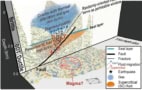 Read article: Scientists obtain detailed maps of earthquake-triggering high-pressure subsurface fluids
Global network could pinpoint astronomical sources
 Read article: Phase shift in optical cavities could detect low-frequency gravitational waves
New algorithm turns structured motion into sharper images
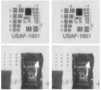 Read article: Motion blur brings a counterintuitive advantage for high-resolution imaging
With further improvements, the instrument could enable direct tests of relativistic effects
 Read article: Optical gyroscope detects Earth’s rotation with the highest precision yet