
Want more in this topic? Physics World now has a newsletter dedicated to particle and nuclear physics. To sign up, go to My account then click on "My alerts".
New book provides an essential guide to the science, regulatory landscape and real world practice of radiological protection
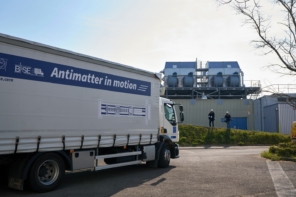
Truck was used last month to transport 92 antiprotons around CERN
.
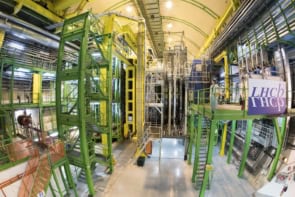
LHCb spots elusive particle in just one year of data
 Read article: Heavier cousin of the proton discovered at the LHC
Electron undulator amplifies X-ray beam
 Read article: Cavity-based X-ray laser delivers high-quality pulses
ALICE collaboration identifies three-phase process that allows particles to form despite energetically unfavourable conditions
 Read article: CERN team solves decades-old mystery of light nuclei formation
CMS Collaboration focuses on a family of three all-charm exotic hadrons
 Read article: Tetraquark measurements could shed more light on the strong nuclear force
CERN’s ATLAS experiment confirms previous observation by CMS
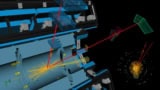 Read article: Higgs decay to muon–antimuon pairs sheds light on the origin of mass
GeV-scale bremsstrahlung from an electron accelerator can be used to produce copper-64 and copper-67
 Read article: Leftover gamma rays produce medically important radioisotopes
From the Higgs boson at CERN to nuclear reactions inside stars, who doesn’t love particle and nuclear physics? There’s so much exciting work going on in both fields, which is why we’re bringing you this new free-to-read digital issue of the Physics World Particle & Nuclear Briefing.
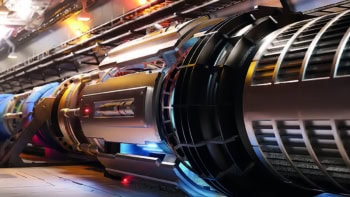
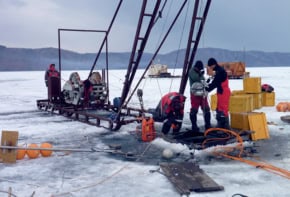
Little evidence of radionuclide accumulation in vessel's surrounding environment
 Read article: Sunken nuclear submarine is leaking radioactive material intermittently
This is the fifth international photowalk following events held in 2010, 2012, 2015 and 2018
 Read article: Inside the world’s particle‑physics labs: Global Physics Photowalk 2025 winners revealed
A consultancy firm with expertise in radiation safety can help companies developing a new generation of commercial fusion reactors to navigate the regulatory framework
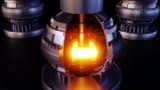 Read article: Licensing puts the power into nuclear fusion
Early-career physicist Natasha Khan talks about her journey to becoming a nuclear safety engineer
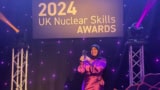 Read article: A physicist’s journey into nuclear energy
Plasma physicist Debbie Callahan, chief strategy officer at Focused Energy, talks to Hamish Johnston about her work in laser fusion research
 Read article: Focusing on fusion: Debbie Callahan talks commercial laser fusion
Honor Powrie looks at the perils and plus-sides of nuclear-powered transport
 Read article: Nuclear-powered transport – how far can it take us?
Jim Smith reflects on the 1986 disaster and how it still shapes public perception of nuclear power
 Read article: Chernobyl at 40: physics, politics and the nuclear debate today
LHCb spokesperson-elect Tim Gershon is our podcast guest
 Read article: LHCb upgrade: CERN collaboration responds to UK funding cut
Robert P Crease reports from a conference at CERN on particle physics in the 1980s and 1990s
 Read article: The future of particle physics: what can the past teach us?
Mats Larsson and Ramon Wyss reveal why Chien-Shiung Wu never won a Nobel prize
 Read article: Twenty-three nominations, yet no Nobel prize: how Chien-Shiung Wu missed out on the top award in physics
Michael Riordan calls on CERN to face financial and geopolitical reality
 Read article: The Future Circular Collider is unduly risky – CERN needs a ‘Plan B’
Plasma physicist Debbie Callahan is our podcast guest
 Read article: Laser fusion: Focused Energy charts a course to commercial viability
Robert P Crease reveals the curious twist in the development of Chinese physics in the 1960s
 Read article: The obscure physics theory that helped Chinese science emerge from the shadows
Cash comes as Mark Thomson takes the reins at CERN
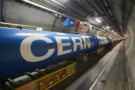 Read article: CERN accepts $1bn in private cash towards Future Circular Collider
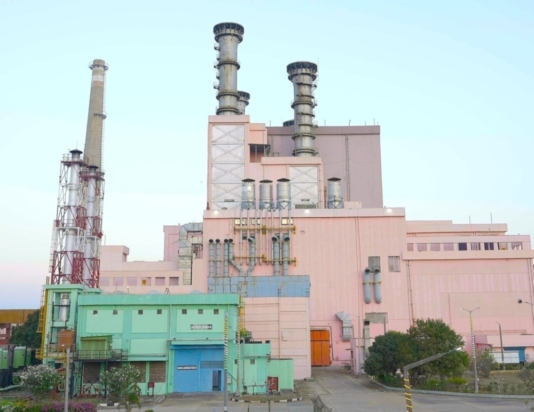
While SMRs could help meet climate targets there are concerns over their commercial viability
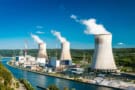 Read article: India turns to small modular nuclear reactors to meet climate targets
Astrophysics, archaeology, neutrino lasers and more
 Read article: Particle and nuclear physics: quirky favourites from 2025
Fourth flavour not seen in beta-decay and oscillation
 Read article: Sterile neutrinos: KATRIN and MicroBooNE come up empty handed
The Helen Edwards Engineering Research Center is designed to act as a collaborative space for scientists and engineers
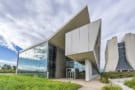 Read article: Fermilab opens new building dedicated to Tevatron pioneer Helen Edwards