Tetraquark measurements could shed more light on the strong nuclear force
CMS Collaboration focuses on a family of three all-charm exotic hadrons
 Read article: Tetraquark measurements could shed more light on the strong nuclear force

CMS Collaboration focuses on a family of three all-charm exotic hadrons
Read article: Tetraquark measurements could shed more light on the strong nuclear force
Work on radium monofluoride could shed light on the asymmetry of matter and antimatter in the universe
 Read article: Physicists use a radioactive molecule’s own electrons to probe its internal structure
High-precision laser spectroscopy measurements on the thorium-229 nucleus could reveal new physics, say TU Wien physicists
 Read article: Looking for inconsistencies in the fine structure constant
New atom-by-atom technique demonstrated for the first time with nobelium might ensure that elements at the bottom of the table are grouped correctly
 Read article: Making molecules with superheavy elements could shake up the periodic table
Measurements could improve our understanding of the strong nuclear force and the formation of elements
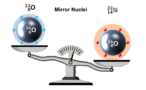 Read article: Physicists discover a new proton magic number
Starquakes and magnetic recombination drive the r-process of nucleosynthesis
 Read article: How magnetar flares give birth to gold and platinum
Asymmetric fission landscape emerges from nuclear shell effects
 Read article: Subtle quantum effects dictate how some nuclei break apart
Particle-accelerator study focuses on the r-process thought to be responsible for forming elements heavier than iron
 Read article: Helium nanobubble measurements shed light on origins of heavy elements in the universe
Device could be used to power microelectronics like microchips
 Read article: Photovoltaic battery runs on nuclear waste
Unexplained peak in the abundance of beryllium-10 in ferromanganese ocean crusts could become an independent time marker for geological dating
 Read article: Radioactive anomaly appears in the deep ocean