Cheap electrocatalysts convert CO2 to CO using solar cells

Researchers in Switzerland and Spain have developed a solar-driven electrolyser that converts CO2 to CO using only Earth-abundant elements in place of precious metals. Reducing emissions of CO2 by converting it electrochemically to CO is an attractive prospect due to the potential use of CO as a precursor to fuels and high-value chemicals. The work leads the way to further exploration of Earth-abundant metals that might perform comparably to the rare elements used until now.

The conventional method to convert CO2 to CO uses precious-metal catalysts (gold, silver, palladium) at considerable overpotentials and also requires electrolyte additives. What this research has demonstrated is an innovative, inexpensive and stable alternative using a bifunctional system of SnO2-modified CuO electrodes separated by a bipolar membrane and driven by a solar cell. This newly developed system constitutes a milestone for the catalysis community as it avoids the requirement – until now – of noble metals.

Preparing and testing the electrodes

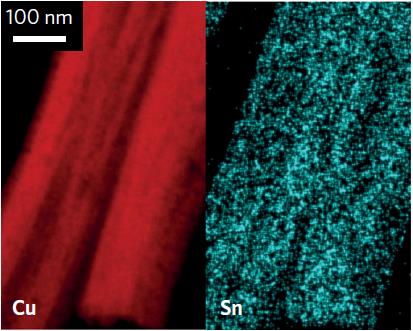
The team, led by Jingshan Luo and Michael Grätzel of École Polytechnique Fédérale de Lausanne (EPFL), anodized copper films to produce CuO nanowires (figure 1), and then applied an SnO2 coating by atomic-layer deposition (ALD). The synthesized electrodes’ structure and shape were characterized by X-ray diffraction and energy-dispersive spectroscopy (figure 2).
To evaluate the prepared electrodes, the researchers compared the CO selectivity of their SnO2-coated electrodes to the bare CuO equivalents. CO selectivity is a measure of the moles of CO2 converted to CO in relation to the total moles of all products. The unmodified electrodes achieved a 36% CO selectivity, while the new, surface-modified, electrodes reached 97%.

The spent electrodes exhibit copper in a metallic state coexisting with metastable tin and copper oxides. The researchers attribute the presence of these metastable oxides to enhanced CO2 reduction activity. Still, further work is needed to fully address this issue under electrochemical conditions.

Understanding how they work

The group measured the evolution rates of H2 and CO at their respective current densities. At higher overpotentials, the unmodified samples primarily yielded hydrogen and other carbon-containing products, but this was inhibited by SnO2addition. Thus, the boost in CO selectivity for the modified electrodes was shown to be due to the suppression of hydrogen production.
Gas adsorption experiments showed that the binding strength of both CO and adsorbed hydrogen was substantially decreased with the SnO2-coated electrodes. The lower hydrogen availability restrains the reduction of CO to alcohols and hydrocarbons while CO’s weaker binding strength on copper is comparable to that exhibited for noble metals like gold and silver. The results from this experiment and the electrochemical tests suggest that SnO2 and CuO are working cooperatively.

Constructing the bifunctional solar-driven device for CO2reduction

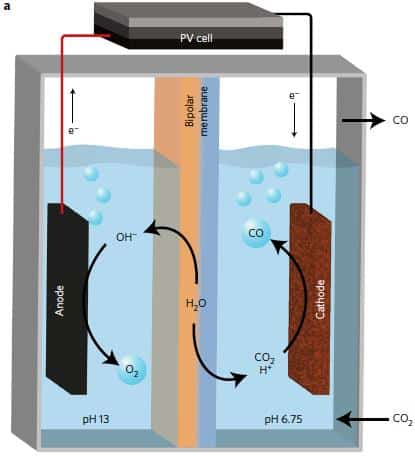
A complete electrochemical system needs a cathode for CO2reduction, an anode for water oxidation, and a membrane for product separation. Grätzel and collaborators used the same cathode composition of SnO2-coated CuO to build the anode. Gas chromatography measurements confirmed oxygen production with no sign of anode corrosion, proving that SnO2-coated CuO electrodes can be used for both CO2 reduction and electrochemical oxidation of water.

The remaining challenge the researchers addressed was that each reaction requires an environment with a different pH. To solve this problem, the scientists utilized a bipolar membrane consisting of an anion exchanger on the anode side and a cation exchanger on the cathode side, allowing the use of a different electrolyte solution in each compartment. Finally, the solar-driven device was completed using a single three-junction GaInP/GaInAs/Ge photovoltaic (PV) cell, seen in figure 3. This was tested with simulated sunlight at room temperature, and achieved a solar-to-CO free-energy conversion efficiency of up to 13.4%.

There is no doubt that Grätzel and colleagues have constructed a novel, bifunctional and cost-efficient device for catalytic conversion for energy applications. This work will lead to new ways to alter the surfaces of plentiful and inexpensive elements in order to reach catalytic activities that rival or even surpass those of the noble metals.

Full details of the work can be found in Nature Energy.

Could volcanic eruptions be predicted using satellite observations?

A new way of monitoring volcanic activity by integrating ongoing satellite measurements into dynamic models has been demonstrated by researchers from France. Based on data assimilation, the method might one day allow for real-time eruption forecasts in volcanic regions.

As magma moves beneath the Earth’s surface – such as under a volcano – the ground above flexes. These ground movements can be measured using both GPS and satellite-based radar data, and used to develop models of the depth and shapes underlying magma reservoirs.

A limitation of many of these models, however, is that they are kinematic in nature – focusing on motion alone. This makes them unable to yield information on the pressures of the underlying magma system. This is important in determining when a magma chamber will rupture and the volcano’s capacity to feed any resulting eruption. The surface disruption caused by a small pressure change in a large magma chamber may look identical to a large pressure change in a small magma chamber, for example – even though the latter case is more likely to lead to an eruption.

Dynamic models

To distinguish between such scenarios, volcanologists must use dynamic models that can consider how the surface displacements change with time. A small chamber, for example, would pressurize much faster than a large chamber. Most dynamic models tend to be based on data inversion and require extensive calculation and the incorporation of all observations beforehand. This makes them unsuitable for real-time eruption forecasting because they are unable to incorporate ongoing measurements.

In their new study, geophysicist Mary Grace Bato and colleagues at the Institut des Sciences de la Terre in Grenoble have addressed this issue by turning to data assimilation. This is a time-stepping approach that combines models, observations and error statistics to forecast the state of a dynamic system. Data assimilation has long been used to produce weather forecasts and predict the effects of greenhouse-gas emissions.

We foresee a future where daily or even hourly volcanic forecasts will be possible – just like any other weather bulletin
Mary Grace Bato, Institut des Sciences de la Terre

The researchers simulated the ground deformation caused by a simple, two-chambered volcanic system, and then tested the capacity of a data-assimilation approach to interpret the results. They found that the approach was able to predict the evolution of the magma pressure. It could also constrain both the shape of the deepest reservoir and the rate of the basal magma flow into this chamber – providing results comparable with existing inversion methods.

“Data assimilation offers great potential for assessing volcanic unrest,” comments Bato, concluding: “We foresee a future where daily or even hourly volcanic forecasts will be possible – just like any other weather bulletin.”

While bulletins may be some way off – and require improvements in existing volcanic models for widespread application – Bato is optimistic about the potential of data-assimilation methods in volcanology. To that end, the researchers are now looking to apply their new approach to two real-life case studies: the Grímsvötn volcano in Iceland and Alaska’s Mount Okmok.

New forecast models

“Applying cutting-edge statistical approaches to active volcanoes is the first step towards developing a new generation of volcano forecast models,” says Patricia Gregg, a geophysicist from the University of Illinois at Urbana-Champaign. Advancements such as these, she adds, “are critical to take full advantage of the excellent data made available through new satellite missions as well as data collected by volcano observatories around the world”.

“For people working in volcano observatories, it is crucial to anticipate eruptions early enough to warn local authorities. However, providing an unequivocal identification of volcano reawakening remains a challenging problem,” comments Aline Peltier, a volcanologist who works at the Piton de la Fournaise volcanic observatory on Réunion Island in the Indian Ocean, where warnings of an eruption are only possible a few hours before its onset. The potential of such complementary methods to estimate magma-chamber pressurization weeks before the event, she notes, would be “of prime importance for eruptive risk mitigation”.

The research is described in Frontiers in Earth Sciences.

Infused Antarctic ice could boost neutrino detection


The sensitivity of the IceCube Neutrino Observatory at the South Pole could be boosted by adding optical materials to the icy boreholes that contain its detectors – according to physicists in the US.

Encompassing 1 km3 of ice, IceCube comprises 86 cables, each up to 2.5 km long, suspended inside vertical boreholes in the ice. Attached to each cable are dozens of photomultiplier tubes (see figure), which record the Cherenkov radiation given off by the secondary particles created when incoming neutrinos collide with nuclei inside the ice.

In 2013, IceCube made the first every detection of cosmic neutrinos from throughout the universe and physicists are now thinking about how the detector could be upgraded. In a preprint on arXiv, Imre Bartos, Zsuzsa Marka and Szabolcs Marka of Columbia University in New York describe how filling sections of the boreholes with materials with desirable optical properties could boost IceCubes’s detection efficiency.

Index increase

They first looked at the effect of surrounding each photomultiplier tube detector with a material with a higher index of refraction than ice – the idea being that the change in refractive index will focus light towards the photomultiplier tubes. The found that for every 0.1% increase in the material’s index of refraction, a 10% increase in light flux to the photomultipliers could be achieved.

The trio also looked at the effect of filling parts of the boreholes with a material that would shift the wavelength of the Cherenkov light from ultraviolet to visible wavelengths – the latter being easier to detect using photomultiplier tubes. Their calculations suggest that filling most of a borehole with a wavelength shifter, but not the region immediately surrounding each detector, could lead to a very large increase in sensitivity.

The team does, however, point out several challenges that would have to be overcome to implementing its scheme. These include dealing with the natural radioactivity of the optical materials and the effect of freezing on the optical properties.

The underlying physics of natural hazards

Natural hazards threaten lives and livelihoods across the globe and can result in huge financial costs. Despite significant progress in understanding hazards, we are still feeling powerless and inadequate in the aftermath of destructive events, which can strike with little warning and often affect vulnerable communities. One of the core missions of the US Geological Survey (USGS) is to conduct research into a range of natural hazards so that the public and policymakers can be better prepared for these events.

At the Menlo Park Science Center in California, USGS scientists are engaged in a range of basic and applied research. In our first video (above), geophysicist Eric Geist explains his studies into the mechanics of tsunamis – giant waves that can wreak havoc on coastal communities and infrastructure. Geist is particularly interested in tsunamis triggered by earthquakes occurring at subduction zones on the seafloor, regions where oceanic plates slides underneath continental plates.

One of the other major hazards affecting the west coast of the US is the threat of large earthquakes. Often they occur along the San Andreas fault, which forms the tectonic boundary between the Pacific Plate and the North American Plate. In our second video (below), you can take a look inside a couple of different earthquake labs at Menlo Park. Brian Kilgore spends his days triggering mini earthquakes on a bench-top and examining their characteristics. Meanwhile, David Lockner works in the rock deformation and friction laboratory where he recreates the conditions in the Earth under which earthquakes occur. This often involves subjecting rock samples to extreme pressures and temperatures and examining how they respond.

To find out more about the science of natural hazards, check out the July issue of Physics World, a special issue that includes feature articles on wildfires, tornadoes and “slow” earthquakes. Physics World‘s editor Matin Durrani introduces that special issue on our blog.

Our hazardous planet: when the world is out to get you

PWJul17cover-200By Matin Durrani

For people afflicted by last month’s devastating fire at Grenfell Tower in London or for those caught up in recent terrorist atrocities, it can seem that many problems in this world are entirely of our own making.

Yes the modern world has benefited from our collective wisdom and creativity – especially through science and engineering – but often it feels as if irrational human behaviour lies at the root of many of our troubles.

Nevertheless, we should remember that our planet itself holds many natural hazards too, as the latest special issue of Physics World reminds us.

Remember that if you’re a member of the Institute of Physics, you can read Physics World magazine every month via our digital apps for iOS, Android and Web browsers.

(more…)

Trump revives US National Space Council

US president Donald Trump has signed an executive order to re-establish the US National Space Council. The council will include key government officials with an interest in space exploration, including the NASA acting administrator Robert Lightfoot and the secretaries of state, commerce and defence. The council will be chaired by US vice president Mike Pence and will also include a “Users’ Advisory Group” that will represent the interests of industries and other organizations not associated with the federal government.

The council had existed in 1989–1993 during the presidency of George H W Bush. A previous incarnation called the National Aeronautics and Space Council was in place in 1958–1973.

Deep interest

Lightfoot says that the council will “ensure that all aspects of the nation’s space power – national security, commerce, international relations, exploration and science – are co-ordinated and aligned to best serve the American people”. He adds: “The establishment of the council is another demonstration of the Trump Administration’s deep interest in our work, and a testament to the importance of space exploration to our economy, our nation, and the planet as a whole.”

Canada’s birthday physics, Liberty’s true colours, Trump’s Science cover

Tomorrow (1 July) is the 150th birthday of Canada. Or more precisely the anniversary of the day when three British colonies (one of which was already called Canada) joined together and started the long and peaceful journey to becoming fully independent of the UK in 1982. How very Canadian, and I should know because I am one of the 36 million Canadians who will be celebrating tomorrow.

Synonymous with physics in Canada over the past decade or so is the Perimeter Institute for Theoretical Physics in Waterloo, Ontario. Folks there have put together a selection of “13 physics innovations you may not know are Canadian”. I wasn’t aware of some of the innovations, including the work of Harriett Brooks (above). But I am pleased to say that I have met both of the physics Nobel laureates mentioned in the article – Art McDonald and Bert Brockhouse.

(more…)

NEMO-3 hunts for ultra-rare beta decay

For the best part of 30 years, physicists have been looking for a very rare nuclear process known as neutrinoless double beta decay. With discovery still elusive, an international team of researchers led by Pawel Guzowski and colleagues at the University of Manchester have now turned their attention to an even rarer process called neutrinoless quadruple beta decay. As expected, their first search has drawn a blank. But they say it is worth persisting, given the potential prize on offer: an explanation for the universe’s matter/antimatter asymmetry.

In normal beta decay, an electron and an antineutrino are emitted from a nucleus within which a neutron transforms into a proton. There are also several dozen isotopes that have been shown to undergo double beta decay, in which two neutrons turn into two protons and emit two electrons plus two antineutrinos. But what physicists have been keen to observe, so far without success, is the neutrinoless version without the emission of any antineutrinos.

The discovery of this phenomenon, if real, would be huge news in physics, since it would defy the never previously violated conservation of lepton number – protons and neutrons having a lepton number of zero while electrons and neutrinos are +1 and their antimatter counterparts –1. Such a violation in turn might explain the dominance of matter over antimatter, since it would reveal a process that yields a slight excess of matter.

Majorana particles

Neutrinoless double beta decay would also mean that the neutrino is its own antiparticle, a so-called Majorana particle. This is because an antineutrino emitted by one of the two decaying neutrons could be absorbed by the other neutron as a neutrino, leading to no neutrino output. In contrast, the quadruple form of the decay would allow the neutrino to be a Dirac particle, like every other particle in the Standard Model, which is not the mirror image of itself.

Neutrinoless quadruple beta decay was proposed theoretically by Julian Heeck and Werner Rodejohann of the Max Planck Institute for Nuclear Physics in Heidelberg, Germany, in 2013. The pair found that by adding three right-handed neutrinos to the existing trio of left-handed neutrinos in the Standard Model, as well as two new scalar particles, which are similar to the Higgs boson, the (virtual) neutrinos emitted in the simultaneous beta decay of four neutrons would annihilate one another before they could be emitted from the nucleus in question.

“Before we published our paper the common opinion was that Dirac neutrinos conserve lepton number,” says Rodejohann. “We pointed out that Dirac particles can in fact violate lepton number, but by four units, say, rather than two.”

Energy boost

The Heidelberg researchers point out that the only nuclei that could undergo this decay are those for which the transformation of just one neutron into a proton boosts their energy – so forbidding normal beta decay, which would otherwise predominate – while the transformation of four neutrons makes them less energetic. They have identified just three such isotopes – zirconium-96, xenon-136 and neodymium-150 – of which the latter is best, they say, because it releases the greatest amount of energy during the decay, so making it more detectable.

Indeed, it is that nucleus that has been used in the Manchester-led research. The work was carried out at the NEMO-3 experiment at the Modane Underground Laboratory in France. This comprises a 3 × 5 m cylindrical detector consisting of thin foils of various isotopes – including 37 g of neodymium-150 – surrounded by tracking chambers and calorimeters. Although optimized to search for neutrinoless double beta decay, the detector’s ability to plot the trajectories of individual emitted particles also makes it well suited to the new line of research.

NEMO-3 has not collected new data, but rather physicists have analysed existing events recorded in its detector between 2003 and 2011. The researchers looked for events generating either three or four particles (in the former, one of the emitted electrons would be reabsorbed by the neodymium foil). Doing so, they found no evidence for events beyond those expected from background radioactive processes. But they were able to stipulate a first lower bound on the process’s half-life – some 1021 years.

Forty orders of magnitude

Steven Elliott of the Los Alamos National Laboratory in the US praises NEMO-3 for reaching “an interesting milestone that no other existing experiment can reach”. But he doubts that the group will be able to detect the putative decay, pointing out that Heeck and Rodejohann predicted a half-life (of around 1065 years) that is “at least 40 orders of magnitude” beyond the experiment’s sensitivity. Ettore Fiorini of the University of Milano-Bicocca shares that scepticism, arguing that a positive sighting “seems to be outside any realistic hope”.

Former NEMO-3 member Xavier Sarazin of the Linear Accelerator Laboratory in Orsay, France, acknowledges that the group is very unlikely to make a discovery. But he maintains that it will still be worthwhile carrying out a new search with the upgraded “SuperNEMO”, which should start taking data in about a year and which could contain up to a kilogram of neodymium-150. “You would never design an experiment from scratch to look for this decay,” he says, “but if you can increase the amount of neodymium, why not?”

Indeed, Heeck says that potential alternatives to the model developed by himself and Rodejohann might feature much shorter decay half-lives. “Our hope would be that NEMO-3’s first experimental search for quadruple beta decay will motivate people to explore models that could lead to testable rates,” he says.

The research has been accepted for publication in Physical Review Letters and a preprint is available on arXiv.

Supermassive black holes in orbital dance

Two black holes with a combined mass of 15 billion suns have been tracked as they slowly orbit each other at the centre of a galaxy 750 million light-years away. The lumbering pair were watched for 12 years by astronomers led by Greg Taylor at the University of New Mexico in the US – who used a string of radio telescopes stretching from the Caribbean to Alaska.

The objects are separated by about 23 light-years, which is the smallest known orbit of two supermassive black holes. Writing in the Astrophysical Journal, the team describes how it tracked the motion of the black holes at a glacial 1 micro-arcsecond per year – which it says is the slowest motion ever tracked in the sky. Based on its observations, the team reckons that the black holes circle each other once every 30,000 years.

Never to meet

While the black holes are believed to be spiralling towards each other, Taylor and colleagues believe that they are moving so slowly that they may never actually combine to form one huge black hole. The binary system was probably formed when two galaxies – each containing a black hole at its core – merged.

Scientists honoured by the Institute of Physics

Photograph of Charles Bennett, winner of the Isaac Newton Medal

The Institute of Physics has announced its award winners for 2017, honouring 21 physicists for outstanding contribution to physics in academia, industry, education and outreach. The highest accolade, the Isaac Newton Medal and Prize, has been awarded to Charles Bennett from Johns Hopkins University in the US.

Bennett led the Wilkinson Microwave Anisotropy Probe (WMAP) mission – a satellite experiment measuring temperature fluctuations in the cosmic microwave background. The mission allowed scientists to make many breakthroughs in the field of cosmology, including the first fine-resolution (0.2 degree) full-sky map of the microwave sky, helping to determine the age of the universe to within half a per cent and providing evidence of dark matter and dark energy.

“I am sincerely honoured to receive the Isaac Newton Medal and Prize,” says Bennett. “It is humbling to be selected, especially as the previous awardees are all of great distinction.”

Alongside Bennett, six physicists have been awarded Gold Medals. Michael Duff (Imperial College London) received the Paul Dirac Medal, the Michael Faraday Medal went to Jeremy Baumberg (University of Cambridge), David Charlton (University of Birmingham) won the Richard Glazebrook Medal, Cliff Jones (University of Leeds) received the Katherine Burr Blodgett Medal, Mary Whitehouse (University of York) won the Lawrence Bragg Medal, and the William Thomson, Lord Kelvin Medal was awarded to Wendy Sadler (Cardiff University).

The Institute’s Subject Awards and Early Career Awards have also been announced, and a full list the 2017 winners can be found online.

Copyright © 2026 by IOP Publishing Ltd and individual contributors