Optical centrifuge magnetizes molecular gas

A dense molecular gas has been rapidly magnetized using light. Done by physicists in Canada, the experiment involves using an “optical centrifuge” to rotate the molecules. This causes the electronic spins of the molecules to line up in the same direction. The technique could have a wide range of applications including the production of large amounts of spin-polarized electrons.

Creating a magnetized gas in which electronic spins point along the same direction is very difficult to do by simply applying a magnetic field – even using the strongest laboratory magnets. Magnetization can be achieved by shining circularly polarized light on a gas. If the light is resonant with the molecule’s electron energy levels, a high degree of spin polarization can be achieved in about 100 ns. However, this only works if a high-intensity source of light at the correct resonant frequency is available. Another problem is that the technique is only practical for relatively diffuse gas samples.

Corkscrew-like pulses

Now, Alexander Milner, Alexsey Korobenko and Valery Milner at the University of British Columbia have used a non-resonant optical technique to magnetize a sample of oxygen gas. Called an optical centrifuge, the method involves firing broadband laser pulses into an optical system that outputs corkscrew-like pulses. These pulses are then able to deliver large amounts of angular momentum to molecules. A process called spin-rotational coupling then causes some electron spins on the molecules to become polarized and point in the same direction, thereby magnetizing the gas.

Although only a few percent of the oxygen molecules are actually centrifuged in the process, the number of polarized electrons created is about 1000 times greater than achieved using resonant techniques. The magnetic field created in the sample is on the order of tens of milligauss – which is about one tenth of the Earth’s magnetic field.

Other benefits of the technique are that it works in less than one nanosecond, and that it can be deployed at room temperature in relatively dense gases. The team also found that the process can be enhanced by placing the gas in a magnetic field.

Chemical reactions

According to the researchers, the optical-centrifuge technique could be useful for nuclear magnetic resonance (NMR) imaging because the electron-spin polarization can be converted to a nuclear-spin polarization for NMR. A spin-polarized gas could be used as a source of spin-polarized electrons for particle-physics experiments as well as for probing the dynamics of chemical reactions and analysing the electronic properties of materials.

The research is described in Physical Review Letters.

Flash Physics: Physics of skull building, exoplanets come in two sizes, South Korea begins nuclear phase-out

Building a skull with physics not biology

Physics and geometry have been used to simulate how the human skull grows. At birth, the skull is a series of bone plates connected by soft fibrous boundaries called sutures. The arrangement means the skull can grow and remodel around the increasing volume of the brain. To understand the driving force behind the growth, biologists have focused on genetics and biochemistry, but some believe the mechanical stresses induced by the evolving brain are equally important. Johannes Weickenmeier from Stanford University in the US and colleagues have built a computational model that is based purely on the mechanical processes. In the simulation, the cranial vault holding the brain is treated as a semi-ellipsoid, separated into segments that represent the plates. Using existing estimates of pressures, stresses and strains related to the developing brain and bones, the team incorporated two modes of bone growth. Suture growth refers to the accretion of new bone between the skull plates, compensating for the growing volume of brain. Meanwhile, surface growth thickens the bone plates and also allows for any changing curvature by removing bone on the inside surface and producing new bone on the outer surface. As well as depicting the growth of a normal skull, the simulation successfully modelled the development of known skull deformities, confirming that it accurately represents biological processes. Exactly how the brain and skull communicate in order to grow in sync remains a mystery, but the researchers hope that incorporating biochemical processes into the model will provide an insight. With further development, the work described in Physical Review Letters could help surgeons treat infants with skull growth problems.

Most exoplanets come in two distinct sizes

Histogram showing the prevalence of exoplanets in terms of their radii

Most exoplanets fall into two distinct groups – rocky Earth-like bodies and larger “mini-Neptunes”. That’s the conclusion of a team of astronomers in the US and Canada, who have classified 2000 of the nearly 3500 exoplanets that are known to exist in the Milky Way. The 2000 exoplanets had been discovered using NASA’s Kepler space telescope, and the team used spectral data from the Keck Observatory to determine the sizes of exoplanets’ host stars. This allowed the astronomers to measure the radii of the exoplanets at four-times higher precision than before – thus revealing the two distinct size groups (see figure). The Earth-like exoplanets have radii up to about 1.75 that of Earth, while the mini-Neptunes measure-up between 2–3.5 Earth radii. There is also a clear dearth of exoplanets between 1.75–2 Earth radii, according to a paper by the team to be published in The Astronomical Journal. “In the solar system, there are no planets with sizes between Earth and Neptune,” says team-member Erik Petigura of Caltech. “One of the great surprises from Kepler is that nearly every star has at least one planet larger than Earth but smaller than Neptune,” he adds. “We’d really like to know what these mysterious planets are like and why we don’t have them in our own solar system.” In a separate development, astronomers working on Kepler have released their latest survey catalogue of exoplanets, which covers the mission’s first four years of observing. Kepler has so far identified over 4000 candidate exoplanets, of which 2335 have been confirmed. These include more than 30 Earth-sized exoplanets that are in the habitable zones of their stars – which means that they could harbour life.

South Korea to phase out nuclear energy

Photograph of president Moon Jae-in at Kori-1

South Korean president Moon Jae-in has announced that the country will begin to phase out its nuclear-energy programme. South Korea has 25 reactors that generate around a third of the country’s electricity, and in a speech yesterday at an event to mark the closure of the Kori-1 nuclear power plant, he declared that no new reactors would be built and existing units will not operate beyond 40 years. Moon says that the country would now focus on developing renewable sources of energy. “An era of clean energy that puts first the safety of the people is what our energy policies must pursue,” he notes. Kori-1, which came online in 1978, is the country’s oldest nuclear power plant and will now be decommissioned – the first South Korean nuclear power unit to do so.

No physics in gastrophysics

A word of warning. You might think that Gastrophysics: the New Science of Eating will be a book about “molecular gastronomy”, in which scientists create novel concoctions using our understanding of how food materials transform when cooked. The term was coined in the late 1980s by the University of Oxford physicist Nicholas Kurti, who famously created a reverse baked Alaska – a pudding that’s hot inside but cold outside – using a microwave oven. In fact, “gastrophysics” is a concatenation of gastronomy and “psychophysics” – a long-established branch of psychology that examines the link between physical stimuli and the sensations they produce. Gastrophysics, in other words, is a book all about the psychology of eating: how sight, smell, taste and dining environment influence our perception of the food we eat. Written by Oxford psychologist Charles Spence, the book nevertheless has some appeal for physicists, who will be intrigued, for example, by his description of why food and drink taste weird in the low-pressure environment of an aeroplane and why an unfeasibly large number of passengers pick tomato juice from the trolley (tomatoes are rich in umami taste, which we respond more strongly to on planes). The book, which over-eggs the anecdotes about famous chefs, suffers from presenting far more ideas than can be easily digested. Like an all-you-can-eat buffet, it leaves the reader full but not particularly satisfied.

  • 2017 Viking 464pp £16.99hb


Losing physics Pictionary

Physics is often best explained with the help of a diagram, as anyone who has ever tried to explain the photoelectric effect will attest to. Whether in a lesson, lecture or coffee shop discussion, diagrams offer a simple way to portray complex information. Drawing Physics looks back on how this has been the case throughout history. In a series of short essays, author Don S Lemons aims to illustrate 51 key ideas in physics and mathematics using diagrams. Lemons, a physics professor at Bethel College in the US, begins as far back as Thales of Miletus and his work on triangulation in 600 BC, before travelling through the history of physics, up to the discovery of the Higgs boson in 2012. On the way, he covers a huge array of topics aimed at those with little mathematical and physics background. As a book covering subjects from mechanics to astrophysics, it’s understandable that Lemons cannot go into much detail. Yet, rather than using his limited text to clearly explain the basic science, he focuses on the history of the scientists instead. While interesting, this seems to be a distraction from the book’s main aim as set out by Lemons in the preface, which was to outline the important role drawing has played in teaching and understanding physics. Furthermore, despite the book’s title, there are typically only two (poorly labelled) diagrams per chapter and these are not described particularly clearly. Although the book’s premise is promising, Lemons doesn’t quite do it justice. The diagram for the photoelectric effect, for example, is simply a rectangle containing circles with dashes and two wiggly arrows – there are no labels. His follow-up description is then reliant on bracketed directions, providing a rather stilted read. In a game of Pictionary, physicists may recognize this as a sea of electrons, two incoming photons and two outgoing photoelectrons, but Lemons’ target audience would likely be left wondering.

  • 2017 MIT Press 264pp £22.95hb

More than a minute needed

Physicist Richard Feynman supposedly said “If you think you understand quantum mechanics, you don’t understand quantum mechanics.” The subject has expanded and grown by leaps and bounds since Feynman’s time, but the principles of quantum mechanics are still infamous for being weird, non-intuitive and just plain difficult to comprehend at times. In Quantum Physics in Minutes: the Inner Workings of our Universe Explained in an Instant, author and journalist Gemma Lavender aims to provide a quick and handy guide to all things quantum. The small, square-format book is part of a bigger series that includes titles on economics, world history and more.

Made up of more than 200 entries divided into 13 sections, this book covers everything from wave–particle duality and the Higgs boson to quantum cryptography and superfluids. Each entry is a page long, packed with information and accompanied by a diagram, picture or graph on the opposite page. Clearly explaining any topic in science in just a few hundred words is no mean feat, but doing so with as complex a subject as quantum mechanics is even harder. In some ways, this book could be the perfect pocket guide for an undergraduate just dipping their toes into the subject and looking for a quick and robust description of, say, Compton scattering or quantum harmonic oscillators.

A substantial chunk of the book is also dedicated to discussing particle physics and cosmology, which, while off-topic, may still come in handy. The same applies to the pages on string theory and supersymmetry. But it is the many entries on topics such as eternal inflation, “types of multiverse”, “quantum consciousness” and “no free will” that are worrying. While Lavender mentions that these are theories and not accepted science (even offering opposing views in some cases), it is exactly topics such as these that are commonly little-understood, greatly exaggerated and ultimately peddled as “woo” by those not intimately involved in the discourse and dialogue around such ideas. As tempting as it is to delve into these “extensions” of quantum mechanics – they are often the very things that make the subject interesting – they easily become hyperbolic and any actual scientific significance is lost. While debating such hypotheses is solidly within the remit of advancing science, doing so in 200 words or less, with minimal background and rebuttal, only breeds ignorance.

On the other hand, the book contains surprisingly few entries on quantum computing (though those present are very well written) and its many recent advances. Lavender would have done well to dedicate a few more entries to, say, superconducting versus silicon qubits, rather than vague descriptions of “the observer’s role” in possibly sustaining the universe.

  • 2017 Quercus 416pp £9.99pb

Web life: Hogg’s Research

So what is the site about?

Hogg’s Research: Galaxies, Stellar Dynamics, Exoplanets, and Fundamental Astronomy, as the name suggests, is a blog all about astronomy, astrophysics and cosmology. Written by astrophysicist David W Hogg, the blog can best be thought of as his research diary. Hogg has some interesting rules that he has set for himself – that he must blog five times a week, so long as he is not travelling, and that his posts are based on ongoing research, rather than other topics in academia such as teaching or refereeing. Hogg – a professor at the Center for Cosmology and Particle Physics at New York University in the US – has been writing the blog since 2005. The website hosts an impressive 200+ entries per year, all of which are tagged. This makes it easier to jump to older posts on a topic – a useful feature on a blog with such a large archive of posts.

Apart from this website, Hogg, a veteran blogger, also writes four other blogs that cover everything from teaching to DIY to cooking. These blogs are much less frequently updated, with just a few entries every year. The most interesting of these is Hogg’s Ideas, which is a repository of scientific ideas that are “free to use by anyone” – an intriguing concept, though it remains unclear how many of these, if any, have come to fruition.

What are some of the topics covered?

Hogg’s research interests, as well as those of his group, centre on observational cosmology. As previously mentioned, the blog covers work as it is being done so many posts are short and quick with the latest update on, say, binary star systems or spectroscopy or black holes. In fact, almost every celestial object that you can think of has a few entries on the blog. Another theme that is regularly mentioned is statistics and big data – a topical subject in astronomy and cosmology today. But Hogg also reports on the many meetings, discussions, conferences and talks he attends, giving the reader a quick update on all the various studies and ideas in the community. This is probably one of the best parts of the blog – Hogg has many colleagues with whom he is in constant conversation, which he happily shares with the reader.

Who is it aimed at?

Thanks to the wide variety of posts each week, Hogg’s Research may be of interest to the discerning scientist with a keen interest in astronomy and cosmology. But at its heart, this is a blog for the community itself. Many of the posts are short and fairly technical and Hogg quite happily uses acronyms that non-astronomers may struggle with. Also, he regularly writes about ongoing research done by people in the field, but without much background or context, which make it quite hard for an outsider to keep up. Still, this is the very thing that makes the blog interesting – it’s a bit like walking into a lecture and not quite understanding the minutiae of what is being discussed, but still being interested in the conversation at large.

Can you give me a sample quote?

From a post published in April 2017, titled “Direct detection of the cosmic neutrino background”: “Today was an all-day meeting at the Flatiron Institute on neutrinos in cosmology and large-scale structure, organized by Francisco Villaescusa-Navarro (Flatiron). I wasn’t able to be at the whole meeting, but two important things I learned in the part I saw are the following: Chris Tully (Princeton) astonished me by showing his real, funded attempt to actually directly detect the thermal neutrinos from the Big Bang. That is audacious. He has a very simple design, based on capture of electron neutrinos by tritium that has been very loosely bound to a graphene substrate. Details of the experiment include absolutely enormous surface areas of graphene, and also very clever focusing (in a phase-space sense) of the liberated electrons. I’m not worthy! Raúl Jiménez (Barcelona) spoke about (among other things) a statistical argument for a normal (rather than inverted) hierarchy for neutrino masses. His argument depends on putting priors over neutrino masses and then computing a Bayes factor. This argument made the audience suspicious, and he got some heat during and after his talk.”

‘Molecules’ of light wiggle and jiggle

The first direct observations of how “molecules of light” can vibrate have been made by researchers in France, who have characterized the motions of soliton laser pulses that interact with each other in an optical fibre. Such optical molecules could someday boost the amount of data that can be transmitted along an optical fibre by allowing information to be encoded in the vibrational modes.

A soliton is a pulsed wave that retains its shape as it travels through a medium. Solitons can be created in many situations from laser pulses in an optical fibre to water waves in the ocean. Solitons in optical fibres usually involve extremely bright pulses of light, which modify the surrounding fibre so that the pulse is prevented from spreading out in time, as a weaker pulse would do.

This modification means that two solitons in the same region of a fibre will “feel” each other’s presence in the form of an interaction between them. Over the past few decades, physicists have shown that these interactions can sometimes lead to states of two or more soliton structures that resemble molecules.

Vibrational spectra

Previous studies had offered indirect evidence that these soliton molecules can vibrate much like atomic molecules, but it had proven difficult to measure the motions of individual solitons. Now, however, Katarzyna Krupa, Philippe Grelu and colleagues at the University of Burgundy have overcome this problem by tracking the motions of individual solitons in a molecule using a technique called dispersive Fourier-transform (DFT).

The technique involves sending the solitons through an optical fibre that adds a frequency-dependent delay to the signal. This converts the pulse into a waveform that is extended in time. Information about the motion of the solitons can then be extracted from the nature of this waveform.

The team found that pairs of solitons travelling back and forth through the optical cavity of a fibre laser behave much like a diatomic molecule. Specifically, they found that the separation in time between the pulses oscillates with an amplitude of about 1 ps. They also found that the relative phase of the two solitons also oscillates. The team was also able to make significant changes to the internal dynamics of soliton molecules by fine-tuning the cavity.

The research is described in Physical Review Letters.

Flash Physics: LIGO gravitational waves are not noise, stretching relaxes white blood cells, India joins ESRF

Gravitational-wave detections are not correlated noise, says LIGO physicist

A physicist working on the LIGO gravitational-wave detectors has responded to a claim by physicists in Denmark that LIGO’s first-ever detection of a gravitational wave in September 2015 may not have actually occurred. Last week, James Creswell, Sebastian von Hausegger, Andrew Jackson, Hao Liu, and Pavel Naselsky of the Niels Bohr Institute in Copenhagen posted their own analysis of LIGO data on the arXiv preprint server. Their work suggests that the noise in LIGO’s two detectors is correlated. Furthermore, they point out that the time delay associated with the correlation is the same as the time it should take for a gravitational wave to propagate between the detectors, which are more than 3000 km apart. Detecting the same wave in two detectors with the appropriate time delay plays a crucial role in identifying gravitational waves from background noise. As a result, Creswell and colleagues suggest that the September detection (and two subsequent detections) could simply be correlated noise. Not so, says LIGO member Ian Harry of the Max Planck Institute for Gravitational Physics in Potsdam-Golm, who has responded in a blog. Harry says that the noise correlations seen by the Danish team are related to an error in how they analysed the data and that the noise correlations reported by Creswell and colleagues do not exist.

Optical stretching deactivates white blood cells

Microscopy images of an activated cell (left) and the same cell deactivated (right) using optical stretching

Immune cells can be deactivated by optically stretching them, according to physicists and medics. Andrew Ekpenyong of Creighton University in the US and colleagues were studying the stiffness of neutrophils – a type of white blood cell – when they accidentally discovered the unusual property. In the body, neutrophils are the first to respond when a foreign object invades. The alien presence activates the cells, causing them to change from smooth and round to rough and irregular. It can then take between 40–120 min for the cells to return to their resting state. Although designed to fight illness, neutrophils can cause life-threatening problems. For example, in acute lung injury (ALI) and acute respiratory distress syndrome (ARDS), activated neutrophils can become stuck in the lungs’ tiny capillaries. To study the cells, Ekpenyong and team used an optical stretcher – a dual-beam laser that transfers photon momentum to an object’s surface to trap and deform it without the need for direct contact. “Just for a bit of fun,” Ekpenyong stretched an activated cell and discovered that the mechanical deformation triggered deactivation. Indeed, the team found repeated stretching can return an activated cell to its resting state within 60 seconds – two orders of magnitude faster than natural deactivation. The researchers confirmed the mechanical effect using a microfluidic microcirculation mimetic (MMM) that mimics capillary constrictions in the body. The team hopes to translate the findings, presented in Science Advances, into a clinical application.

India joins European synchrotron as 22nd partner nation

Photograph taken at the signing ceremony in New Delhi

India has become the 22nd country to be a partner in the European Synchrotron Radiation Facility (ESRF) in Grenoble, France. India will contribute 0.66% of the ESRF budget and its scientists will have access to the facility for “non-proprietary research” with a focus on structural biology. At a signing ceremony today in New Delhi, ESRF Director General Francesco Sette says: “I’m very pleased and honoured by the decision of India to join the ESRF, and in particular, its forefront structural biology programme.” He added: “The ESRF community will greatly benefit from the collaboration with the vibrant Indian scientific community.” Sudhanshu Vrati of the Regional Centre for Biotechology in Faridabad signed on behalf of India and says: “I’m confident that this new agreement will lead to exciting new discoveries and nucleate other scientific collaborations between India and Europe.” Indian scientists had used a beamline at ESRF in 2009–2016 under a memorandum of understanding that has resulted in the publication of more than 400 scientific papers on macromolecular crystallography.

Chicken sandwich goes stratospheric, socks for space, dressmakers have needle-sharp vision

By Sarah Tesh and Hamish Johnston

If you could put anything on a high-altitude balloon, what would it be? World View Enterprises has opted for a spicy chicken sandwich. The company plans to run balloon excursions to the stratosphere and on 21 June it will make its debut voyage carrying a Zinger sandwich from Kentucky Fried Chicken (KFC) – but with no-one on board to eat it. According to the New York Times the flight is tied in with KFC’s current space-based advertising campaign and the sandwich will spend at least four days in the stratosphere. As well as planning to charge tourists $75,000 per person for a ride, World View Enterprises says that its balloons could also be used to create an early warning system for tornadoes.

Sock hop socks

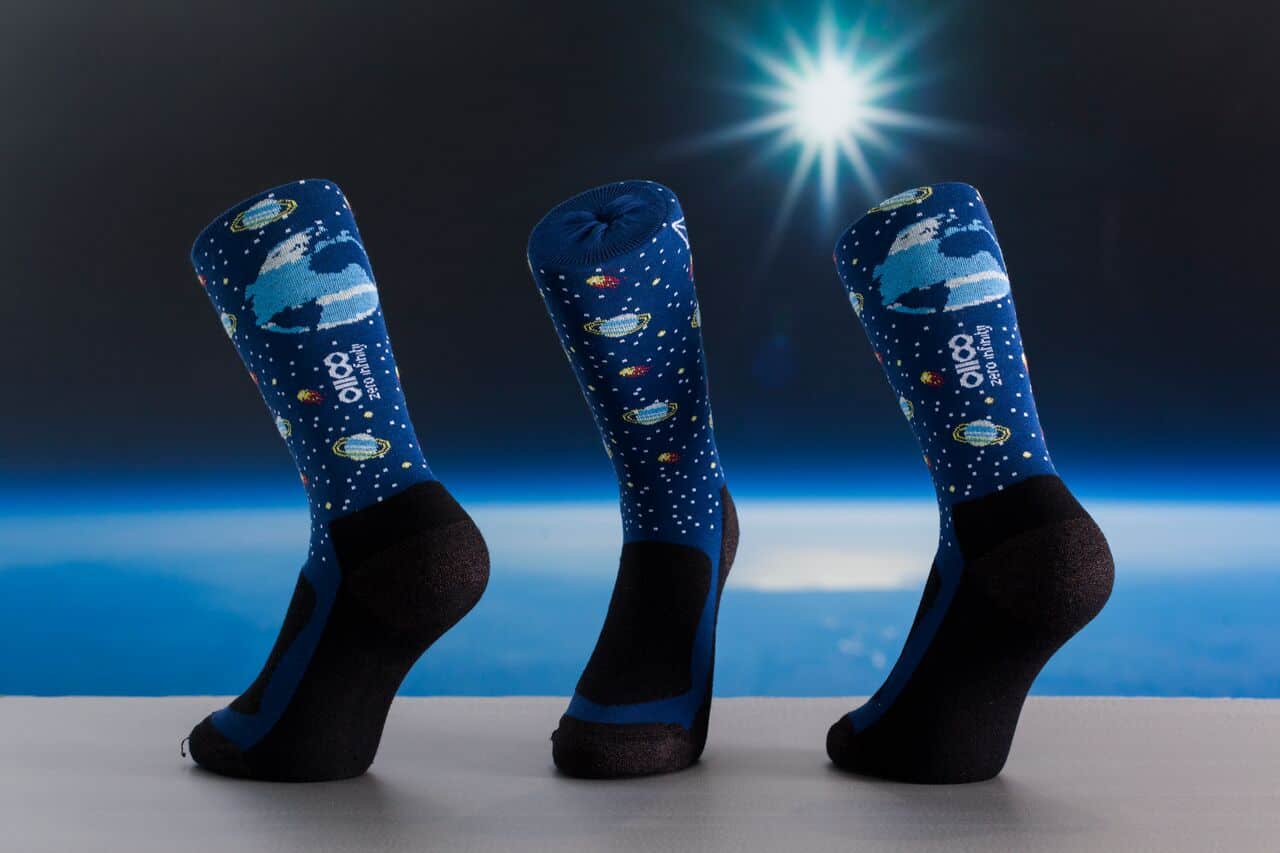
When tourists do begin venturing into space, they won’t have to worry about having unfashionable socks. Why? Because Spanish company Sock’M has created SpaceSocks. Sock’M is a designer sock brand and was created after its founders got lost in the mountains and started dancing naked with creatures wearing knee-high socks (yes, that’s what they say). Hoping to help make space travel more accessible, Sock’M teamed up with Zero 2 Infinity to create socks scientifically designed to meet the challenges of space. The socks are made with fire-proof cotton and are reinforced with silver and copper thread to inhibit the electrostatic charging that occurs in synthetic fabric in zero gravity. As most of us are still grounded however, Sock’M has also made limited edition socks to fill our space fashion needs.

Moving from one meeting of science and fashion to another, a team at the University of California, Berkley, has concluded that dressmakers have impressive 3D, or “stereoscopic”, vision. This means their brains are particularly good at translating the 2D viewpoints of each eye into one 3D image, which is important for threading a needle, catching a ball or parking a car (based on these I would be an awful dressmaker). Published in Scientific Reports, the researchers showed that dressmakers are 80% more accurate than non-dressmakers at calculating the distance between themselves and the objects they’re looking at. They are also 43% better at guessing the distance between two objects. Whether dressmakers gain this needle-sharp vision with experience or are drawn into the profession because of it, remains a mystery.

NASA showcases its latest tech investments

By Lucina Melesio in Washington DC

Yesterday in Washington DC NASA showcased its latest technology investments.  The event took place just few steps away from Capitol Hill, where the US Congress will decide on the current administration’s proposed budget cuts for the agency.

“The technologies displayed here today illustrate how sustained investments made by NASA, industry and academia directly benefit our nation’s innovation economy,” reads the event’s brochure. “These technologies help America maintain its global leadership in aerospace and enable NASA’s current and future missions of exploration and discovery,” it continues.

3D-printed rocket igniter

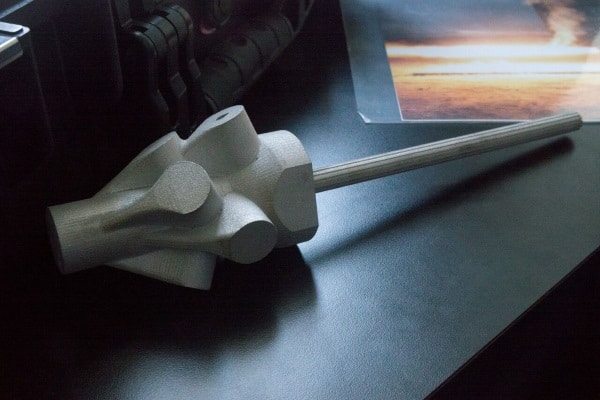
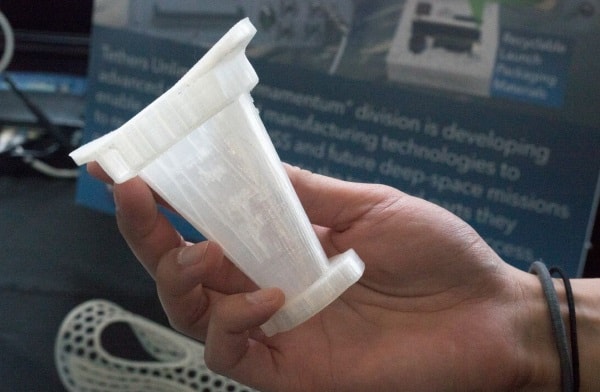
The exhibits I viewed include 3D-printed rocket injectors and igniters that promise to be safer than current with no assembled parts, drone operation systems that would enable real-time drone management through airspace, new NASA X-planes that would also revolutionize the commercial flight market improving fuel efficiency by over 40%, and an onboard 3D printer that recycles waste plastic from space missions to print tools for astronauts – designed for the International Space Station and the future mission to Mars.

Feelings about budget cut threats were mixed among exhibitors. While some said it would halt projects like the X-Plane programme that is strongly dependent on NASA funding, others like the drone operations system said budget cuts wouldn’t immediately affect their projects since they are developed independently by the industry for NASA.

3D-printed urine cup

Other NASA showcased projects included the Vascular Tissue Challenge – one of NASA’s Centennial Challenges – which offers a $500,000 prize for creators of  metabolically functional human organ tissue in a controlled laboratory environment. While this project was thought as a step towards enabling organ transplants for astronauts in Mars, it would also advance this research field for the benefit of Earthly humankind.

“NASA is innovating, developing, testing and flying technology for use in NASA’s future missions that have real benefits here on Earth, today,” reads the final paragraph of the brochure.

Copyright © 2026 by IOP Publishing Ltd and individual contributors