A judge has recommended that a construction permit should be granted for the $1.4bn Thirty Meter Telescope (TMT). Retired judge Riki May Amano called on the Hawaii Board of Land and Natural Resources (BLNR) to issue a new permit, so long as a number of conditions are met. If the BLNR agrees with Amano’s verdict, then construction of the TMT could begin in April 2018 with completion in 2022.
Once built, the TMT will be one of the world’s largest ground-based telescopes with a 30 m primary mirror that is made up of 492 hexagonal segments. The structure that will house the telescope will be 66 m wide and 56 m tall.
The TMT board chose Mauna Kea, which already hosts 13 other telescopes, as the observatory’s site in July 2009. Over the following six years, the organization received a series of necessary approvals and permits. However native Hawaiians, who regard the Mauna Kea summit as sacred – and who had previously objected to the growth in the number of telescopes there – carried out a protest at the telescope’s ground-breaking in October 2014.
Six months later, following further demonstrations, construction was postponed. Then in December 2015, the Hawaiian Supreme Court invalidated the TMT’s building permit, ruling that the BLNR had not followed due process when it was approved. The court then remanded the case back to the board, who appointed Amano to rehear the case.
Now, following 44 days of testimony by 71 witnesses, Amano released her judgement in a 305 page document. It calls for the permit to be granted, given that nine conditions, such as that building work abides by government rules, are met. The judge also calls for “additional conditions” to be met, including that employees attend mandatory cultural and natural resources training and that the organization creates “informational exhibits” for visitors that showcase the natural, cultural and archaeological resources of Mauna Kea.
The BLNR will now invite all parties to submit their response to Amano’s verdict before making a final decision to grant the permit. Meanwhile, TMT chose La Palma in the Canary Islands as a back-up site earlier this year.
Aggregated proteins can cause diseases such as Alzheimer’s and Parkinson’s. Using cryo-electron microscopy (cryo-EM), Daniel Southworth and his team at the University of Michigan, in collaboration with Jim Shorter at the University of Pennsylvania, discovered how yeast solves the problem of protein aggregates. They observed on an atomic level how a protein called Hsp104 recognizes and unfolds proteins, thereby dissolving harmful protein aggregates (Science 357 273).
Many organisms have adapted to the threat of aggregated proteins by producing so called disaggregases. Now for the first time, researchers have observed the molecular mechanism of such a disaggregase.
The Hsp104 complex consists of six subunits arranged in a spiral with a central channel through which the aggregated protein is pulled. By switching between two conformations, one subunit after the other releases its grip on the target protein and grabs it again further up the chain. Every switch pulls the aggregated protein further through the channel, thereby unfolding it. The cooperative action of six subunits powered by adenosine triphosphate (ATP) hydrolysis provides enough force to even dissolve stable aggregates.
Like many other disaggregases, Hsp104 belongs to a group of proteins powered by ATP. These proteins fulfil diverse functions by changing conformation upon ATP hydrolysis. When ATP is hydrolysed to ADP, energy is released that allows the protein to move to another conformation. In the case of Hsp104, two parts move like little arms to release the target protein and grab it again further down the chain.
In order to observe this fast process, in their study Southworth and colleagues used a molecule that is similar to ATP but is hydrolysed more slowly. This gave them time to observe the unfolding process using cryo-EM.
The low temperature in cryo-EM makes it possible to take images of protein complexes while minimizing radiation damage that results from the necessary electron beam. The researchers collected images of protein complexes at random angles and averaged these to yield a three-dimensional structure. Resolution down to 4Å, at which it is possible to see amino acid side chains, allowed Southworth and his team to observe the mechanism at great detail.
When proteins avoid water
Ideally, a protein assumes its intended three-dimensional structure, called the native state, after being synthesized. By moving to the protein centre, this process allows hydrophobic regions of the protein to avoid contact with water. If the hydrophobic regions end up on the surface instead, for example due to high temperature, they will bind to neighbouring proteins to avoid water. As a result, aggregates form. This process is irreversible because the proteins are in a low-energy state that makes them very stable so that they cannot refold without energy input and the help of other proteins such as disaggregases.
Large aggregates of proteins disrupt normal cellular processes especially in nerve cells. Apart from Alzheimer’s and Parkinson’s, there are many other amyloidoses, diseases caused by protein aggregates, including amyotrophic lateral sclerosis (ALS), famous from the ice bucket challenge, and bovine spongiform encephalopathy, also known as mad cow disease.
In their study, which was published in Science on 21 July, the authors used casein, a protein commonly found in milk that readily aggregates, as a model substrate protein. Their assumption is that the mechanism of disaggregases on casein is the same as for physiological substrates. The discovery of this general mechanism might help to find drugs and therapies against aggregated proteins.
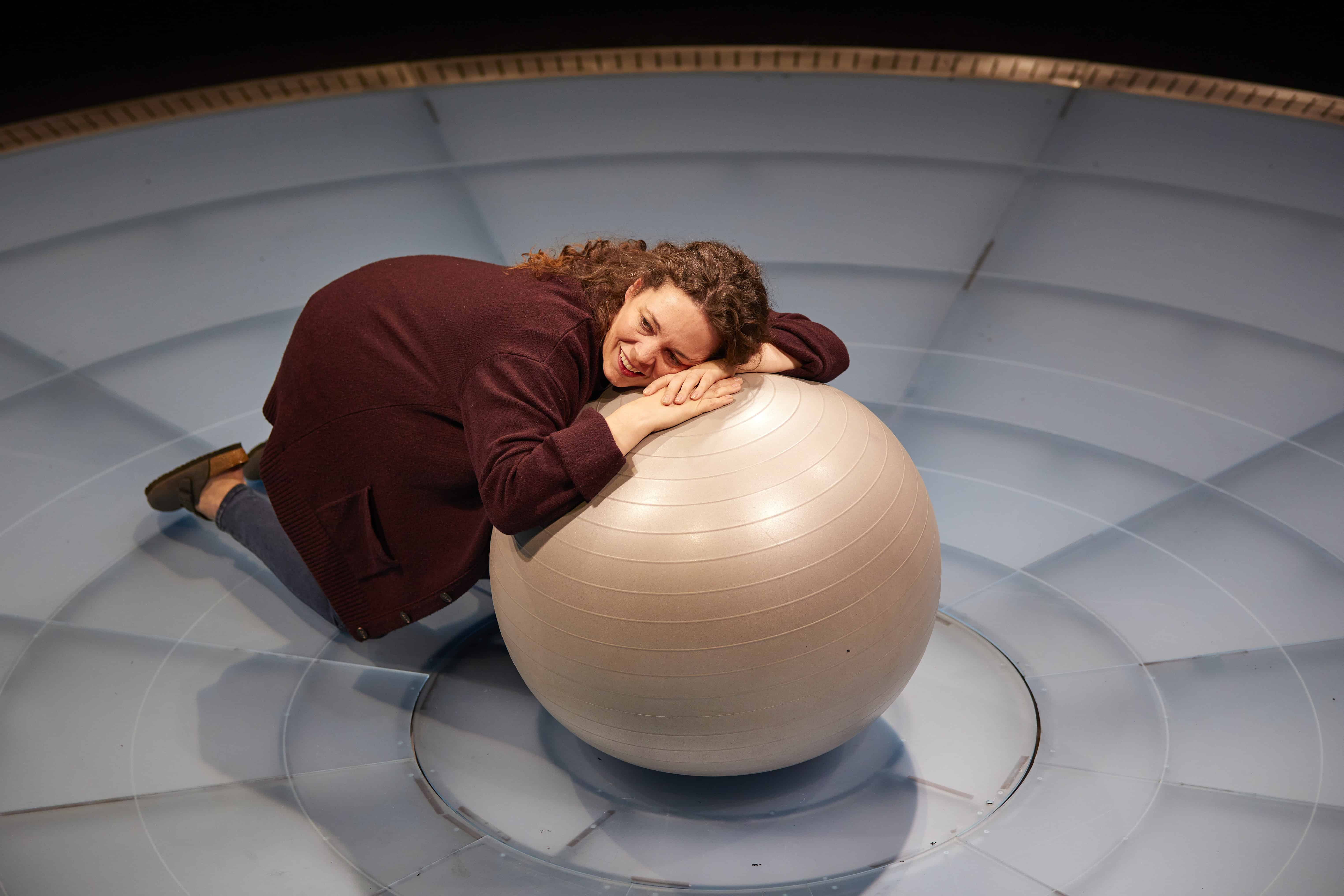
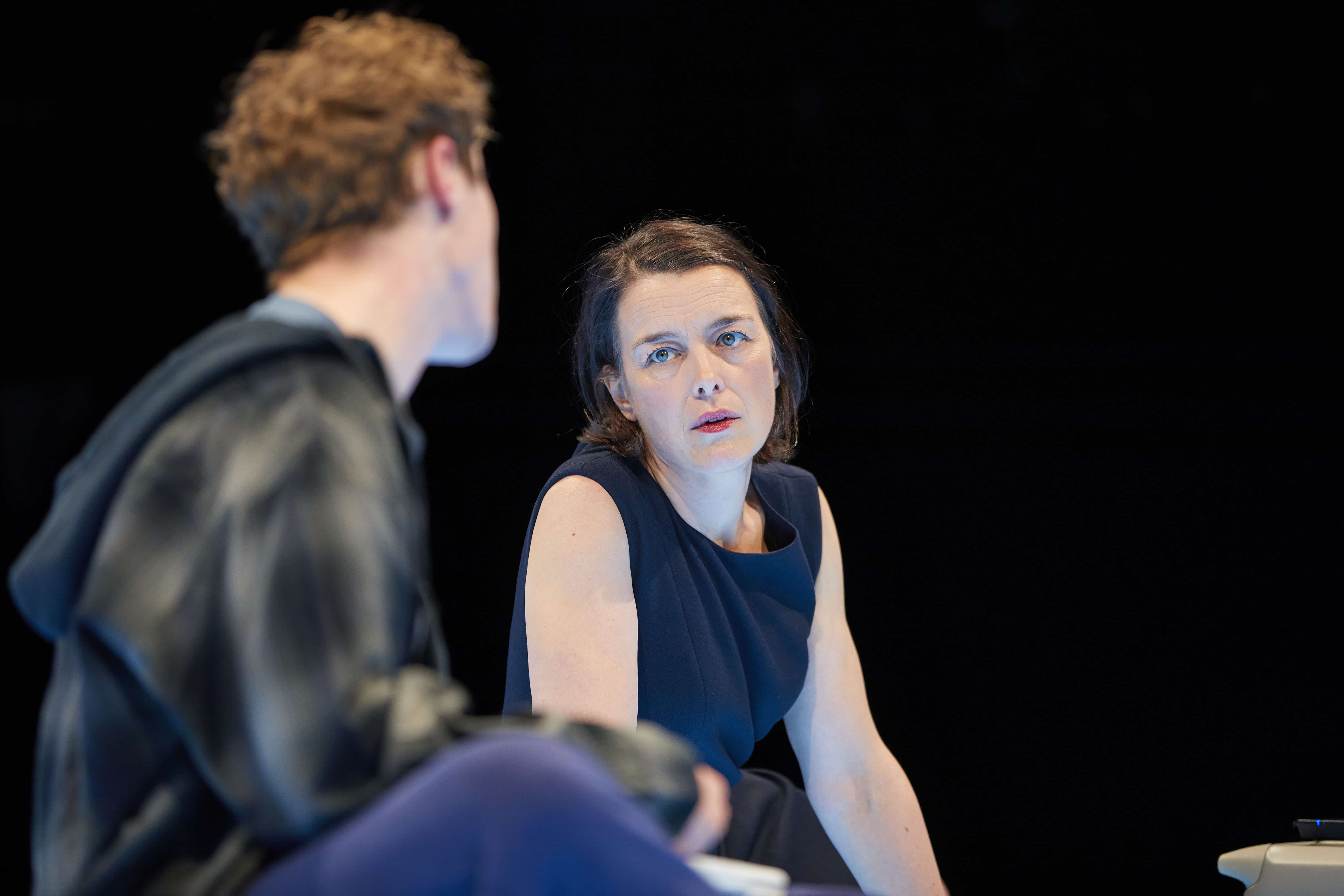
Sceptical siblings: Olivia Williams (left) and Olivia Colman in Mosquitoes by Lucy Kirkwood. (Courtesy: National Theatre/Brinkhoff & Mogenburg)
Working at Physics World for the last six years has taken me to some pretty cool labs – everywhere from CERN to the Laser Interferometer Gravitational-wave Observatory (LIGO). My job has allowed me to meet some quite famous people too…at least in the world of physics, that is. But getting to spend a morning at the National Theatre in London watching Olivia Colman and Olivia Williams rehearse for a play is not usual even for me. That is precisely why I jumped at the chance, when I found out that the pair star as sisters in the recently opened play Mosquitoes.
You may be wondering what a play with that moniker has to do with physics. Mosquitoes tells the story of rational and lucid Alice (played by Williams), a particle physicist at the Large Hadron Collider (LHC), and her often-illogical sister Jenny (played by Colman) “who spends a lot of time Googling” and is easily swayed by the bad science she chances upon. Written by Lucy Kirkwood and directed by Rufus Norris – the National Theatre’s current artistic director, the play follows the siblings through a family tragedy, as well as the fairly disastrous switching on of the LHC in 2008, and takes a hard look at our relationships with science, facts, belief and so much more. Kirkwood, whose previous successes include Chimerica and The Children, was commissioned to write the play by the Manhattan Theatre Club as part of its Alfred P Sloan Foundation initiative, which aims to “stimulate artists to create credible and compelling work exploring the worlds of science and technology and to challenge the existing stereotypes of scientists and engineers in the popular imagination”.
I’ll be honest with you: I had my doubts when I first heard about the play and read its short premise, which includes the line “When tragedy throws them together, the collision threatens them all with chaos.” But within a few moments of watching Colman and Williams rehearse (what I later learnt was) one of the play’s most brutal and powerful scenes, I was absolutely captivated. I won’t reveal much about what I watched them perform (spoilers!), but it was quickly apparent to me that Mosquitoes is the play we need in these times of “alternative facts”. The play is set in 2008 because that is when Kirkwood began writing it, and of course the science news making the global headlines at the time was the switching on of the LHC. After nearly a decade of writing, editing (she did a big rewrite after Brexit) and finessing, the play opened last week and is solidly sold out for its entire run until the end of September. In fact, the only way to get a ticket is to try your luck via the National Theatre’s weekly Friday Rush ticket lottery.
I caught up with Kirkwood to talk about art, science, the “human condition” and how it can be improved. “For me, as a lay person, the whole play is about how we engage with brilliant people…I’m split between Jenny and Alice myself when I try to understand science.” She remembers the doomsday headlines about black holes and worse that surrounded the LHC and is intrigued by fear. “Where does such fear come from, especially from usually coherent people?” she ponders. She is quick to add though that she too can be quite irrational at times, and it is often when we are at our most vulnerable that misinformation and its purveyors can get their hooks into you.
This is one of the main themes that Kirkwood explores in the play, about how we are “somehow wired to be a bit fearful” and how this can affect the most rational of people, not to mention those who are more inclined towards unfounded belief. In a telling scene, a pregnant Jenny longs for a cigarette, insisting to Alice that their mother smoked while pregnant with both of them. In the same breath, she refuses to get an ultrasound scan, citing some study she found on the Internet that suggested the procedure was not completely safe. This sort of juxtaposition in reasoning is something that Kirkwood deftly uses throughout the play and is the main source of Jenny and Alice’s disagreements.
Baby bump: Olivia Colman playing a pregnant Jenny. (Courtesy: National Theatre/Brinkhoff & Mogenburg)
For Kirkwood, this behaviour also links to the “current anti-intellectual and anti-expert strain…we can’t seem to separate fact from feeling”. As she and I talk about the false information that surrounded Brexit and the campaign for Britain to leave the European Union, she points out that “the people making these claims knew the information was false, but that didn’t seem to matter”, as these falsehoods would do most harm to the non-elite. In an age where information is power, Kirkwood worries about the “currency of fear”, which has the biggest impact on people who are at their most vulnerable.
As I talk to Kirkwood I can’t help but think of how Williams, who I also had a long chat with after watching the rehearsal, described the playwright. “Her extraordinary skill is in embracing complex philosophical, scientific and psychoanalytical ideas, and putting them into real people and turning them into scenes.” As I ask Williams more about the kind of topics Kirkwood likes writing about, she gets rather poetic herself, telling me “She is sort of boundless…my father used to collect Persian rugs and they say that with Persian rugs if you look at it they have a border on the outside but that the picture inside is infinite and that’s a bit like Lucy Kirkwood’s brain. That her outline is just containing infinite possibilities of thought and drama and we’re just seeing into a little window of her crazy brain.”
Williams describes Mosquitoes as embracing “everything from why we have mass, how the universe began, what the consequences of colliding particle might be and the elusiveness of the Higgs boson”. She adds that Kirkwood’s ability is to take “tangible things and spin them into another place”, for instance, she has turned the Higgs particle into a person who has disappeared. “The other thing she does is that she takes things that have a rational explanation and applies them to what we are, which is irrational beings…how do you know something if you can’t see it? It’s a huge philosophical question which [Kirkwood] tackles in an unbelievably conversational and domestic way…you know, two sisters having a fight about the safety of an ultrasound or the safety of a vaccine.”
Artistic vision: Rufus Norris and Lucy Kirkwood in rehearsals for Mosquitoes. (Courtesy: National Theatre/Brinkhoff & Mogenburg)
Indeed, the arguments and fights that the sisters have are simultaneously some of the most riveting and difficult-to-watch parts of the play. Williams worries that “I am going to be the most hated woman in Britain because I stand attacking a national treasure [Colman] shouting ‘you’re a retard….I reject you and we have to leave you behind and move on!’ ” The scene she is talking about happened to be one of the two I watched the pair perform and I myself couldn’t help feeling bad for Jenny, even though I agreed with much of what Williams’ character Alice was saying – but I suspect that it is these conflicting emotions from varying perspectives that Kirkwood wants us all to think about.
I asked Kirkwood and Williams if they had visited CERN to prep for the role and do research. “We [the National Theatre] have just had a half a million budget cuts so trips to CERN are not included,” says Williams, but she watched some lectures and spoke with a friend who is a producer of BBC Radio 4’s The Life Scientific to try get to grips with the science. She also tells me that in preparing for any role, “I do not need to know what they know…I need to know how to look like I know what they know and to inhabit their attitude of mind. I’m not going to be able to understand the physics but I have to understand how it makes me feel when I find something out or when I find something doesn’t work, or when someone like my younger sister does all her learning with irrational Googling. It’s a funny business because you find yourself asking people who do what you’re pretending to do what they think are the most tangential, bizarre and irrelevant questions…It tends to be things like ‘What shoes do you find comfortable when you’re at CERN?’ ”
Looking ahead: Olivia Williams in Mosquitoes by Lucy Kirkwood. (Courtesy: National Theatre/Brinkhoff & Mogenburg)
Kirkwood concurs, telling me that she usually looks for “emotion rather than data”, although the script does include a lot of scientifically accurate vernacular – “I’m a word junkie and ‘quench’ is a great word!” For this, Kirkwood did have four particle physicists from CERN serving as consultants who regularly advised her on the science. She also confesses that “I have a history of writing plays that are difficult to stage and visualize…but I couldn’t help anthropomorphizing the Higgs boson because I love writing characters.”
Mosquitoes was partially funded by the Institute of Physics (which publishes Physics World), so I was interested to know how both Kirkwood and Williams felt about art–science collaborations and the impact they have on educating people. “I think something moving that has happened in the last 10 years is that I have had much more access to physics and science than I had since I was at school…and I do think there is a collision – please excuse the pun – between the arts and the sciences at last, thank god,” says Williams, adding “Unless people understand how the planet works, we’re going to fuck it up. If we keep rejecting science in all its forms…well the consequences are in this play.” Kirkwood agrees, telling me that just like Jenny and Alice, the arts and the sciences are two parts of the same world, which must come together and push to the future. Williams believes “We should all be hanging out in the same space and talk about each other’s work…so tell all the physicists!”
Ireland has opened a new antenna station as part of the €150m Europe-wide Low Frequency Radio Array (LOFAR). The addition of the Irish station, which is located at Birr Castle Estate in County Offaly and operated by Trinity College Dublin, means that the LOFAR network now stretches 2000 km across increasing the telescope’s sensitivity.
The telescope was switched on by John Halligan, Ireland’s minister for training, skills, innovation, research and development. “Membership of LOFAR affords a unique opportunity for research and engagement to young people across the country with astronomy and science in general,” says Halligan. “As minister, it is my distinct pleasure to be here to celebrate the achievement of such a wide section of the Irish scientific community.”
Fifty-one antenna stations
LOFAR is being developed by a consortium led by ASTRON, the Netherlands Institute for Radio Astronomy. It consists of 51 antenna stations, 38 of which are in the Netherlands with six in Germany, three in Poland and one in England, Ireland, France and Sweden.
The telescope operates between 10–240 MHz, allowing scientists to look back to the formation of the first stars, scan the skies for rare transient phenomena and study high-energy cosmic rays.
“Thanks to the new LOFAR station in Ireland, we can observe the universe in even more detail. For example, we can look more closely at objects near and far, from our Sun to black holes, magnetic fields, and the emergence of galaxies in the early universe,” says LOFAR director Rene Vermeulen. “These are important areas of research for astronomers in the Netherlands and partner countries.”
Rising costs have forced scientists to cut back plans for the world’s largest radio telescope, known as the Square Kilometre Array (SKA). The project’s first phase will now contain fewer antennas spread over a smaller area with poorer frequency coverage than was envisaged two years ago. Even though representatives of the 10 countries funding the SKA are confident that the observatory will “deliver transformational science capabilities”, astronomers are nonetheless worried about the impact of a far more compact set of antennas in Australia.
As its name suggests, the SKA will ultimately consist of antennas with a combined collecting area of 1 km2. Its full design calls for thousands of mid-frequency radio dishes spread out across southern Africa and a million low-frequency dipole antennas distributed throughout Australasia. But with a likely price tag of several billion Euros, the partner countries – currently Australia, Canada, China, India, Italy, New Zealand, South Africa, Sweden, the Netherlands and the UK – are initially building a slimmed-down version known as SKA1.
However, even SKA1 is proving a headache. A first incarnation, consisting of 250 dishes in Africa and about 250,000 antennas in Australia, was proposed in 2013 in response to a cost cap of €674m (in 2016 prices) imposed by the partner countries. Yet a subsequent increase in the estimated cost meant that the proposal had to be scaled back two years later. Now, following a further price rise of about €150m, plans have had to be pared back further still.
Deployment baseline
At a meeting held in the Netherlands on 18–19 July, the SKA council approved a “deployment baseline” drawn up by the project’s management. Compared to the design laid out in 2015, this involves reducing the number of African dishes by three to 130 and spreading those dishes out over just 120 km – as opposed to 150 km. It also halves the number of dishes that are sensitive to all three of the frequency bands foreseen at this stage of the project and reduces equipment used to observe pulsars. The cutbacks also involve slashing computing power by more than 80% with the idea that the shortfall can be made up when processors are cheaper.
Heino Falcke, a radio astronomer at Radboud University in Nijmegen, the Netherlands, says he is “surprised in a positive sense” with what he describes as “fairly modest” changes. He is, however, worried by cuts to the Australian portion of the project. These involve reducing the number of antenna stations from 512 to 476 and squeezing those stations along a “baseline” of 40 km rather than 65 km. Doing so, he explains, might impede astronomers’ ability to remove foreground radio noise when measuring hydrogen emission from the universe’s “dark age” shortly after the Big Bang – one of the SKA’s headline aims. “I hope it would still be possible,” he says, “but the change adds uncertainty.”
According to Philip Diamond, director-general of the SKA Organisation based at Jodrell Bank in the UK, astronomers advising on the cuts had initially said that 40 km would probably be enough, but that after doing additional modelling of the telescope’s likely performance they became “a little bit concerned” about the shortening. “They haven’t finished those simulations yet, but they raised their hands and said they are not sure about this,” he says.
Approval needed
Diamond says that the Australian baseline could be extended back to 50 km at a cost of about €14m, which, he suggests, could be made available if just one of seven possible new partner countries joins the project. As things stand, the existing members have yet to formally approve funding, but Diamond expects them to do so in the first half of 2019, following the setting up of an intergovernmental organization to oversee the project. Construction should then start a few months later and take around five years to complete.
Although the full SKA remains on the back burner for the moment, Diamond is heartened by council’s approval of the reformulated SKA1. “I have always known that [realising the SKA] would be tough,” he says, “but I felt quite buoyant after the meeting.”
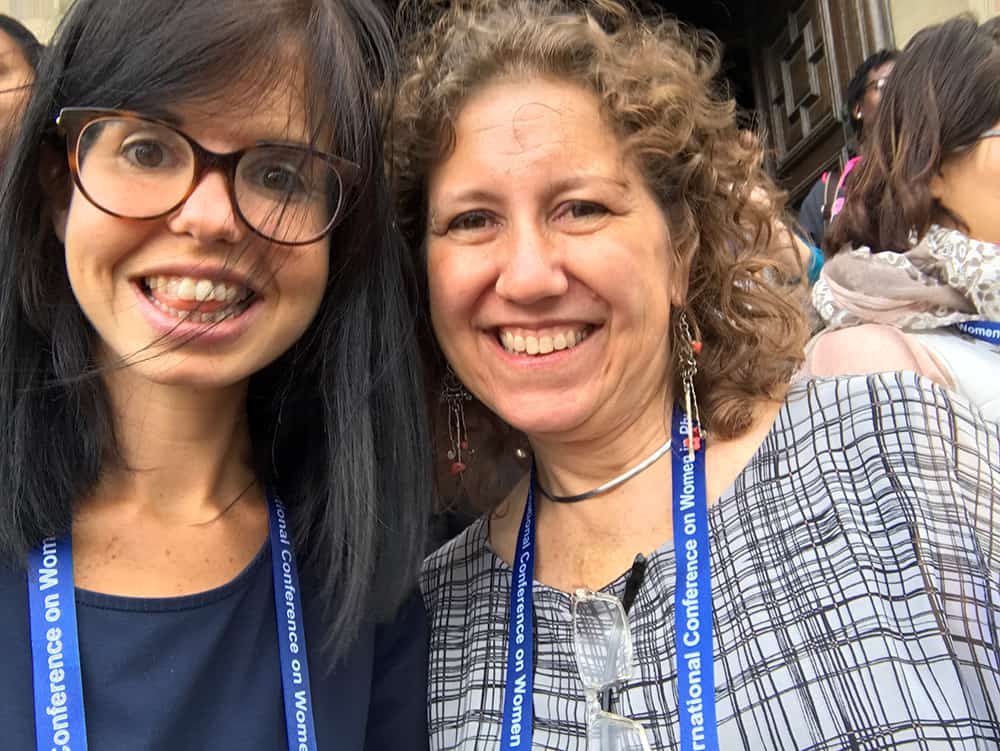
On accepting the Institute of Physics (IOP) President’s Medal at the International Conference on Women in Physics (ICWiP), Dame Jocelyn Bell Burnell closed with Laurel Thatcher Ulrich’s infamous quote – “Well-behaved women seldom make history.” And what does she say is the least well-behaved thing she’s done during her scientific career? Become a working mother. Jocelyn battled with stereotyping and bias because she was a woman in a male-dominated field who also dared to have a family and career. She persevered and refused to back down, going on to become an award-winning scientist, Fellow of the Royal Academy and Dame Commander of the Order of the British Empire (keep an eye out for a feature on Jocelyn Bell Burnell in Physics World later this year). Bell Burnell’s story was one of many awe-inspiring tales of ground-breaking women at ICWiP last week, which was held at the University of Birmingham in the UK – and here are some whose stories were too good to keep to myself.
Dame Athene Donald is a trailblazer. The first woman to be professor in a UK university and master of a Cambridge college, she has never been afraid to ruffle feathers or say what she thinks. She is an important member of more committees, assessment panels and boards than most academic departments combined, but still finds time to visit schools. And when she does, she challenges what they think: that physics is the Large Hadron Collidor at CERN and…men.
Donald is humble, observant and inquisitive – characteristics that have contributed to making her one of the world’s finest scientists and communicators. But the road hasn’t always been easy and the most difficult time in Donald’s life was mid-career. From the outside, it looked like she had made it, which is when the professional jealousy of others started to kick in. She was frequently the only woman on committees, where she was ignored, and she felt her research group was suffering from the lack of resources she could pull in. But Athene was not going to give up, instead creating a network of mentors and supporters and channelling anger into gender work. Donald was made the gender champion of Cambridge, which holds the only Athena Swan gold award for a physics department in the country. She began initiatives to support women returning from maternity leave, offered CV advice and frameworks for promotion, ran workshops on confidence and impostor syndrome, and helped postgrads with career advice. But with great power came great responsibility – from broadcast to print media, everyone wants Donald’s comment. Today, she advises everybody, from academia to pre-19 education and even parliament and the hardest part is learning to say no to other people’s requests.
There were several things in Donald’s lecture at ICWiP that particularly resonated with me. Other than a short time in the US, Athene has never left Cambridge. It was here she completed her undergraduate, PhD, first lectureship, first readership, first professorship. Here she became Fellow of the Royal Society and Dame. There is ongoing dialogue in academia that you should move across the country and world to gain an “international reputation” and improve your academic status. Her commitment to her husband, children and parents demonstrates that being successful is not “either/or”.
The Institute of Physics’ president-elect, chemical engineer Dame Julia Higgins was instrumental in establishing the Athena Swan (Scientific Women’s Academic Network) charter in 1999. She began her quest for diversity in the 1990s, “I had always assumed that if I looked over my shoulder there would be more following up behind, but there weren’t.” She was the first woman to become both a Fellow of the Royal Society and of the Royal Academy of Engineering. When Higgins became a professor of polymer science at Imperial College, London, she doubled the number of women at that level. Over her career she has seen the ratio change – there are now more than 50 female professors at Imperial – but she’s still not happy with it. “When we set up the Athena Project, we called it a project because we intended it to be time-limited. There is still a great deal to do.” If you’re interested in Higgins’ research, listen to her on the BBC radio show Life Scientific.
Gabriela González is part of the 1000-person team that detected gravitational waves. In fact, she’s a pretty important part. González is a professor of physics and astronomy at Louisiana State University in the US and the former spokesperson of the LIGO Scientific Collaboration. Her plenary talk at ICWiP was a whistlestop tour into general relativity; starting in a Swiss patent office and ending in a €400m space antenna. González began her career trying to detect gravitational waves from the orbiting neutron stars first observed by Bell-Burnell; an undertaking so complicated even Einstein said it would never be done. They were so determined to detect gravitational waves that her team designed the Laser Interferometer Gravitational-Wave Observatory (LIGO) using technology that hadn’t been invented, with absolute confidence that the scientific community would catch them up. Gradually they pushed the sensitivity of their system further, resolving astrophysical events deeper into outer space. As they tweaked and tested, the physics community was in total suspense – then came challenges to LIGO’s suspension. For statistical certainty, they would need less noise and more light… “Sounds simple right? Well, it’s not very simple – and it’s quite expensive.” The build-up to turning on the detector took over Gabriela’s life: “I was so stressed about preparing for this. I would dream about protocol and analysis – watching out for lightning bolts, reading about earthquakes.”
She wasn’t only concerned whether the accuracy would be good enough – she wanted her team to be good enough too. When you see a page of logos or an author list, it is easy to forget that behind them there are real people living complicated lives. Having such a large team of people from different cultures also makes it easy for bad behaviour to slip under the radar. Gabriela ensured there was an anti-harassment initiative for the LIGO Scientific Collaboration and the Virgo Collaboration (read more here: LVC Allies), along with an active diversity committee that offered training and support. The coalescence of binary black holes detected on 14 September 2015 was the first notes that we have heard of gravity’s symphony. “It has been very exciting, but it’s going to be even more exciting.”
It was difficult to work out how the organizers of ICWiP could make the event even more inspiring following such trailblazers. Enter Nobel laureate Malala Yousafzai.
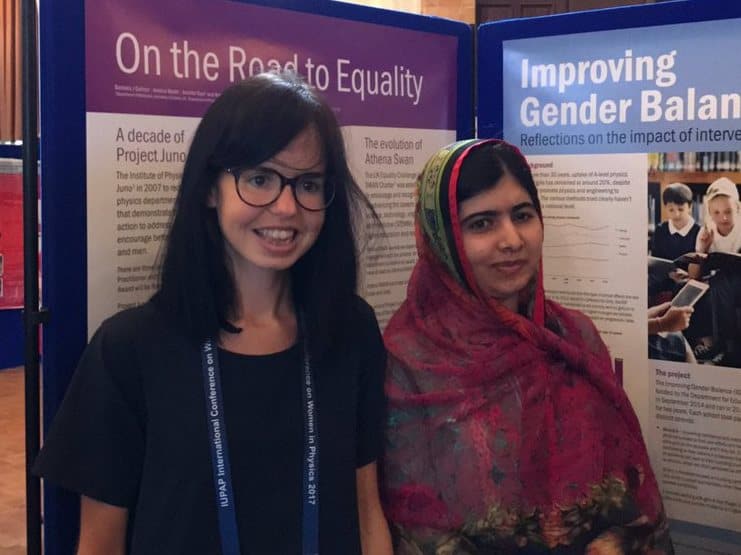
Star struck: Malala Yousafzai made a surprise appearance at ICWiP. (Courtesy: Jess Wade)
Malala finished her A-levels two weeks ago and from there she jumped on a plane (technically 10 planes) to tour the world on a “Girl Power Trip” with the Malala Fund. So far, she’s had lunch with Justin Trudeau, spent her birthday in Iraq with girls who lived in ISIS captivity, and visited Nigeria, which has the highest number of out-of-school girls in the world. By the end of the adventure, she will have spoken in Africa, North America, the Middle East, Latin America and Europe. And, thanks to the efforts of the Pakistani team, Malala found herself in a conference hall in Birmingham, speaking to 200 excitable physicists. Despite enjoying it when she lived in Pakistan, Malala didn’t study physics at A-level. Next year she will be studying PPE at the University of Oxford (I am sure she could already teach the course, but I’m also keen for her to be prime minister one day, and this degree seems mandatory). She recognizes the need to get more girls into physics, and agrees with much of the IOP’s Improving Gender Balance report. This is an issue for schools, parents and communities to solve. She was graceful, considerate and engaging and she didn’t only talk about her Nobel-prize-winning mission but listened to ours.
So how will we overcome the gender imbalance in physics? For that I turn again to Higgins: “The best thing that I could do for women in science was to be one and to be successful.”
Eclipse America is a one-stop shop for everything concerning next month’s total solar eclipse in the US, as its 70-mile-wide shadow tracks it way from Oregon in the west to South Carolina in the east on Monday 21 August 2017. The event will be witnessed by approximately 12 million people during the late morning through to the mid-afternoon as it passes across this vast country. The website includes a detailed map that illustrates the path of totality, and the best possible locations from which to view the total eclipse. It also shows the degree of partial eclipse visible to the north and south of the Sun’s path (there will be a partial eclipse visible from north-west Europe) and includes advice and information to help viewers enjoy the eclipse safely. The site gives a concise and user-friendly overview of the phenomenon, explaining how this rare and spectacular event will one day no longer be witnessed on Earth, as the Moon moves further away and its apparent size shrinks over time.
Who is behind it?
The Eclipse America website is hosted and run by the American Astronomical Society (AAS) whose large membership is made up of physicists, mathematicians, geologists and engineers with an interest in contemporary astronomy. The society aims to enhance people’s understanding of the universe and advance physical sciences for the benefit of all.
What are some of the topics covered?
Eye safety forms a large section of the website, with a short video and several pages advising viewers how to protect their eyes while viewing the eclipse. The site advocates using eclipse shades or a solar filter on specialist equipment, while also offering advice on how to verify that equipment is safe and complies with ISO12312-2 standards. It also suggests other methods via which the event can be enjoyed and viewed safely such as pinhole projection and instructions on how to make a sun funnel. Guides for educators and community leaders are included in the downloads section along with links to articles about eye care. The Solar Eclipse Experience page provides a detailed account and associated images of a solar eclipse, from “first contact” through every stage until the Sun re-emerges. There is also a helpful glossary that explains eclipse terminology, as well as a description of what to expect when weather conditions are cloudy. A handy resources page forms a collection of further reading, advice, maps and images as well as recommendations of the most up-to-date apps and software.
Who is it aimed at?
As a total solar eclipse is a relatively rare event, the spectacle will undoubtedly generate a lot of public interest. Eclipse America has wide appeal and is aimed at anyone with an interest in witnessing this “cosmic coincidence”, from dedicated eclipse chasers keen to record the event, to educators, community leaders and children. For budding or professional photographers, a section advises how to capture the perfect solar eclipse image or video and also provides valuable advice on copyright and accreditation. The educational materials and videos page are conveniently grouped in age-related collections, which make the resources easily accessible by teachers, lecturers and outreach providers.
How can I take part?
The website encourages people to get involved in various ways, from downloading the instructions to make a sun funnel or becoming a citizen-scientist by signing up to one of the Citizen Science Projects. If you’re in the US, you can search for an eclipse-related event taking place near you by using an interactive map or contacting the AAS to have your lecture, presentation or conference included on the website.
Can you give me a sample quote?
So what is so special about a solar eclipse? More of an experience than an event, the Eclipse America website describes it as “hauntingly beautiful and, without doubt, one of the most awesome sights in all of nature”. And the following description sufficiently raises expectations: “At the beginning and end of totality, the thin middle layer of the Sun’s atmosphere, the chromosphere, blazes in an arc of ruby red. The sky darkens to a deep twilight blue, with yellow, orange, and pink sunrise/sunset colours on the horizon in all directions. Bright stars and planets shine forth, and the air temperature drops noticeably. Birds and farm animals, thinking dusk has settled, return to their nests and barns, and bats come out to feed.” If that doesn’t sell it, then nothing will.
Great myth: Matt Brown debunks science myths, such as that the Great Wall of China is visible from the Moon – it is, but only with a telescope. (Courtesy: iStock/SteveAllenPhoto)
Everything You Know About Science is Wrong – this is the bold claim made by science writer Matt Brown, and it’s also the title of his latest book. Despite its somewhat click-baitey nature, the book’s title is compelling enough to make anyone pick it up and have a look, if only to decide whether you agree with the loaded assertion or not. But don’t let the title fool you, this book is full of extremely accurate science, and what Brown aims to do is bust common science myths that masquerade as facts. “The world is full of pseudoscience – ideas that sound plausible and scientific, but are ultimately worthless. Whole industries are built on the credulity of a trusting public,” writes Brown.
The book is divided into eight sections – science and scientists in pop culture, astronomy, physics, chemistry, biology, geology, the human body and famous scientists. Brown tackles archetypal myths such as the Great Wall of China being the only man-made object visible from the Moon (it’s not, unless you take along a telescope), or that nothing can travel faster than light (this is true only for light in a vacuum that is not interacting with anything else) or that water is a good conductor of electricity (pure water isn’t…it’s the impurities in tap or sea water that act as conductors).
Although this is a book full of nit-picking, I thought that Brown did admirably well to avoid the I-think-you’ll-find tone that would likely annoy readers. Instead, he comes across as enthusiastic and whimsical, while also being glib and funny. Take the chapter on faster-than-light travel: after talking about quantum entanglement (and the instantaneous transfer of information), he ends by pointing out that the British royal family does not seem to obey the laws of relativity given that the transfer of title for a monarch at the death of a previous one is instantaneous. Brown describes a paradoxical scenario where a future monarch dies on Mars and the heir (assumed to still be on Earth) immediately becomes the new king or queen, despite the fact that they won’t know it for the 20 minutes or so it would take for the message to be sent from Mars.
While the science is simple and light, the book is an enjoyable read, particularly the “A–Z of Pseudoscience” towards the end, where Brown lambasts and pokes fun at everything from detoxing and kale to Moon-landing conspiracies and “quantum nonsense”. If you are scientifically up to date, then buy this book for a chuckle and pub-quiz trivia. More importantly though, definitely buy this book for the people in your life who are easily swayed by “alternative” science facts – they will learn something true, new and enjoy themselves while they’re at it.
Remember that scene from the US sitcom The Big Bang Theory when one of the main characters, Howard Wolowitz, is gearing up to go into space and has his first Skype call with a NASA astronaut? The usual hilarity ensues, with Wolowitz’s mother shouting out his breakfast-cereal options midway through the call, which leads the astronaut to give Wolowitz the nickname “Froot Loops”. Despite using his real name in that cameo, few people realized that the astronaut in question was Michael James “Mike” Massimino – a US engineer who served as a NASA astronaut from 1996 to 2014.
Probably best known in the astronomy community for the two space flights that he participated in to fix the Hubble Space Telescope, Massimino says “It’s safe to say that more people know me from [The Big Bang Theory] than anything I ever did in orbit.” Massimino has now told the story of how he ended up on the show, not to mention his long and illustrious career in space, in his new book Spaceman: an Astronaut’s Unlikely Journey to Unlock the Secrets of the Universe.
Currently a professor of mechanical engineering at Columbia University and senior adviser of space programmes at the Intrepid Sea, Air and Space Museum in New York, Massimino’s love affair with space began when, as a little boy of seven, he watched the first Moon landing. He describes meeting Neil Armstrong and refraining from telling the legendary astronaut where he was while Armstrong walked on the Moon (as everyone else was doing), but does describe this scene to the reader with painstaking detail, which suggests just how pivotal this moment was for him.
Massimino may not be the most poignant of writers, but his story is captivating as is his enthusiasm. His descriptions of events are relatable (if a bit US-centric) – he compares going on his first space walk to being picked as a starting pitcher in the World Series but never actually having played the game before. Spaceman is a light and enjoyable read, and a good present for the astro-nut in your life.
Advances in medical imaging enable bespoke tissues and organs to be developed for transplant or engraftment with remarkable resolution and definition using 3D bioprinting. The incorporation of stem cell therapies into these 3D tissue constructs is incredibly promising for the delivery of pioneering stem cell regenerative therapies. Typically, 3D bioprinting requires use of a biomaterial to aid with deposition, which can cause negative host responses. To avoid such problems, US researchers have developed a biomaterial-free cardiac patch (Scientific Reports 7 4566).
Developing a biomaterial-free cardiac patch
Heart disease affects thousands of people every year and effective repair of cardiac tissue would reduce a large medical health care burden. Researchers from the Narutoshi Hibino labat Johns Hopkins Hospital and Johns Hopkins University have devised a 3D-bioprinting procedure that allows for the biofabrication of cardiac tissue patches to deliver regenerative stem cells, without using biomaterials. The process utilises aggregated balls of cardiac cells (cardiospheroids), which are directly printed into a cardiac patch construct. The cardiospheroids are identified, picked up by a vacuum and bioprinted directly onto a needle microarray (a video of the 3D-bioprinting process used is available from JOVE). This novel method allows the patch to be constructed with cells alone and will avoid detrimental effects induced by biomaterial grafts.
Stem cell techniques for tissue regeneration typically rely on biomaterial scaffolds to provide structure and support for cells during grafting. The grafting or introduction of biomaterials to a patient induces an immune response, or can create scar tissue from the graft, potentially damaging the region of tissue intended to be repaired. Through developing a biomaterial-free graft, it is possible to avoid these detrimental factors. And by using a patient’s own stem cells it is possible to create native tissue that is fully biocompatible.
Cardiac patch integrity
3D bioprinting was crucial to the development of effective cardiac patches, with specific spatial distribution being crucial to mechanical integrity. Cardiospheres without specific placement to overlap with other cardiospheres disintegrated after removal from the needle array; although partially disintegrated regions were able to fuse back together eventually. This effect removed the structural definition of the patch, negating the advantages of using bioprinting for developing a cardiac patch of specified dimensions.
In vivo grafts
The researchers grafted patches onto rat hearts and after a week saw signs of blood vessel formation, with viable cells and red blood cells present in the cardiac patch. Tissue protein stains showed that collagen was present in the patch, indicating the deposition of a native extracellular matrix from the cells, crucial to cell integration. Further staining showed the presence of human nucleic acid in rat tissue, implying that the human cell derived patch had successfully grafted with the rat tissue.
This biomaterial-free cardiac patch was developed using pluripotent cardiomyocyte stem cells, cardiac fibroblasts and human umbilical vein endothelial cells (HUVECs), which were aggregated into cardiospheroids for bioprinting. Cardiospheroids were able to develop a functional phenotype after 48 hours, with spontaneous beating and electrical conductivity a week after bioprinting. Cardiomyocytes alone were not able to reproduce this functional phenotype.
Biomaterial-free future?
This process demonstrates a novel approach to eliminating biomaterial-induced damage. Further development of this 3D bioprinting technique in conjunction with stem cell therapies could progress biomaterial-free cardiac patches into the popular domain.