Four new beamlines will be built at The European Synchrotron (ESRF) X-ray source in Grenoble, France. One of the new beamlines will be used for serial macromolecular crystallography, which will allow scientists to work-out the structures of proteins from measurements made on tiny samples measuring just 1 μm across. Hard X-ray diffraction microscopy will be done on another new beamline and will allow researchers to study the structures of materials on length scales from millimetres to nanometres. This could prove very useful for understanding how some materials undergo structural failure.
The third new beamline will be dedicated to the use of coherent X-rays to study dynamical processes in samples as varied as heart muscle, teeth and smartphone displays. Last but not least, high-throughput X-ray tomography will be the focus of the fourth new beamline. This new facility will provide images of the interiors of large objects at sub-micron resolution and could be used in a wide range of applications including characterizing aeroplane components to studying the insides of archaeological mummies.
Extremely brilliant
Work on the new beamlines will begin next year and should be completed by 2022. This will allow users to take advantage of the current €150m upgrade to ESRF – called the Extremely Brilliant Source – which is also scheduled for completion in 2022.
Lithuania is on course to become an associate member of CERN, pending final approval by the Lithuanian parliament. Associate membership will allow representatives of the Baltic country to take part in meetings of the CERN Council, which oversees the Geneva-based physics lab. Lithuanian citizens will be eligible to work in certain roles at CERN and companies based in Lithuania will be able to bid on CERN contracts.
The relationship between Lithuania and CERN began in 2004, when the country signed an agreement of co-operation with the lab. Since then, Lithuanian physicists have become involved with the CMS experiment on the Large Hadron Collider (LHC), with a focus on data mining and data-quality analysis. Researchers from Lithuania are also involved in developing new detector technologies for the LHC.
Impetus for growth
“Co-operation with CERN gives a new impetus for economic growth, provides an opportunity for us to take part in global research and opens a wide horizon for our youth,” said Lithuanian president Dalia Grybauskaitė at a signing ceremony in Vilnius that was attended by CERN’s director-general Fabiola Gianotti. Twenty-two countries are full members of CERN, which also has six associate members – two of which are on track to full membership.
The Large Underground Xenon (LUX) collaboration has set new constraints on hypothetical dark-matter particles called WIMPs – weakly interacting massive particles. The LUX experiment is a dark-matter detector at the Sandford Underground Research Facility in the US. Buried 1500 m under radiation-shielding rock, it consists of a 2 m-tall titanium tank filled with 370 kg of liquid xenon cooled to –108 °C.
The detector relies upon the assumption that WIMPs should occasionally collide with the xenon atoms. If this occurs, the recoiling atom will create light and some free electrons. The electrons are accelerated by an electric field such that they create more light when they reach a layer of xenon gas at the top of the tank. Light signals from the collision point and the top of the tank are collected by extremely sensitive detectors and the energy of the collision can be deduced from the brightness. Requiring two signals from each event makes it easier to discriminate against light created by background radiation.
However, the two null results have allowed researchers to set a new upper limit on the spin-dependent WIMP–nucleon elastic cross-sections. The value for proton collisions is 5 × 10–40 cm2, while for WIMP–neutron interactions the cross-section is 1.6 × 10–41 cm2 – the most sensitive constraint to date.
Patterned graphene should be an ideal material for creating infrared topological plasmons, according to calculations by physicists in the US and China. Dafei Jin, Thomas Christensen and colleagues at the University of California, Berkeley, Massachusetts Institute of Technology and the Institute of Physics of the Chinese Academy of Sciences came to this conclusion after calculating the electronic properties of graphene – a sheet of carbon just one atom thick – patterned with a triangular lattice of circular holes (see figure).
Plasmons are particle-like collective oscillations of conduction electrons that can be created when light is shone on a material. The team’s calculations suggest that when a magnetic field is applied perpendicular to the patterned graphene sheet, plasmons created by infrared light are able to propagate in one direction along the edge of the sheet. However, the plasmons do not propagate into the interior of the sheet – and this behaviour is a hallmark of a topological material.
Writing in Physical Review Letters, the team suggests that infrared topological plasmons could be useful for creating practical devices that combine optics with ultrafast electronics.
If any physicist couples out there are struggling to find a first-dance song for their wedding, CERN has just come up with the perfect solution. US communications manager Sarah Charley teamed up with grad students Jess Heilman and Tom Perry to produce a particle-physics parody of Howie Day’s song “Collide”. Day came across their music video on Twitter and asked to visit CERN – “I figured it was a long shot, but why not?” The project spiralled from there, leading to Day re-recording the song and filming a new video that features him playing guitar in the LHC tunnel and CERN scientists dancing in their labs.
Neutral particles play a crucial role in the creation of mysterious jets of plasma called spicules that burst from the surface of the Sun. Computer simulations done by researchers in the US and Norway suggest that an interplay between neutral particles and plasma in the Sun’s atmosphere allows tangled magnetic fields to launch the jets.
The middle layer of the Sun’s atmosphere – the chromosphere – is permeated by about 10 million spicules at any given time. These jets travel at speeds of 50–150 km/s and reach lengths of 10,000 km before collapsing. Rather than pointing straight out of the Sun, they tend to flop back towards the surface – giving the chromosphere the appearance of a lawn in need of cutting. Spicules could be providing hot plasma to the Sun’s outer atmosphere – the corona – and a better understanding of the jets could help solve the long-standing puzzle of why the corona is millions of degrees hotter than the surface of the Sun.
However, understanding what drives the emergence of spicules has been a difficult task. They are tricky to observe because they move very quickly, with each jet lasting only 5–10 min. This means that it has been difficult to improve computer simulations of spicules by comparing them to observations of the real thing. Indeed, scientists have been working on one particular computer model of the chromosphere for 10 years without being able to simulate the emergence of spicules.
Missing ingredient
Now, Juan Martínez-Sykora and colleagues at the Lockheed Martin Solar and Astrophysics Laboratory and the University of Oslo have found a missing ingredient that appears to have been holding back the success of the computer model – neutral particles.
Solar physicists believe that spicules are created when tangled magnetic fields from within the Sun emerge into the chromosphere and straighten out like a snapping whip. Previous models had not been able to reproduce this behaviour as Martínez-Sykora explains: “Usually magnetic fields are tightly coupled to charged particles. With only charged particles in the model, the magnetic fields were stuck, and couldn’t rise beyond the Sun’s surface. When we added neutrals, the magnetic fields could move more freely.”
Previous simulations had ignored these neutral particles because it is computationally very expensive to include them. Indeed, the team’s new version of the computer model that includes neutral particles took a year to run on NASA’s Pleiades supercomputer.
Worth the wait
The long wait was worth it because the model was able to simulate spicules for the first time. Furthermore, the output of the model was a close match to spicules observed by NASA’s Interface Region Imaging Spectrograph space telescope and the Swedish 1-m Solar Telescope in the Canary Islands.
The simulation also revealed that the snapping magnetic fields create Alfvén waves. These are strong magnetic waves that physicists believe are responsible for heating the Sun’s atmosphere and driving the solar wind of charged particles towards Earth.
In the early 1960s the physicist John Bell dreamt up one of the most profound experimental tests ever imagined. While on sabbatical in the US on leave from CERN, he had been contemplating the weirdness of quantum mechanics, which predicts some especially strange outcomes in experiments with entangled particles. In an intuitive world, faraway events can’t influence each other faster than the speed of light (what is known as “locality”) and properties of objects have a definite value even if we don’t measure them (what is known as “realism”). However, quantum theory makes different predictions from those one would expect from this “local realism”, and Bell devised a form of experiment, now known as a Bell test, to check whether these theoretical implications translate to the real world.
For half a century, Bell tests showed that local realism doesn’t hold up in the real world – something even the most senior of quantum physicists still struggle to grasp. But there remained two well-known loopholes in the tests that allowed us to hang on to the idea that the tests were flawed, and that the world does, after all, “make sense”. Now, thanks to work by three separate research groups published in 2015, those loopholes have been closed, and the death of local realism is generally accepted.
However, some physicists are suggesting that there could be some even more obscure loopholes at play. The question therefore is: might local realism still be alive and kicking?
The quantum cake factory
Quantum mechanics is famed among students, the public and academics alike for concepts that are difficult to get one’s head around. Locality and realism are some of the worst offenders, as is the related concept of entanglement. Explaining entanglement to students and non-physicists usually needs quantum equations, knowledge of things such as photon polarizations, and abstract proofs that even graduate students find boring. So it was that at a conference one summer in the late 1990s, physicists Paul Kwiat and Lucien Hardy came up with a real-world analogy to explain the weirdness of entanglement without any maths, calling it “the mystery of the quantum cakes”.
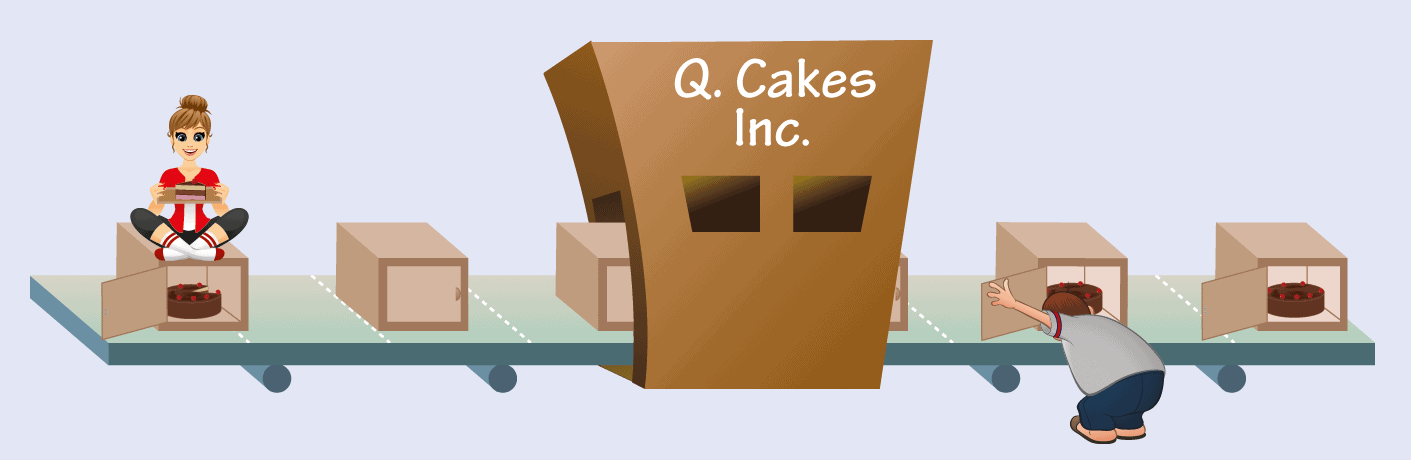
1 The mystery of the quantum cakes
(Courtesy: IOP Publishing)
Lucy and Ricardo explore nonlocal correlations through quantum mechanically (non-maximally) entangled cakes. Because Ricardo’s first cake (far right) rose early, Lucy’s cake (far left) tastes good. Redrawn from American Journal of Physics68 33 with the permission of the American Association of Physics Teachers.
Here’s the story as Kwiat, who is now my graduate adviser, told it to me. Imagine a bakery producing cakes for sale, and Lucy and Ricardo are inspectors testing the finished product. The bakery, shown in figure 1, is unusual because it has a kitchen with two doors, one on the left and one on the right, from which emerge conveyor belts (like the moving sidewalks at an airport). Cakes are sent out on the conveyor belts in little ovens, and they finish baking as they travel to Lucy (on the left) and Ricardo (on the right). The cakes are sent out in pairs, so Lucy and Ricardo always get one at the same time.
There are two tests that Lucy and Ricardo can do on the cakes. They can open the oven while the cake is still baking to see if it has risen early or not. Or they can wait until it finishes baking and sample it to see if it tastes good. They can only do one of these tests on each cake – if they wait until it finishes baking to taste it, they lose the chance to check whether it rose early, and if they check partway through baking to see if it has risen early, they disturb the cake (maybe it’s a soufflé) and they can’t test whether it tastes good later. (These two mutually exclusive tests are an example of “non-commuting measurements”, an important concept in quantum mechanics.)
Lucy and Ricardo each flip coins to randomly choose which test to do for each of their cakes. After testing cakes all morning, they then get together to compare their results. Because of the coin flips, sometimes they happened to do the same test on a pair of cakes and sometimes different tests. When they happened to do different tests, they notice a correlation: if Lucy’s cake tasted good then Ricardo’s always rose early, and vice versa. This isn’t so strange – maybe the cakes are made from the same batter, and maybe batter that rises early always tastes good. Now, in the cases where they both happened to check the cake early, Lucy and Ricardo find that in 9% of those tests, both cakes had risen early. So how often should both cakes taste good, when they both waited to taste them? (Go on, try to work it out.)
The answer is at least 9% of the time, right? We know that when one cake rises early, the other always tastes good, so as they both rise early 9% of the time, both cakes should taste good at least as often as they both rise early. However, Lucy and Ricardo are surprised to find that both cakes never taste good. This seems impossible – and it is, for normal cakes – but if the pairs of cakes were in a particular entangled quantum state, it could happen! Of course, physicists can’t really make entangled cakes (well, not yet), but they can make entangled photons and other particles with the same strange behaviour.
So why did we make the wrong prediction about how often both cakes must taste good? We assumed that random choices and outcomes on Lucy’s side shouldn’t affect what happens on Ricardo’s side, and vice versa, and that whether the cakes will taste good or rise early was already determined when they were put in the ovens. These seemingly obvious assumptions are together called local realism: the idea that all properties of a cake or a photon have a definite value even if we don’t measure them (realism), and the assumption that faraway events can’t influence each other, at least not faster than the speed of light (locality). In a local realistic world, both cakes have to taste good at least 9% of the time – nothing else makes sense. Observing fewer than 9% (or none at all) is evidence that at least one of the assumptions of local realism must be false.
This imaginary quantum bakery is a version of a Bell test – an experiment that can check whether or not we live in a local realistic world. (Some physicists, notably Einstein, had already realized that entanglement seemed to defy local realism, but it was long thought to be a philosophical question about the interpretation of quantum theory rather than something to be tested in the lab.) In the half-century since Bell’s discovery that local realism can be tested, the experiment he proposed has been carried out in dozens of labs around the world using entangled particles, most commonly photons.
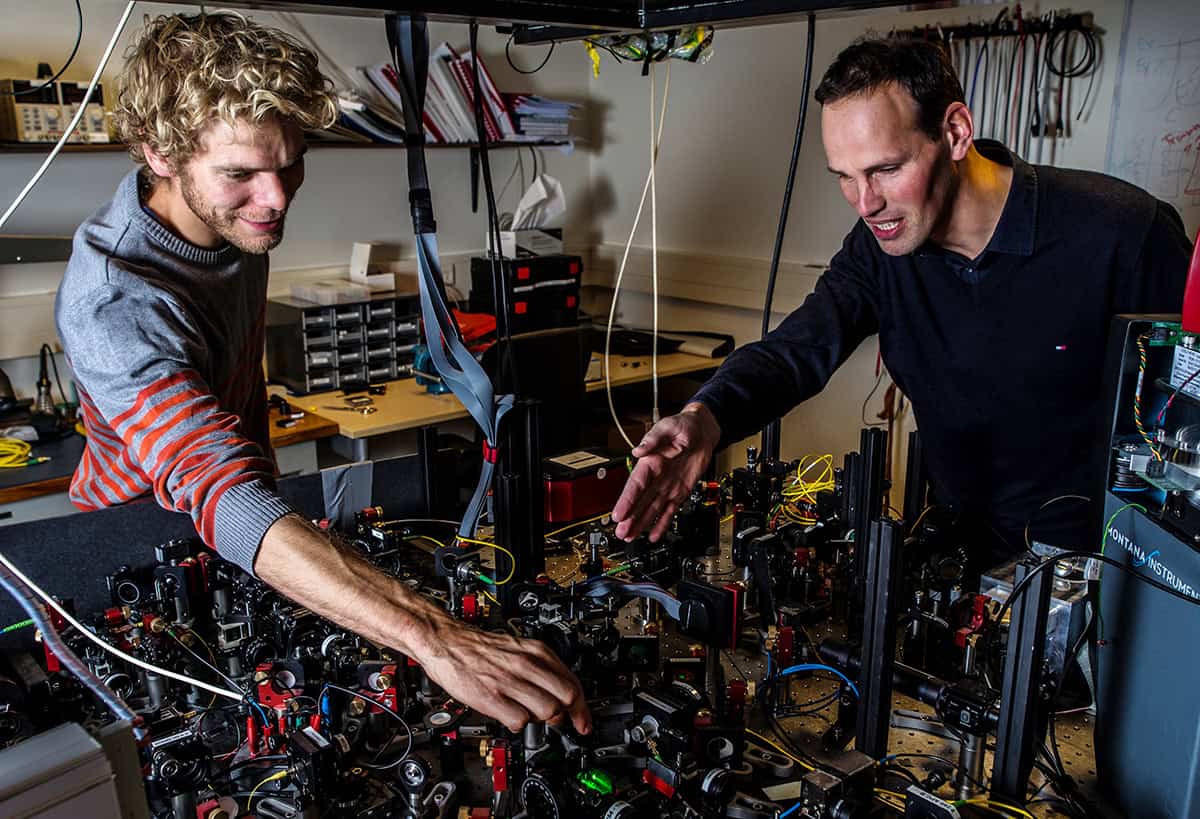
First to success Bas Hensen and Ronald Hanson from Delft University of Technology adjusting their Bell test set-up. (Courtesy: Frank Auperle/TU Delft)
Photons don’t taste good or rise early, so instead physicists usually measure some other property, such as their polarization in two different measurement bases (horizontal/vertical and diagonal/anti-diagonal, for example). Like the two cake tests, these polarization measurements are “non-commuting”. Using a particular entangled quantum state and measurement directions, the “quantum cakes” experiment has actually been performed in the lab and found precisely the same percentages as the story. Bell tests can use other entangled states, and there are many different mathematical conditions for violating local realism, but the idea is the same. With some relatively simple optics equipment, undergraduates at the University of Illinois, US, can even do a Bell test in one afternoon for their modern physics lab.
Closing loopholes
Prior to 2015, every Bell test ever carried out was imperfect. Physicists weren’t able to rule out every “loophole” that could allow local realism to still be true even though the experimental results seem to violate it.
The first loophole can appear if not every photon or cake is measured. In the quantum cakes story, we implied that every single pair of cakes was tested. In an experiment with photons, this is never true, because there are no perfect single-photon detectors, and some fraction of the photons is always lost. This can open a loophole for local realism: if enough photons are not tested, then maybe the ones we missed would have changed the outcome of the experiment. (In the quantum cakes analogy, maybe the cakes come down the conveyor belt too fast to test all of them, so some of the pairs that were not tested might both taste good and Lucy and Ricardo wouldn’t know.) This is called the “detection loophole”, and to close it the experimenters must ensure they collect both entangled photons most of the time. In a common version of a Bell test, the minimum is two thirds.
A second important loophole appears if some kind of signal could travel between different parts of the experiment to create the measured correlations, without transmitting information faster than the speed of light. Long distances and quick measurements are the keys to closing this “timing” loophole. In the quantum cakes example, imagine that vibrations are transmitted down the conveyer belt, so that whoever opens their oven first to taste their cake (which might taste good) always causes the other cake to collapse and taste bad. Then both cakes would never be found to taste good, without actually violating local realism. To avoid this, Lucy and Ricardo should be far enough apart that no signal could travel between them and influence their measurements, even at the speed of light. In special relativity this condition is called “space-like” separation. To rule out the possibility that the chef making the cakes could somehow influence the measurements, the two testers and the bakery itself should be space-like separated as well.
While both of these loopholes had been closed in separate experiments, closing them both in the same experiment was a challenge that remained unresolved for many decades. To successfully close the loopholes, experimentalists would need innovative experimental designs and equipment – including optical components with very low loss, fast random number generators and measurement switches, and high-efficiency single-photon detectors – and careful arrangement of the experiment in space and time. In 2015 three different groups in three countries successfully carried out loophole-free Bell tests for the first time: a team led by Ronald Hanson at Delft University of Technology in the Netherlands was first (Nature526 682), followed by teams led by Krister Shalm at the National Institute of Standards and Technology (NIST) in Boulder, Colorado, US (Phys. Rev. Lett.115 250402), and Anton Zeilinger at the University of Vienna, Austria (Phys. Rev. Lett.115 250401).
The Delft team’s experiment used nitrogen vacancy centres, which are defects in diamond crystals that contain an isolated electron. The electron has spin, a quantum property that can point up, down or in a quantum superposition of the two. The electron can be made to emit a photon that is entangled with its spin direction. Using two of these nitrogen vacancy centres and combining the emitted photons with a beam splitter, the Delft team transferred this photon–spin entanglement to spin–spin entanglement between the two electrons. The spins of the two electrons could then be measured along two different directions (analogous to the two different types of cake tests or two different polarization measurements), and this process was repeated many times to carry out a Bell test. The two diamond crystals were placed in different buildings on the Delft campus, separated by about 1.3 km, so the entanglement creation and the spin measurements could be space-like separated. One advantage of this design is that the researchers were able to successfully measure the electron spins each time they were entangled, eliminating the detection loophole altogether. However, successfully entangling the two spins was difficult, and this made the experiment slow – over 18 days the researchers recorded only 245 spin measurements, still enough to violate the limit of local realism by two standard deviations.
The NIST and Vienna teams took a different approach, both using entangled photons, and a cake-factory-like design in which entangled pairs are produced and sent to two different measurement devices. To close the timing loophole, the measurements had to be far from the entangled pair source – more than 100 m at NIST and about 30 m in Vienna. (Finding suitable lab space was challenging – the Vienna experiment took place in the empty basement of a 13th-century palace.) The measurements also had to be chosen and carried out quickly, using ultrafast random number generators and polarization switches.
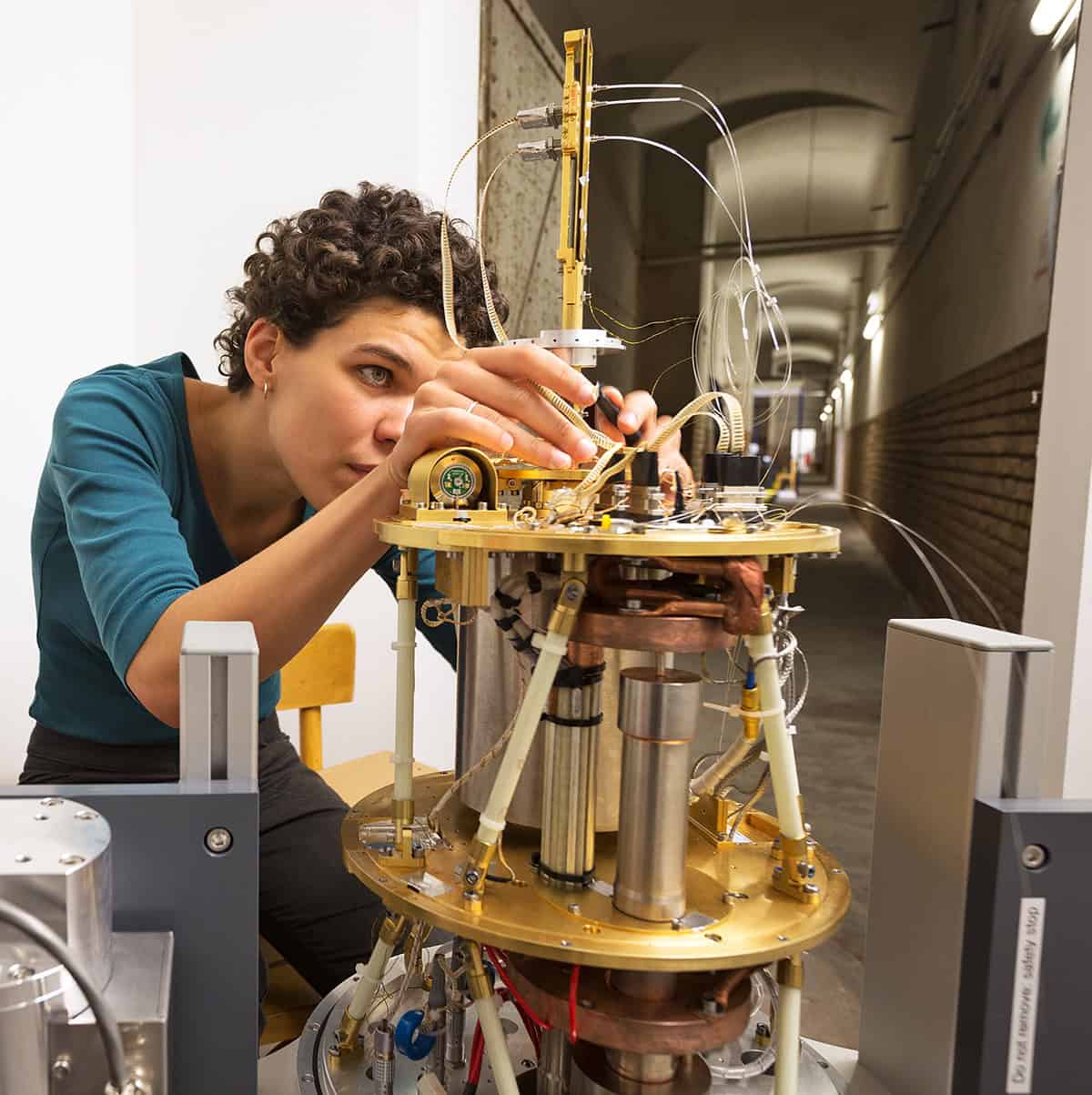
Solid violations Scientist Marissa Giustina, of the University of Vienna, installs superconducting detectors in the “Alice” cryostat. The “Bob” cryostat in the opposite measurement station can be seen in the distance, about 60 m away. (Courtesy: L Lammerhuber/Austrian Academy of Sciences)
Advanced superconducting single-photon detectors were also critical to both experiments. The Vienna team used transition edge sensors, which use a thin piece of tungsten cooled to about 100 mK to detect photons. At this temperature, tungsten sits on the edge of its transition to superconductivity, hovering between normal resistance and the drop to zero resistance as it becomes superconducting. Any tiny amount of energy deposited by a single photon will cause a sudden and relatively large change in the resistivity of the metal. The resulting change in the electrical current through the detector is measured with a superconducting quantum interference device (SQUID) amplifier. Transition-edge-sensor detectors can be up to 98% efficient, a big improvement over other detectors such as single-photon avalanche diodes, but the low temperatures and special electronics required make them large, expensive and sensitive to noise (one researcher found he could only use them at night, because they picked up interference from cell phones in the busy classrooms below the lab). The NIST team used superconducting nanowire single-photon detectors, which are slightly less efficient than transition-edge-sensor detectors, but can be used at higher temperatures and are faster and less noisy. Both the NIST and Vienna loophole-free Bell tests found solid violations of local realism, with results 7–11 standard deviations from the expected limit.
Is local realism dead?
There is one possibility that may be impossible to truly eliminate: what if the outcomes of all the measurements were determined before the entangled particles were created?
Most physicists agree that these three experiments eliminated the most important loopholes, providing solid proof that local realism is dead. Since the first (imperfect) Bell tests in the 1980s, few people ever expected that a loophole-free test would give any other result, but the experiments of 2015 overcame remarkable technical challenges to put any doubts to rest. Loophole-free Bell tests also have some possible applications, including certifying the security of quantum cryptography systems even if the two parties can’t trust their own equipment, and verifying the independence of quantum random numbers. (NIST has plans to generate secure random numbers live and make them freely available online.)
But there is one possibility that, however unlikely, may be impossible to truly eliminate: what if the outcomes of all the measurements were determined before the entangled particles were created, or before the experiment even began, or before the experimenters were even born? If that were the case, local realism could still be law even though we seem to observe violations in Bell tests. At some point in the lifetime of the universe all the atoms and particles that make up the entangled photon sources, random number generators and measurement devices would have had a chance to “communicate”, no matter how far apart they are placed during the experiment (and indeed, according to the Big Bang model, all the matter in the universe was once in the same place at the same time). No-one has proposed exactly how this “cosmic conspiracy” would work, but it would not be forbidden by physics as we know it, as long as no information were transmitted faster than light.
One approach to this challenge is to try to narrow down how recently the parts of a Bell test experiment could have interacted. An experiment carried out earlier this year by the same Vienna group tried to do this by using light from two distant stars to choose the type of measurement on each photon in a Bell test (Phys. Rev. Lett.118 060401). The idea is that the two stars, which are separated by hundreds of light-years, could not have exchanged information any more recently than the time it would take light to travel between them, placing a limit on how far any cosmic conspiracy must extend backwards in time. (Random fluctuations in the colour of the starlight were used as “coin flips” to decide which measurements to do on each pair of entangled photons.) In a Bell test using these random settings, the team did find a violation of local realism, and concluded that any pre-determined correlations must have been generated more than 600 years in the past. In principle, future experiments could use light from distant quasars to push this limit back millions or billions of years. These “cosmic” Bell tests are impressive experimental achievements, but they are still unable to eliminate the possibility that the local electronics used to measure the stellar photons – which could have communicated in the much more recent past – could produce correlations, which may limit their usefulness. Ultimately, these conspiracy-minded loopholes may have to be abandoned as fundamentally untestable.
Does the world look different, post-loopholes? Physicists have had decades to come to terms with the probable death of local realism, but it still seems like an obvious truth in daily life. That even unasked questions should have answers, and unmade measurements should have outcomes, is an unconscious assumption we make all the time. We do it whenever we talk about what would have happened – like “When both cakes were found to rise early, they would have tasted good,” which was key to our flawed reasoning about the quantum bakery – or even “If it didn’t rain today I would have been on time for work.” Local realistic thinking leads to wrong answers in quantum experiments. But entangled particles don’t often appear in everyday life, so outside the lab – if we choose – we’re probably OK to keep up the illusion of local realism.
The first 3D view of a supernova remnant has been assembled using 12 years worth of data from NASA’s Chandra X-ray observatory. A supernova remnant is what is left over after a star explodes. As the ejected matter expands outwards into the interstellar medium, bounded by a shockwave, the remnants often exhibit asymmetries in their motion and shape. In an attempt to understand the mechanisms involved in shaping remnants, Brian Williams at the Space Telescope Science Institute in the US and colleagues studied the Tycho supernova remnant using X-ray data. First observed in 1572, and named after astronomer Tycho Brahe, Tycho is a type Ia supernova thought to result from the destabilization of a white dwarf in a binary system as its partner star transferred mass to it. Now, Tycho appears to be a roughly circular cloud of clumpy matter, but it is understood its shockwave has twice the velocity on one side than the other. To investigate the asymmetry, the team focussed on 57 “tufts” of silicon-rich ejecta in Tycho. Using the Chandra observations, they were able to measure the tufts’ velocities and therefore build a full 3D map of their motion. Unlike the shockwave, the ejecta shows no asymmetry, suggesting the explosion itself was symmetrical. A possible explanation is that the shockwave is affected by density gradients in the interstellar medium while the ejected matter is not. Williams and colleagues also attempt to address Tycho’s clumpy nature, questioning whether the ejecta started out as clumpy or began as smooth and then clumped together during expansion. Their simulations, however, demonstrate that neither option can be ruled out at the moment. The work is presented in The Astrophysical Journal.
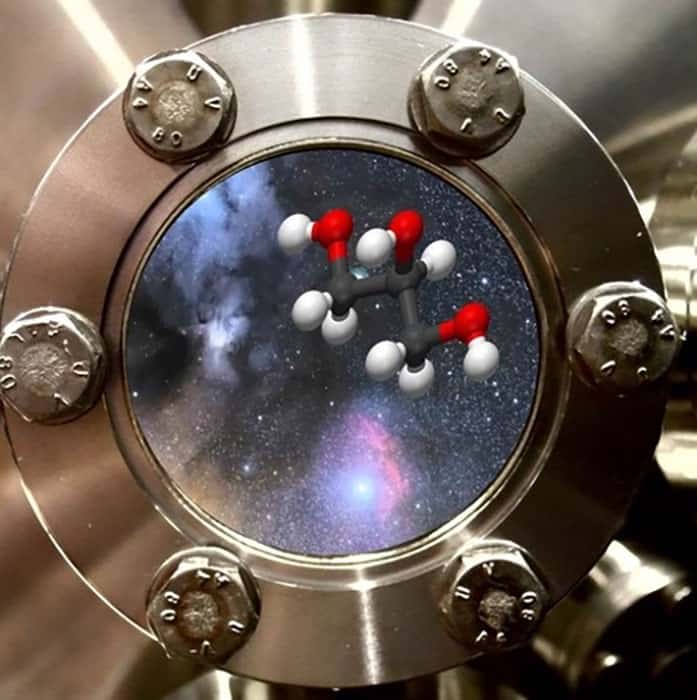
Cosmic glycerol is made here on Earth
Photomontage showing a ball and stick representation of glycerol. (Courtesy: Harold Linnartz)
Glycerol has been made for the first time in a laboratory that simulates the conditions in dark interstellar clouds. Gleb Fedoseev, Harold Linnartz and colleagues at the University of Leiden in the Netherlands made the compound by firing hydrogen atoms at carbon-monoxide ice at low pressure and at a chilly 23 K. Glycerol is an essential component of cell membranes in living creatures and it is possible that life on Earth – and perhaps other planets – emerged because this and other life-related molecules can be delivered to planetary surfaces by comets. The compound comprises 14 atoms and is the largest made so far under interstellar conditions. In 2009, the team made formaldehyde (four atoms) and methanol with (six atoms). Then in 2015, they made the eight-atom sugar glycolaldehyde. Linnartz explains that successively larger molecules are created by having the smaller molecules interact with each other. “We now have reached the level of glycerol, two levels higher and we have ribose, a sugar that is important in the coding of our genes,” he says. While formaldehyde, methanol and glycolaldehyde have already been discovered in interstellar clouds, astronomers have yet to spot glycerol in space. The Leiden team now plans to use the ALMA radio telescope in Chile to look for signs of the compound. The research is described in The Astrophysical Journal.
A “momentum microscope” that can fully characterize a quantum many-body system has been unveiled by physicists in Australia. The device was demonstrated by measuring correlations between ultracold atoms and could provide insights into tricky many-body problems, such as high-temperature superconductvity.
A many-body quantum system containing a lot of particles can be fully characterized by measuring all correlations between particles in the system. While this is extremely difficult to do in practice, a very good characterization can sometimes be achieved by using a specific set of correlations between just a few particles.
One million atoms
Sean Hodgman of the Australian National University and colleagues have achieved such a characterization by colliding two Bose–Einstein condensates (BECs), which are ensembles of ultracold atoms all in one quantum state. In this experiment, about one million helium atoms were used to make both BECs.
After the BECs collide, the team measures the momenta of atoms by tracking their positions as a function of time. This information is then used to calculate the correlations between the momenta of pairs and triplets of atoms in the halo of atoms created by the collision.
Pairing field
The measurements also allowed the team to calculate the “pairing-field amplitude” for the system – which they describe as a key building block for working out the higher-order correlations in the system. Indeed, the team has calculated that the measurements provide enough information to fully characterize the halo as a many-body system.
The technique, which is described in Physical Review Letters, could provide insights into poorly understood highly correlated systems such as high-temperature superconductors. It could also help physicists understand exotic phenomena such as many-body localization, glassy dynamics and Efimov resonances.
Kate Wyness is studying for a PhD, researching nuclear “sludge”. She’s working on a probe that could delve down into it, characterize it and help find solutions to the challenges of dealing with nuclear waste at Sellafield nuclear plant in the UK. This short film for Physics World’s Faces of Physics series reveals what life is like for Kate during her PhD programme at the University of Bristol. The experimental work Kate is engaged in brings opportunities to develop practical skills, but also brings challenges given the complexity and highly-regulated nature of the nuclear industry.
”A nuclear-powered PhD” has been produced by Andrew Glester and Ben Cowburn, who document Kate’s experiences inside the lab as part of a team of applied researchers. The film also shows what life is like for an early career researcher living in Bristol, a city with a strong maritime history, which has developed as a strong cultural hub in recent times. Kate explains how she was drawn to the city’s sense of community – a factor that Kate also values in her approach to physics.
Physics World’s Faces of Physics series is a collection of short films about the lives of people working in physics, exploring their motivations and the impact of their work. By telling personal stories, we hope to show that physics is an ordinary activity that can lead to an extraordinary array of careers. Earlier films in the series profiled an engineer working in green energy, a physics teacher in New York and a Mexican astronomer with a passion for photography.
To find out more about the social side of physics, take a look at the March 2016 issue of Physics World, a special edition about diversity issues in physics. Find out how to access that issue here.